Managing payments, maintenance, and reporting across multiple properties with unpredictable budgeting creates manual work for property managers and HOA teams. Most cloud-based property management software charge high transaction fees, complex subscriptions, or lack automation for accounting and tenant communication. This comparison covers pricing, automation features, and integration flexibility across four alternatives so you can match one to your operational needs and portfolio size.
Table of Contents
QuonSapp

At a Glance
Every tenant payment routes directly into the manager's Stripe account with no intermediary holding period. The platform highlights a configurable $1.00 flat platform fee per transaction. It also advertises real time sync across devices, mobile apps for staff and residents, and a full suite of HOA features.
Core Features
QuonSapp centralizes property and resident records with lease tracking, resident profiles, and an interactive property map for quick unit lookup. The system includes online resident payments, partial payment handling, and a full payment ledger with overdue alerts. It also covers HOA workflows such as violation reporting, board votes, ARC requests, and bulk dues distribution.
Key Differentiator
The organization network lets a parent account link multiple sub orgs with consolidated stats and per seat billing options. That linking includes data ownership controls and inline notes per sub org for contextual record keeping. For managers running several companies, the network view shows total properties, units, residents, and staff at a glance.
Pros
QuonSapp ties payments directly to a manager Stripe account, which shortens the payout path and reduces reconciliation steps for accounting teams. The mobile native apps and Convex powered real time sync keep field staff and front desk teams aligned on work orders, package logs, and inspections. The platform bundles staff scheduling, GPS clock in, and payroll export tools so labor tracking flows into payroll systems without manual reentry.
Cons
- The public product pages include limited technical documentation and some details appear as marketing summary rather than full specifications.
Who It's For
This product fits HOA managers, building supervisors, and front desk teams who operate multiple properties and need one dashboard for residents and maintenance. It also suits managers who want payments to land directly in a manager Stripe account and who run parent level reporting across subsidiaries. Vendors and maintenance staff benefit from photo documentation and a vendor directory tied to work orders.
Unique Value Proposition
QuonSapp's marketing materials state a $1.00 flat platform fee per transaction. That fee model lets you decide whether residents pay the charge at checkout or whether it is deducted from payouts. For portfolios with frequent small transactions, that clarity on per transaction cost makes budgeting predictable.
Real World Use Case
A regional HOA manager uses QuonSapp to run eight condominium communities from one account. Front desk staff log packages and issue visitor passes from the mobile app while maintenance teams update work order status and attach photos on site. The parent account reviews consolidated occupancy and collection metrics, then exports timesheets to payroll tools for month end.
Website: https://quonsapp.com
Buildium
At a Glance
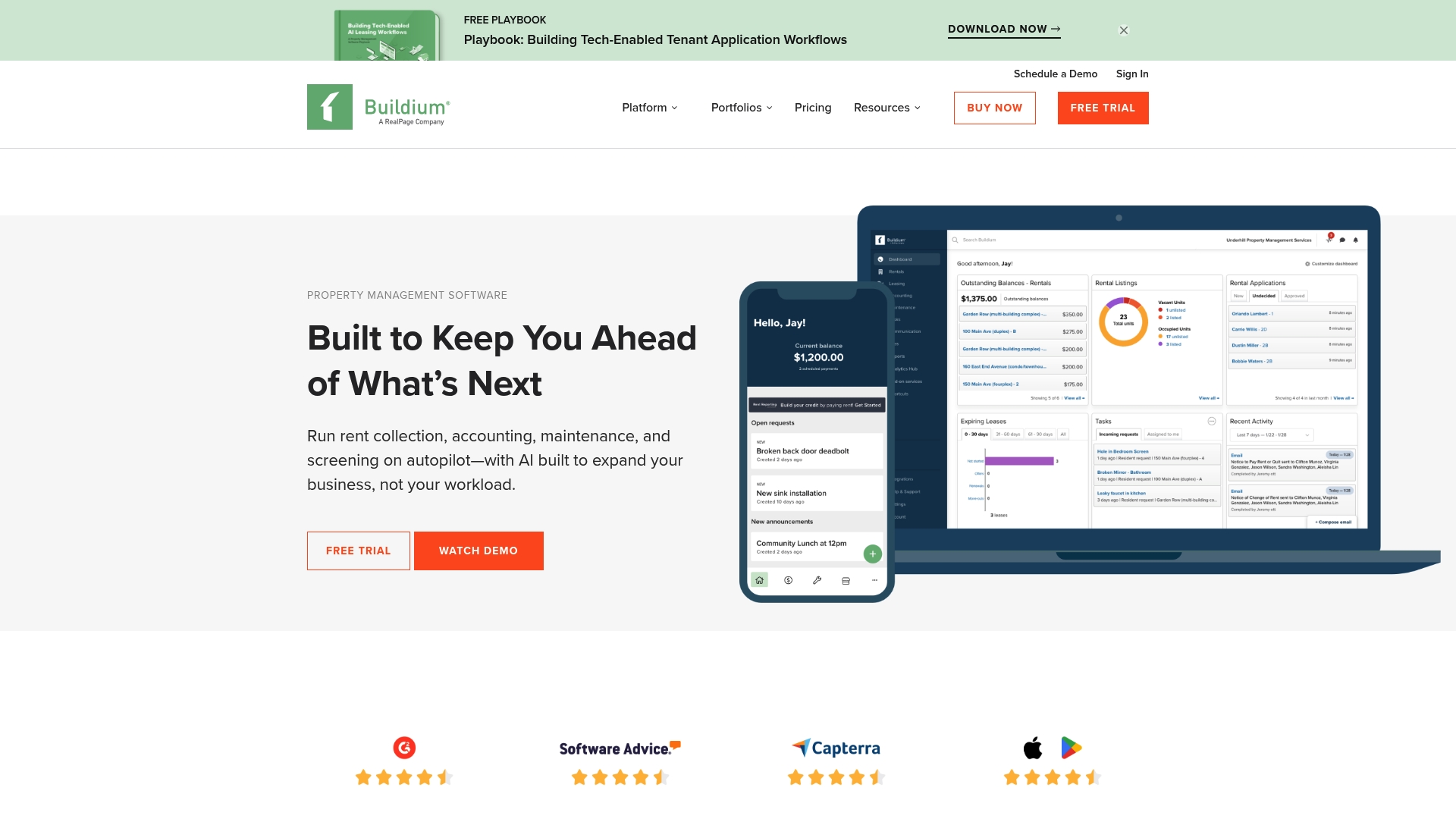
Property accounting includes automated bank reconciliation and 1099 e-filing. This capability pairs with online payments and tenant screening to reduce manual accounting tasks. The platform targets managers running mixed portfolios that need stronger financial and leasing controls.
Core Features
Buildium centralizes rent collection with ACH and credit card options and a resident portal that records payment history and partial payments. Leasing features cover online applications, e-signatures, and listing syndication while maintenance tools let staff create work orders, attach photos, and update status from mobile. Tenant screening connects to TransUnion, and a marketplace plus an open API allow custom integrations and workflow templates.
Key Differentiator
Buildium focuses on automation and accounting depth combined with configurable workflows. That emphasis suits teams that prioritize billing accuracy, tax reporting, and lease lifecycle automation. It serves a different operational focus than tools built mainly for front-line amenity handling and field staff scheduling.
Pros
The interface reads cleanly and helps teams reduce repetitive tasks in leasing and billing. Automation handles reconciliations, reminders, and routine notices so staff spend less time on manual entries. The Buildium Marketplace and an Open API extend core functions, and the vendor backs the platform with training resources and customer support.
Cons
- Customer support response times vary and the app can slow during high traffic periods.
- Accounting workflows are complex and require extra training for accurate use.
- Subscription increases have appeared, which may affect longer term budgeting.
- Some secondary tools remain basic and may not meet advanced enterprise reporting needs.
When It May Not Fit
If you run a very small portfolio on a tight budget, Buildium's price shifts may reduce value. If your priority is heavy on amenity bookings or daily field-task routing, a different tool may fit those workflows better. Organizations that need simple, minimal accounting may find the learning curve unnecessary.
Notable Integrations
Buildium lists the Buildium Marketplace offering more than 50 property management apps and an Open API for custom connections. Integrations cover payments, screening, and specialized accounting or tenant services.
Who It's For
Property managers and landlords who need integrated accounting, rent collection, and leasing automation will get the most value. It suits mixed portfolios that include apartments, associations, and commercial units. Teams ready to invest in training will extract the most from its accounting features.
Real World Use Case
A manager automates rent collection and posts payments directly to bank reconciliations to reduce month end cleanup. Maintenance requests arrive with photos and move through an assignable status pipeline so vendors get work orders quickly. Tenant screening and e-signatures speed leasing across apartments, commercial suites, and association units.
Pricing
Plans start at $62/month for the Essential plan with higher tiers for growth and premium features. A free 14-day trial is available to test payments, leasing, and accounting workflows. Enterprise pricing and add-ons vary by portfolio size and required integrations.
Website: https://buildium.com
DoorLoop
At a Glance
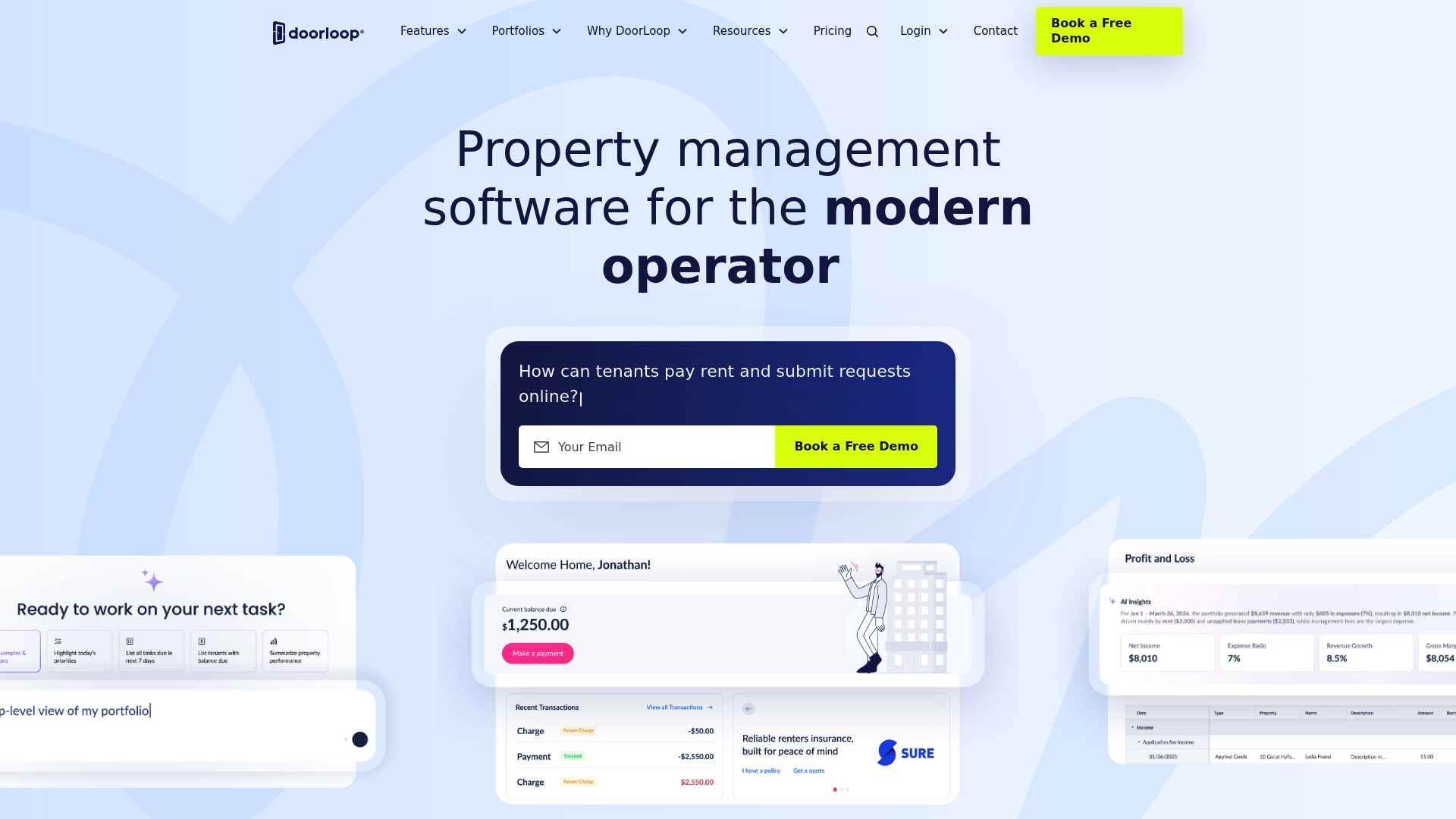
Starts at $69/month with plans that scale by unit count and features. DoorLoop combines rent collection, tenant screening, maintenance, and accounting into one platform aimed at property managers. The product advertises built in automation and AI features to reduce repetitive work and centralize daily operations.
Core Features
DoorLoop offers real time financial reporting with a customizable chart of accounts and bank sync, plus an integrated accounting module that can replace external bookkeeping tools. Tenant workflows include online applications, screening, eSignatures, tenant portals, and multi method rent collection with reminders and late fees. Maintenance and inspections use AI driven workflows and photo documentation, while iOS and Android apps keep staff and residents in sync across properties.
Key Differentiator
DoorLoop positions itself as an all in one, easy to use platform that adds automation and AI to routine property tasks. The product targets managers who want fewer separate tools and a single ledger for payments, invoices, and expenses. Its emphasis on built in accounting and AI driven inspections separates it from tools that require third party finance software.
Pros
The interface is clean and easy to navigate, which lowers training time for new staff and seasonal hires. Entry level pricing makes it accessible for small portfolios while higher tiers add accounting, maintenance, and integrations as needs grow. Rent collection supports ACH, credit card, debit, check, and cash workflows, and tenant portals centralize communications and payment history. Automation features reduce manual data entry and help managers focus on exceptions rather than routine tasks.
Cons
- Tenant payment processing fees are high, which raises operating costs for landlords and managers.
- Customer support reports vary, with some users experiencing delays or difficulty getting timely help.
- Pricing tiers can become inflexible and more expensive as a portfolio grows and additional features are required.
- Some users report system glitches and migration problems that caused temporary disruptions or data loss.
When It May Not Fit
If you run a very small portfolio and prioritize the lowest possible transaction costs, DoorLoop may add too much payment fee overhead. If your operation needs a highly customizable pricing structure, the available tiers could feel restrictive as unit counts scale. Organizations that cannot tolerate occasional migration or stability issues should plan for a staged rollout and backup exports.
Notable Integrations
DoorLoop connects with QuickBooks for those who prefer external accounting sync. It also supports Zapier to automate data flows with other tools and trigger custom workflows between apps.
Who It's For
Small to mid sized property managers and landlords managing residential, commercial, or community properties. The platform fits teams that want to consolidate listings, rent collection, maintenance, and accounting into a single interface. It works well for managers planning steady growth up to a few hundred units.
Real World Use Case
A manager with 50 residential units runs rent collection, tenant communication, maintenance requests, and financial reporting from DoorLoop. The manager uses tenant portals for applications and payments and relies on the integrated accounting ledger for monthly reconciliations. That setup reduces manual entry and shortens the monthly close process.
Pricing
Pricing starts at $69/month and scales by unit count and feature set. Higher tier plans add advanced accounting, maintenance, and integrations to support larger portfolios.
Website: https://doorloop.com
AppFolio Property Management Platform
At a Glance
AppFolio's marketing materials state a property manager scaled from 400 to over 14,000 units while using the platform. That case shows the product targets large, enterprise portfolios. The product pairs unified data with native agentic AI to automate tasks and deliver real time insight across leasing, maintenance, and accounting.
Core Features
Unified data management links property operations and investment records in a single account. Built in agentic AI automates routine tasks while Realm X processes run workflow automation for leasing and maintenance. The platform also includes end to end accounting, resident, owner, and vendor portals, role permissions, and tiered plans named Core, Plus, and Max.
Key Differentiator
The main differentiator is the native agentic AI that automates busywork and surfaces operational signals. That automation shifts routine approvals and triage away from staff into configurable rules and triggers. Managers who prioritize automated workflows will see a different operational model than older property systems.
Pros
The feature set fits large scale property operations by combining accounting, maintenance, and leasing into one system. Communication portals for residents, owners, and vendors keep messages attached to units, work orders, and documents. Scalable plan options and integration support let teams add services without migrating data between specialist tools, which reduces duplication and handoffs.
Cons
- Difficulty reaching human support creates delays when an issue needs a person to resolve it.
- Higher recurring costs and reported termination fees make total cost of ownership a concern for smaller portfolios.
- Reports of payment processing accuracy issues and limited workflow customization affect teams with nonstandard billing or maintenance processes.
When It May Not Fit
Smaller portfolios will likely find the subscription model costly for their needs. Operations that require deep customization for niche workflows may hit system rigidity. Teams that expect immediate human support should weigh reported difficulty contacting representatives.
Notable Integrations
Connects with third party proptech applications for add on services and data exchange. Specific partner names are not listed in the product summary, so you should confirm available connectors before committing.
Who It's For
Mid to large property management companies and real estate investors running portfolios at scale. Teams that want unified accounting, leasing, and maintenance in one system will get the most from this platform.
Real World Use Case
A firm tied to that figure centralized maintenance, leasing, and accounting to reduce duplicate entries and speed processing. That example shows how portfolios with thousands of units can consolidate multiple workflows in a single system.
Pricing
Flexible subscription plans are priced by portfolio size and selected features and require a custom quote. Plans are described with the names Core, Plus, and Max and pricing is provided directly by sales.
Website: https://appfolio.com
Bidrento
At a Glance
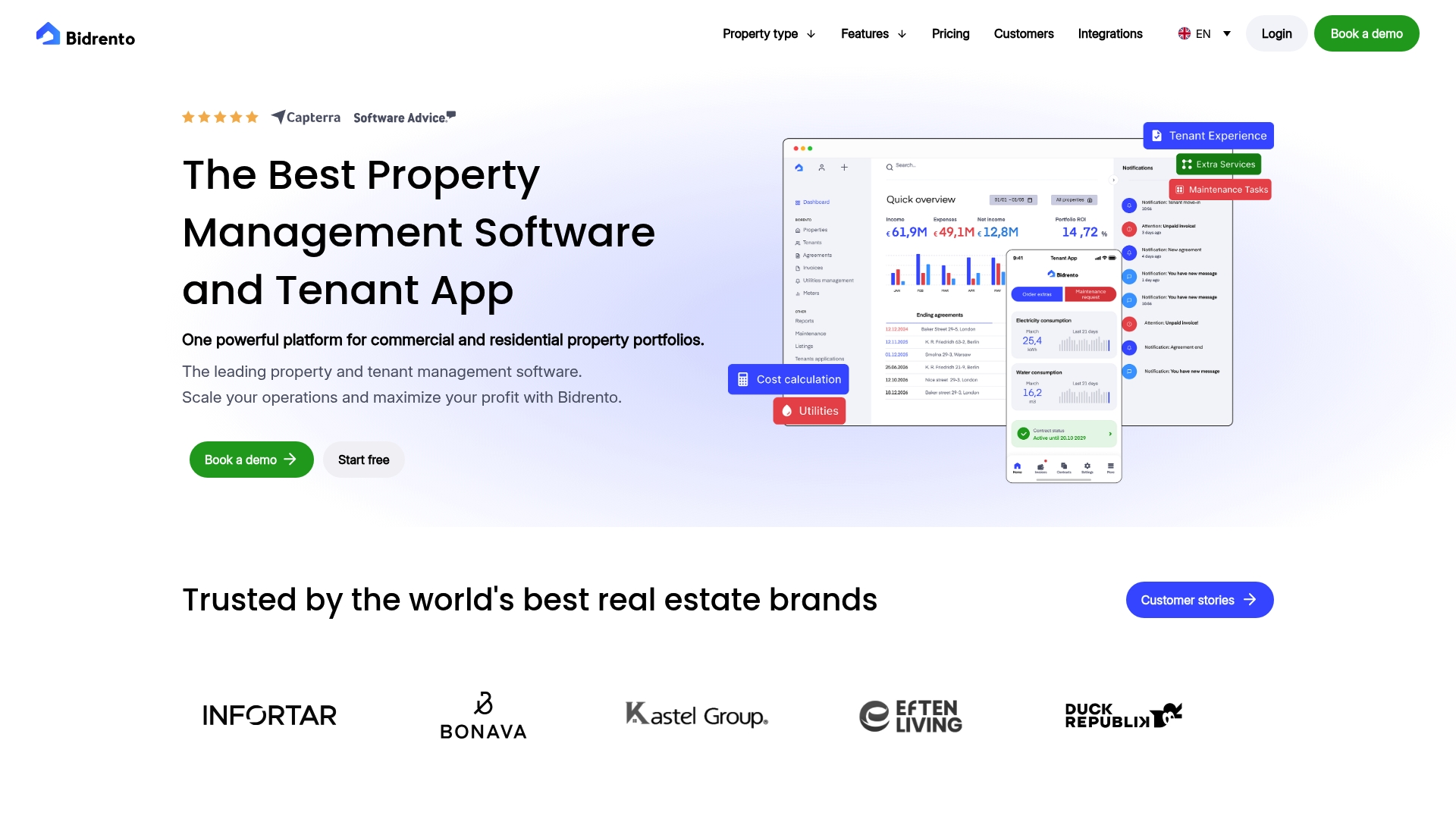
Bidrento's marketing materials note backing from Morgan Stanley for scale-up support. The platform emphasizes automation across leasing, maintenance, invoicing, and tenant communications. It includes tenant-facing reporting that covers utility consumption and CO₂ emissions for ESG tracking.
Core Features
The platform centers on Property Management Automation, combining lease lifecycle tools with service request and work order handling. It offers preventive maintenance scheduling and calendar views that help plan recurring tasks. Invoicing automation and Utility Billing manage rent, meters, and cost allocation with exports for finance teams.
Key Differentiator
Bidrento concentrates on automating the full rental lifecycle from onboarding through payments and maintenance. The product pairs integrated payments with maintenance workflows so accounting and operations share the same records. It also highlights tenant experience and guided onboarding as part of setup and support.
Pros
The vendor reports high user satisfaction ratings and generally positive sentiment from property teams. Its automation focus reduces manual rent and invoice tasks through automated invoicing and tenant portal interactions. Advanced reporting, including ESG reporting, gives managers visibility into utility consumption and emissions alongside standard financial metrics.
Cons
-
Limited third-party ecosystem compared to major players. This can restrict prebuilt connectors for niche local services.
-
Small to mid-sized management focus may not suit large portfolios or enterprise IT teams. Scalability features are present but the product is optimized for mid-market operations.
-
Pricing structure might be less attractive for very small portfolios due to minimum fees. Unit-based or area-based billing can push costs higher for tiny portfolios.
When It May Not Fit
If you run a global or very large enterprise portfolio you may find the integration footprint limited. If your team requires a fixed low monthly cost for a handful of units the minimum fees may make total cost of ownership unfavorable. If you depend on dozens of bespoke integrations you should verify connector availability first.
Notable Integrations
-
Accounting software
-
Payment providers
-
Meter reading systems
-
Smart locks and home automation
-
Tenant background check services
-
Google Calendar and email systems
Who It's For
Property managers, asset managers, leasing teams, and maintenance teams operating multiple residential or commercial properties across Europe and the UK. Teams that prioritize reducing manual invoicing and want tenant-facing utility and ESG reporting will get the most value. It fits organizations that can accept unit or area based pricing.
Real World Use Case
A regional property manager moved from spreadsheets to a single platform to automate rent invoicing and tenant communications. The team started scheduling preventive maintenance and recording meter reads in the tenant app. Reporting exports fed the finance workflow and reduced reconciliation time.
Pricing
Plans start from €56/month and include a 14-day free trial. Pricing is charged per unit or by rentable area, and plans support unlimited users with included support.
Website: https://bidrento.com
Comparison of alternatives
When comparing cloud-based property management platforms, several unique strengths are observed among the discussed options. Each solution tailors to specific operational demands, excel under certain conditions, and brings forward efficiencies for modern property management tasks.
Payment processing contrast
QuonSapp provides a direct integration with Stripe, ensuring tenant payments are quickly routed to managers without intermediary delays. This feature offers a significant advantage for accounting teams looking to streamline reconciliation efforts. On the other hand, DoorLoop supports multiple payment solutions like ACH, credit cards, and cash workflows, catering to more varied tenant payment preferences but at potentially higher per-transaction fees.
Scalability and automation insights
For managers handling diverse or large portfolios, AppFolio introduces native artificial intelligence-driven task automation and real-time insights, demonstrating efficacy in handling portfolios of significant scale. Buildium, while lacking AppFolio's systematic intelligence-driven automation, compensates through configurable workflows and leasing controls, making it well-suited for balancing residential and commercial operations within mixed portfolios.
Best fit
- If you manage multiple HOA communities and require integration with Stripe for tenant payments, QuonSapp aligns well with your needs by enabling centralized financial overviews and streamlined workflows.
- For properties demanding rigorous accounting capabilities paired with lease tracking, Buildium stands as the preferred option thanks to its dedicated leasing and reconciliation tools.
- Large portfolio holders aiming for scalability and operational automation should consider AppFolio for its AI-supported workflows.
- Teams seeking advanced tenant engagement metrics alongside environmentally conscious operations effort will benefit from Bidrento's tenant portal and ESG tracking metrics.
Our pick
The distinct advantage of QuonSapp lies in its combination of HOA-specific utilities and integration simplicity, notably the $1 flat platform fee for transparent cost management. While competitors bring a range of distinctive functionalities targeting other niches or workflow preferences, QuonSapp excels when limited costs and streamlined payment functionalities are the priority.
Organizations seeking streamlined cloud-based property management software with comprehensive features and tailored functionalities will benefit from reviewing the following options:
| Product | Key Differentiator | Best Suited For | Pricing | Notable Limitation |
|---|---|---|---|---|
| QuonSapp | Direct tenant payments into Stripe account | HOA managers and multi-property supervisors | Price not published | Limited detailed technical documentation |
| Buildium | Emphasis on leasing and accounting automation | Mixed portfolio management | Starting at $62/month | Complex workflows may require additional training |
| DoorLoop | Integrated accounting and AI-driven inspections | Small to mid-sized property managers | Starting at $69/month | Tenant payment fees are higher than some competitors |
| AppFolio | Unified management with agentic AI and automation | Mid to large-scaled portfolios | Custom quote required | Reports of limited customer support accessibility |
| Bidrento | Automation across leasing and utility billing | Mid-market property managers in Europe and UK | Starting at €56/month | Less extensive third-party integration ecosystem available |
Challenges With Cloud-Based Property Management Software Choices
Selecting the right cloud-based property management software often means balancing detailed accounting, tenant payments, and maintenance workflows across multiple properties. The article highlights key pain points such as complex fee structures, slow payments, and the difficulty of managing multiple organizations from one dashboard. QuonSapp meets these challenges by putting tenant payments directly into the manager's Stripe account with a clear, flat $1.00 transaction fee. This reduces reconciliation headaches and ensures faster access to funds.

For HOA managers, building supervisors, and front desk teams who handle multiple properties, QuonSapp's multi-property portfolio dashboard presents a unified view of resident payments, maintenance requests, and staff scheduling. Its real time sync keeps teams aligned across devices, while integrated features like violation reporting and board votes simplify HOA management. Explore how QuonSapp can reduce complexity by managing payments and operations all in one place—import your tenant data and start tracking invoices with clear fee settings today.
FAQ
How does QuonSapp handle online resident payments?
QuonSapp allows tenants to make online payments directly into the manager's Stripe account. This setup eliminates intermediary holding periods, making payment processing quicker and simpler for property managers. Managers can expect faster access to funds and streamlined reconciliation during accounting periods.
What is the difference between QuonSapp and Buildium?
Buildium excels in automation and depth of accounting features, making it well-suited for teams that prioritize billing accuracy and tax reporting. In contrast, QuonSapp generates payments directly into a manager's Stripe account, which shortens the payout process and reduces manual reconciliation steps. Property managers focused more on direct payment handling will find QuonSapp advantageous.
Can I use QuonSapp if my organization runs multiple properties?
Yes, QuonSapp is designed for managers operating multiple properties with its organizational network feature that links a parent account to multiple sub-accounts. This allows for consolidated stats, making it easier to manage properties efficiently. Expect a unified overview of properties, units, and residents under one dashboard.
Which platform offers the best mobile app experience for staff and residents?
QuonSapp provides native mobile apps that allow staff and residents to track work orders, package logs, and inspections in real time. This feature enhances communication and efficiency among teams working onsite and within the office. Property managers seeking an integrated mobile solution should consider QuonSapp for its user-friendly experience.
How does QuonSapp's pricing model differ from other platforms?
QuonSapp showcases a $1.00 flat platform fee per transaction, allowing property managers to decide whether residents absorb this fee during payment. This transparent pricing model makes budgeting predictable for property managers. Organizations looking for clarity in transaction costs may find this model beneficial.