Managing leases and property records from outdated or disconnected tools causes extra manual work and errors. Major lease tracking platforms often require expensive upgrades for automation or lack support for affordable housing compliance and mobile workflows. This comparison highlights automation, compliance, and pricing so property managers and real estate professionals can select the software that matches their portfolio size and sector regulations without overspending.
Table of Contents
Buildium
At a Glance
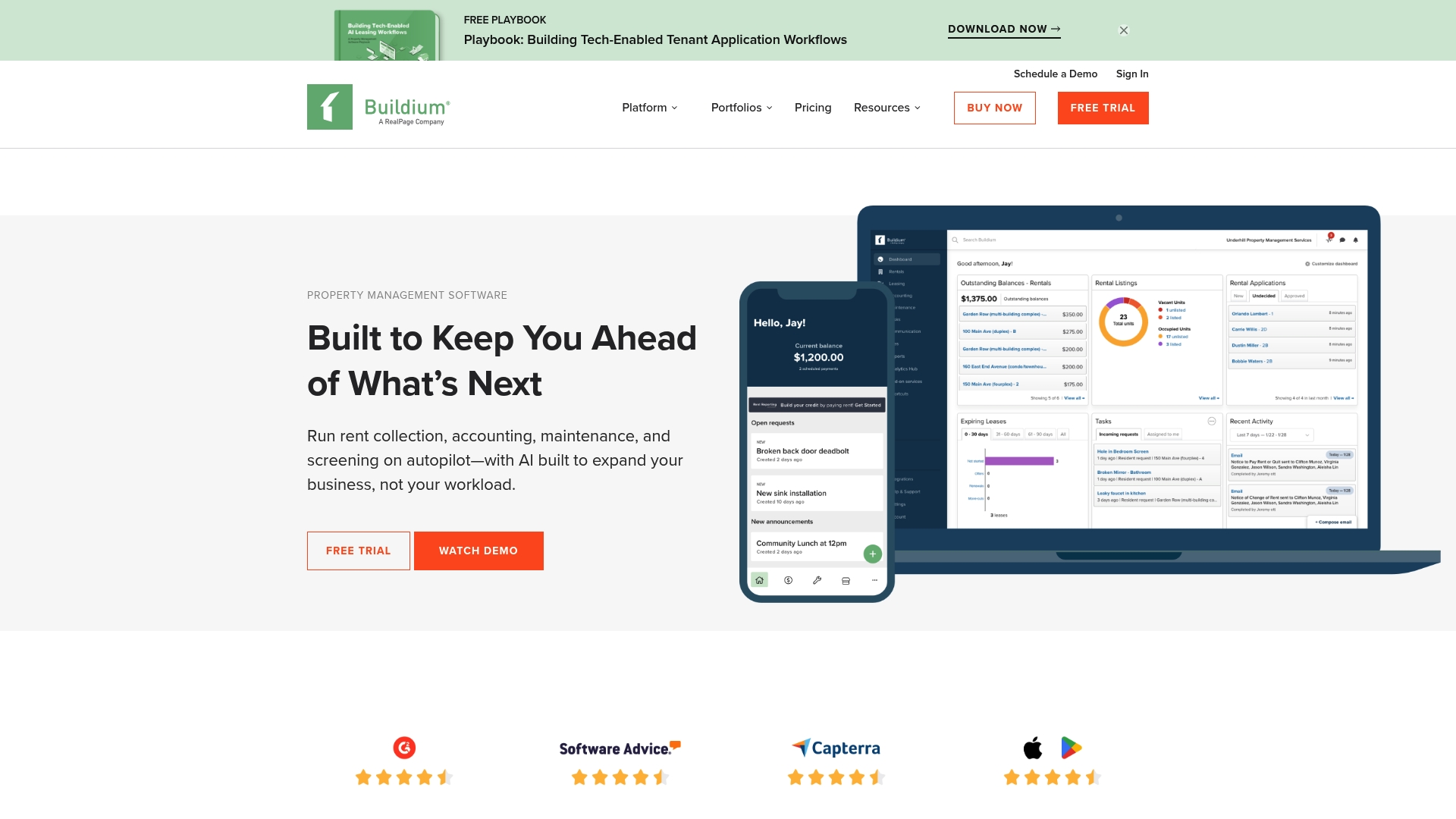
Buildium's marketing materials state a 95% customer satisfaction rate. That satisfaction figure is a frequent selling point for property managers evaluating platforms. The product has been serving the market since 2004, and targets residential, commercial, and community association portfolios.
Core Features
Buildium combines property accounting, online rent collection with automated payments, and digital leasing with tenant onboarding in one interface. Maintenance request and work order management tie into tenant records and accounting entries so teams can close jobs and record costs. Tenant screening and an open API let you add checks and connect external tools where needed.
Key Differentiator
AI and automation capabilities built into the product drive predictable workflows and task automation across leasing, payments, and maintenance. The platform also integrates with a broad ecosystem of property tech apps so managers can add niche tools without rebuilding key processes. That focus makes it suited to portfolios that need recurring task automation and predictive work routing.
Pros
The suite of features works together, which reduces manual handoffs between accounting, leasing, and maintenance. The interface is generally intuitive for teams and includes training resources and support that back up the satisfaction figure. Flexible customization options and an open API let technical teams connect payroll, CRM, or third party screening services. Buildium scales from small portfolios to large property companies while keeping core workflows consistent.
Cons
- Pricing can be expensive for small or infrequent users, and online payments carry transaction fees.
- Some reviewers report occasional bugs or slowdowns during peak usage times.
- Advanced customizations require technical skill or vendor support to implement properly.
- Reporting customization is more limited than some competitors offer.
When It May Not Fit
Very small portfolios or individual landlords who need only basic rent collection may find the cost too high. Teams without in house technical resources will face a learning curve for complex customization. If you need extreme reporting flexibility out of the box, this product could feel restrictive.
Notable Integrations
- Buildium Marketplace ecosystem of property management apps
- Open API for custom integrations with other business tools
Who It's For
Property managers and real estate professionals running residential, commercial, or association portfolios who want an integrated platform with automation. Best fit for teams that plan to centralize accounting, leasing, and maintenance and that can invest in configuration. Useful for companies that expect portfolio growth and need to add third party apps over time.
Real World Use Case
A mid size management firm uses Buildium to simplify rent collection, automate maintenance requests, and produce monthly financial reports. Staff route work orders from tenants to vendors and record expenses against units. The result is fewer manual reconciliations and clearer owner statements.
Pricing
Three plans start at $62/month for the Essential plan, $192/month for Growth, and $400/month for Premium. A free 14 day trial is available so teams can test the interface and core workflows before committing.
Website: https://buildium.com
ExactEstate
At a Glance
Includes built-in LIHTC, Section 8, HUD, USDA/RD, HOME, Tax-Exempt Bond, Public Housing, and RAD compliance across a single system. ExactEstate combines leasing, accounting, maintenance, and resident communications in one database. The vendor reports high customer satisfaction and awards for ease of use and support.
Core Features
ExactEstate enforces a 3-click rule for critical tasks and offers live guided implementation to speed onboarding. The platform bundles leasing, accounting, maintenance, and industry-specific compliance modules within a single resident portal that handles digital leasing, screening, and rent collection. Workflows emphasize automation and an AI assistant to reduce manual steps during recertifications and renewals.
Key Differentiator
Built by property managers, ExactEstate integrates compliance modules for affordable housing and multifamily communities into one shared database. That focus produces workflows designed to keep compliance data tied to leases and finances, with common actions reachable in three clicks or fewer. The result targets operators who must manage subsidy rules and audit trails day to day.
Pros
ExactEstate delivers a practitioner-first feature set with configurable workflows that match affordable housing operations and multifamily management. Compliance modules ship at no extra cost, which reduces the need for add-on systems during audits. Fast onboarding includes live support and migration assistance, and pricing is a transparent flat rate tied to portfolio size.
Cons
- Platform may be less flexible for property types outside affordable housing and multifamily. It can feel rigid for atypical commercial or niche asset classes.
- Information about third-party integrations is limited, which may force manual exports for uncommon workflows.
- The product focuses on sector-specific modules, so teams running mixed-use portfolios could face feature gaps.
When It May Not Fit
Operators managing commercial-only portfolios or specialized mixed-use sites will likely find ExactEstate too narrowly focused on residential subsidy programs. Teams requiring a broad public API ecosystem or many third-party integrations may need another tool. Large portfolios that do not rely on LIHTC or HUD workflows will find less value in the bundled compliance modules.
Who It's For
Property managers and management companies focused on affordable housing, multifamily, and HOA communities who want compliance and leasing workflows in one place. Ideal users handle LIHTC, Section 8, HUD, or other subsidy programs and need audit-ready records. Small to mid-sized regional firms that prefer live onboarding will gain the most.
Real World Use Case
According to the company, a regional property manager reduced recertification time from days to hours, saving thousands annually. In practice, the single database cut data entry and produced consistent audit logs for LIHTC and HUD reporting. Resident communications consolidated into the portal, lowering phone traffic and missed deadlines.
Pricing
ExactEstate charges $3/unit/month with all features included. The flat-rate model scales with portfolio size and removes per-module fees. Live implementation and migration are included under that single price, simplifying procurement and budgeting.
Website: https://exactestate.com
Landlord Studio
At a Glance
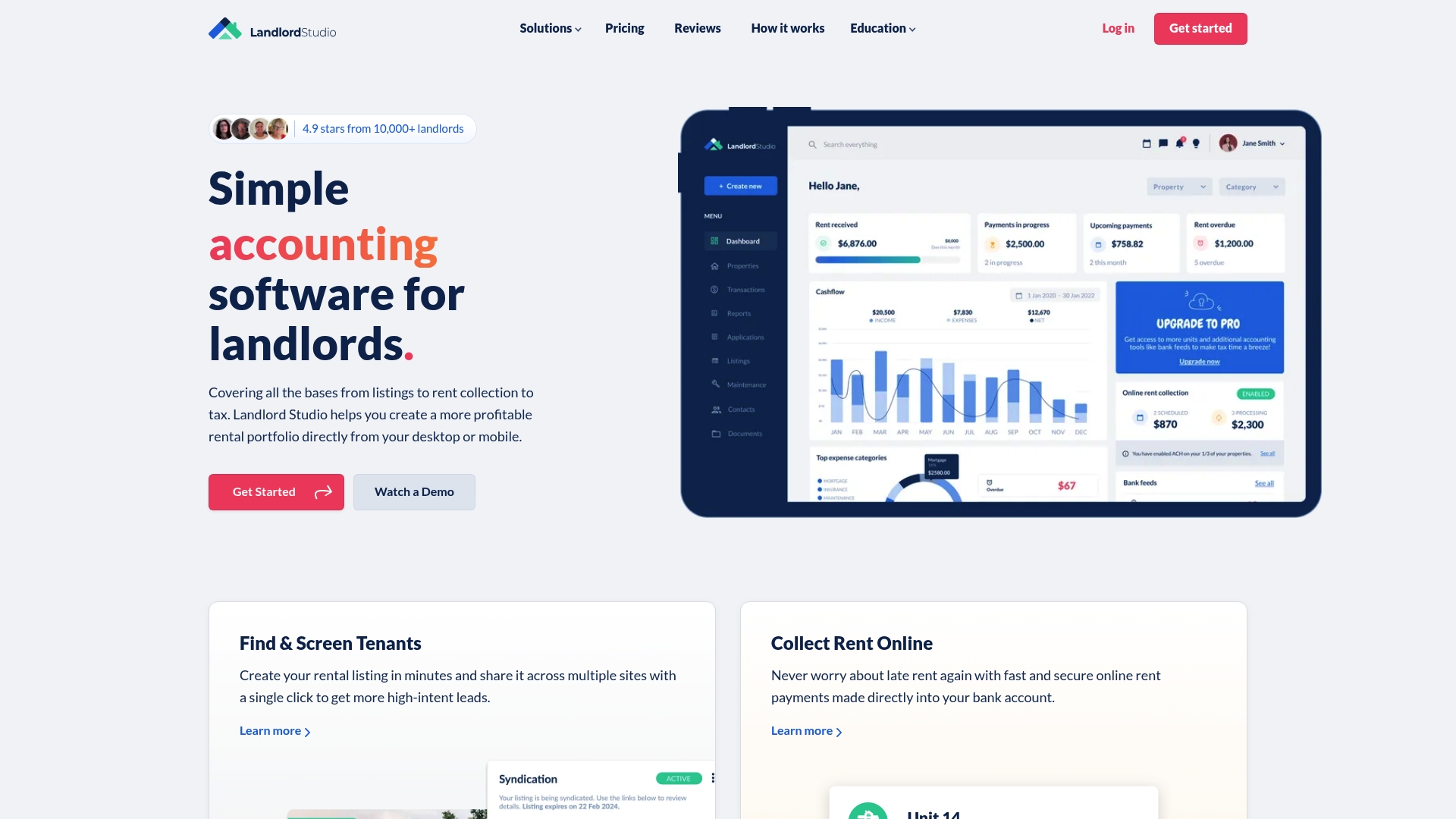
Landlord Studio reports more than 80,000 landlords and a 4.9-star rating from over 10,000 reviews. The app targets independent landlords and small investors who need mobile-first tools for rent, accounting, and tenant screening. It pairs tenant listing and screening with basic maintenance tracking and tax reporting in one interface.
Core Features
The product bundles rental accounting and expense tracking with online rent collection so you can record income and expenses in one place. Tenant listing creation and applicant screening link to payment workflows and electronic signatures for faster move-ins. Maintenance request logging and tax reporting round out the feature set for managing small portfolios from desktop or mobile.
Key Differentiator
Landlord Studio focuses narrowly on independent landlords and small portfolios, keeping workflows simple and mobile-friendly. The interface and automation aim to reduce repetitive tasks like rent reminders, expense categorization, and basic tenant screening. That focus makes routine property administration quicker for solo managers and investors with under 50 units.
Pros
The app is cloud accessible from both desktop and mobile so you can manage properties in the field or at the office. It automates rent collection and expense tracking, reducing manual bookkeeping work and simplifying preparation for tax time. The platform also integrates with Xero, which helps when you export detailed reports to a dedicated accounting system, and that rating above reflects strong user satisfaction with the core experience.
Cons
- Limited scale: best for single owners and small portfolios, not enterprise management companies. Larger teams will miss centralized workflows and vendor portals.
- Free plan constraints: several capabilities require paid plans, so expect to upgrade for screening or expanded reporting.
- Support depth: customer support and advanced features are less extensive than large vendor offerings, which may slow resolution for complex issues.
When It May Not Fit
If you manage hundreds of units or operate multiple regional teams, Landlord Studio lacks enterprise-grade features and role-based controls. If your workflow depends on advanced leasing automation or custom reporting, this product may feel too basic. Expect to move to a dedicated property management platform when you outgrow single-owner requirements.
Notable Integrations
Landlord Studio lists a direct connection to Xero, enabling accounting exports and reconciliation. No other third-party integrations are published in the product details.
Who It's For
Independent landlords and small-scale investors who manage one to fifty rental units will find the most value here. You will appreciate mobile rent collection, tenant screening, and a simplified accounting flow if you handle day-to-day administration personally. Managers who rely on a single owner interface rather than team permissions will adapt fastest.
Real World Use Case
A small landlord with four units uses the app to collect rent, message tenants, and track repairs from their phone. They run monthly expense reports, export figures to Xero for tax preparation, and use screening to shortlist applicants. The result is less paperwork and faster month-end accounting.
Pricing
The product starts with a free tier and offers paid plans at $12/month for Pro and $28/month for Pro Plus, with savings for annual billing. Expect core rent collection and accounting on paid plans and more advanced screening or reporting behind higher tiers.
Website: https://landlordstudio.com
Comparison of alternatives
In the realm of property management platforms providing lease tracking functionalities, a variety of solutions cater to unique operational requirements. Each option specializes in serving specific market segments, ensuring property managers can select tools tailored to their needs.
Adaptability and Customizability
Buildium excels in providing a unified platform that combines property accounting, online rent collection, and tenant screening, enhanced by automation and API integration for custom workflows. This platform offers excellent scalability, addressing the needs of both small and larger portfolios, making it suitable for complex property management operations.
ExactEstate, with its inclusion of compliance modules for affordable housing programs like LIHTC and HUD, provides a niche yet necessary service for property managers concentrated in this sector. However, it is less adaptable for commercial or non-standard lease types due to its focus on regulatory compliance.
Landlord Studio stands out for solo operators and small landlords, emphasizing ease of management with a mobile-centric design. While streamlined for basic rental activities, its features might not scale well for larger or diversified operations.
Cost Structure and Scalability
Buildium's pricing starts at $62 per month, suitable for features aimed at both improving efficiency and providing scalability. ExactEstate, operating on a $3 per unit per month model, is cost-efficient for medium-sized affordable housing portfolios, thanks to its flat pricing model inclusive of compliance tools.
Best fit
- Property managers aiming for a scalable, fully integrated platform with extensive automation capabilities and third-party integrations will benefit most from using Buildium.
- Operators focused on the compliance requirements of affordable housing or similar regulated environments should evaluate ExactEstate.
- For owners of small portfolios needing user-friendly rent collection and expense tracking accessible via mobile devices, Landlord Studio remains an advantageous choice.
Our pick
Given a need to manage both simple and complex property portfolios efficiently whilst utilizing automation and integration versatility, our top recommendation is quonsapp.com. However, property managers specializing in highly regulated sectors may find a more tailored fit in offerings like ExactEstate. By identifying and aligning your specific operational needs, you can choose the platform that best supports your property management goals.
QuonSapp is distinguished for its comprehensive integration capabilities tailored to diverse property management workflows.
| Product | Core Feature or Primary Use-Case | Key Differentiator | Best For | Pricing | Notable Limitation |
|---|---|---|---|---|---|
| QuonSapp | Lease management and portfolio growth | Robust integration options and scalable workflows | Property managers prioritizing flexible integrations | Price not published | Requires initial setup time |
| Buildium | Integrated property management suite | Automation across leasing, payments, and maintenance | Management teams scaling diverse residential and commercial units | $62–$400/month depending on plan | Advanced customizations need technical support |
| ExactEstate | Affordable housing compliance focus | Compliance modules for HUD, LIHTC, and Section 8 workflows | Managers of affordable or subsidized housing portfolios | $3/unit/month, all features included | Limited flexibility for mixed-use portfolios |
| Landlord Studio | Mobile-first small portfolio management | Focused on independent landlords with streamlined accounting and rent collection tools | Small landlords managing up to 50 units | Free tier, $12–$28/month for paid plans | Not suited for enterprise-scale property management |
Addressing Lease Tracking Challenges in Property Management
Lease tracking software must keep lease dates, renewal alerts, and tenant data accurate without adding complexity. Property managers and HOA operators often struggle with disconnected tools that slow workflows and increase errors. QuonSapp offers a unified platform designed specifically for these challenges, combining lease tracking, resident profiles, and payment processing into one accessible dashboard.

With QuonSapp, you get real-time lease notifications, online resident payments depositing directly to your Stripe account, and easy management of multiple properties from one place. See how QuonSapp simplifies portfolio oversight and cuts down administrative tasks. Start by importing your current lease data and receive renewal alerts automatically in under a minute.
FAQ
How does QuonSapp support lease tracking for property managers?
QuonSapp offers integrated features for lease tracking, which help property managers maintain accurate records and compliance. The platform combines functionalities like rent collection, leasing, and maintenance tracking within a single dashboard, ensuring efficiency for property management teams. Property managers looking to streamline their processes should consider leveraging QuonSapp's comprehensive workflow capabilities.
What is the difference between QuonSapp and Landlord Studio regarding scalability?
Landlord Studio excels at serving independent landlords and small investors who manage up to 50 rental units. QuonSapp, on the other hand, is designed for property managers aiming to handle larger portfolios and more complex operations. Companies needing to grow their portfolio without losing efficiency may find QuonSapp to be the better choice.
Which platform offers better automation features for maintenance requests?
QuonSapp delivers automated maintenance request management, which integrates seamlessly with tenant records. This integration allows for faster response times and documented work orders. Property management teams aimed at reducing manual tasks should explore QuonSapp’s automation capabilities to enhance their service efficiency.
Can I integrate QuonSapp with other business tools for better functionality?
QuonSapp provides an open API for custom integrations, allowing users to connect with third-party apps tailored to their unique needs. This flexibility enables teams to enhance their property management workflows with the tools they already rely on. Consider starting with QuonSapp to benefit from its integration capabilities.
How does QuonSapp's pricing compare to that of competitors?
QuonSapp's pricing is designed to meet the demands of varying portfolio sizes without hidden fees. In contrast, some competing platforms, like Buildium, can be expensive for smaller portfolios, especially when factoring in transaction fees for online payments. Property managers focused on transparent pricing should examine QuonSapp as a cost-effective option.