
QuonSapp is the recommended cheapest property management software when you measure total cost of ownership rather than sticker price. It includes direct-to-manager payments via Stripe with no holding period, native HOA governance tools, maintenance work orders, and mobile staff apps — all in one subscription. That combination removes the add-on costs and manual labor that inflate the effective monthly cost of lower-priced alternatives. "Cheapest" here means lowest total cost of ownership (TCO): base subscription plus every fee, hour, and workaround you pay to keep operations running.
Table of Contents
- What does "cheapest" really mean for property management software?
- What features must you have for a low price to be useful?
- Where does the true cost hide in cheap rental management apps?
- Which pricing model is actually cheapest for your portfolio?
- How do you compare vendors quickly? Use this checklist
- How QuonSapp delivers low total cost for U.S. property managers and HOAs
- How to test whether QuonSapp is the cheapest real option for your portfolio
- Key Takeaways
- What actually works in the field for managers and HOAs
- QuonSapp is built for managers who want real savings, not just a low price
What does "cheapest" really mean for property management software?
TCO for property management software is the sum of every dollar you spend to run your portfolio on a given platform. The formula looks like this:
Monthly TCO = base subscription + (per-unit fee × units) + transaction fees + amortized onboarding + add-on services
A platform charging a modest monthly base fee plus per-unit and per-payment fees can easily become more expensive than a higher flat subscription as your portfolio size and payment volume grow. The sticker price tells you almost nothing on its own.
| Cost Line | What to Ask | Why It Matters |
|---|---|---|
| Base subscription | Flat or tiered by units? | Sets your floor cost |
| Per-unit fee | Per door or unlimited? | Scales against you as you grow |
| Transaction fee | Per payment or percentage? | Compounds with every rent cycle |
| Onboarding/training | Included or billed separately? | One-time plus variable fees |
| Add-on services | E-signatures, screening, API? | Can double effective monthly cost |
| Payout holding period | Days held before you receive funds? | Delays cash flow, adds float cost |
The line items managers most often overlook are payout holding periods, per-unit billing tiers that kick in at portfolio thresholds, and premium support charges that unlock basic help-desk access.
What features must you have for a low price to be useful?
Buying cheap software that forces you into manual workarounds or third-party tools is not saving money. The minimum viable feature set for U.S. property managers and HOA boards covers six areas:

| Feature Area | Why It Matters | HOA Non-Negotiable? |
|---|---|---|
| Online payments and direct payouts | Eliminates manual collection and float delays | Yes — dues and assessments |
| Maintenance and work orders | Automates routing, reduces phone calls | Yes |
| Resident/tenant portal | Self-service reduces front-desk time | Yes |
| Lease tracking and renewal alerts | Prevents missed renewals and vacancy gaps | No |
| Reporting and accounting | Required for audits and board transparency | Yes |
| Mobile apps with offline support | Staff in the field need real-time access | Yes |
For HOAs specifically, three features are non-negotiable: board voting workflows, violation and fine management, and ARC request processing. Without them natively, you pay for a separate governance tool or absorb the staff time to manage those processes by hand. QuonSapp's HOA management tools cover all three, which removes that add-on cost entirely.
Pro Tip: Before signing any contract, map every feature your team uses today to the new platform's native feature list. Every gap is a future add-on fee or a staff hour.
Where does the true cost hide in cheap rental management apps?
The most common hidden costs that turn a low sticker price into a high TCO:
- Payment processing markups. Some platforms charge a percentage of rent collected on top of standard card fees. A percentage markup on rent payments adds per-transaction costs that can increase your expenses.
- Per-unit fees above a threshold. A plan that looks flat often has a unit ceiling. Exceed it and per-door charges activate.
- Tenant screening markups. Platforms buy background checks wholesale and resell them at a markup. Ask for the pass-through cost.
- E-signature charges. Many platforms gate lease signing behind a paid tier or charge per envelope.
- Premium support fees. Basic plans often limit you to email-only support with 48-hour response times. Phone or chat support costs extra.
- Data migration and API fees. Moving your existing data in, or connecting to QuickBooks or ADP, can carry a one-time or monthly integration fee.
- Payout holding periods. Platforms that hold resident funds for 3–7 days before releasing them to you create a cash flow gap every single month.
QuonSapp routes every payment directly to your Stripe account with no holding period, and charges a $1.00 flat platform fee per transaction that you can pass through to residents at checkout or absorb in your payout. That structure is transparent and predictable.
Pro Tip: Ask every vendor: "Who holds resident funds, and for how long?" and "What is the exact per-transaction fee at my current unit count?" Those two questions surface the biggest hidden costs faster than any pricing page. A solid vendor management checklist can help you structure the full conversation.
Which pricing model is actually cheapest for your portfolio?
Each model favors a different portfolio profile.
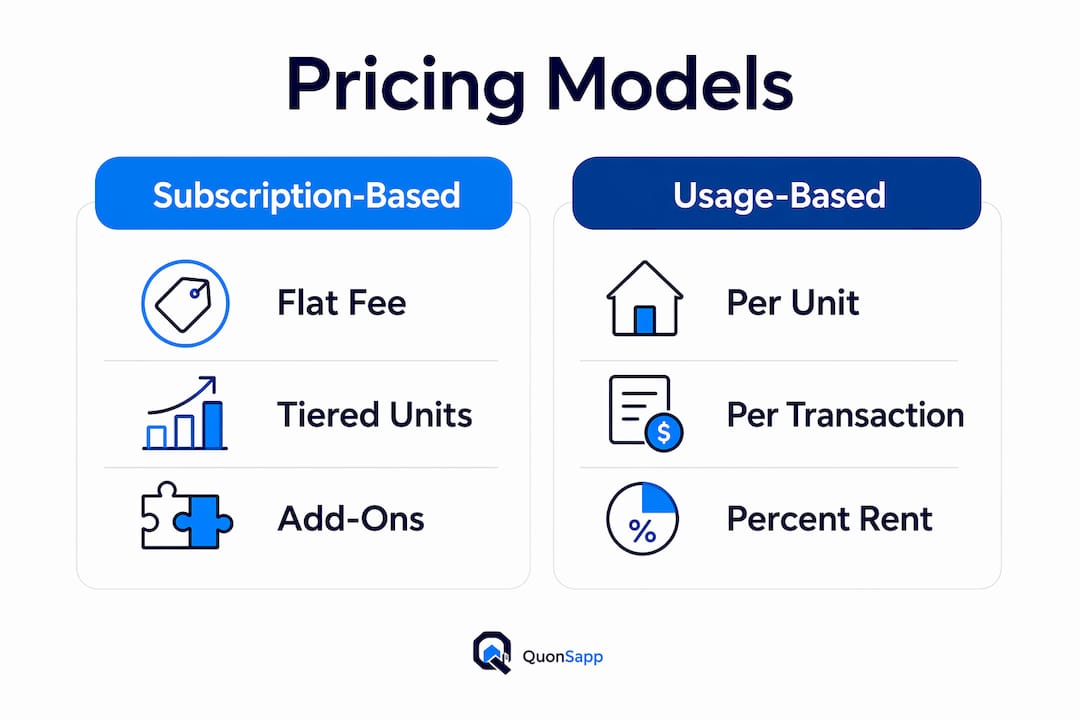
Flat subscription charges one monthly fee regardless of unit count. This is the best model for small-to-mid portfolios because billing is predictable and per-unit costs disappear. The savings compound as your portfolio grows within the same tier.
Per-unit (per-door) pricing starts cheap for single-property managers but scales against you. With a per-unit fee applied at higher unit counts, your monthly fees can increase substantially even before adding transaction costs.
Per-transaction pricing works for low-volume portfolios with infrequent payments but becomes expensive in HOA environments where dues, assessments, and fines generate dozens of monthly transactions.
Percent-of-rent marketplace fees are the most expensive model at scale. A percentage-of-rent fee on a portfolio with many units and high rents can result in monthly fees exceeding typical flat subscription costs.
Freemium with paid add-ons looks free until you need e-signatures, screening, or accounting exports. The add-ons often cost more than a mid-tier paid plan.
Payment flow matters as much as the pricing model. Platforms that hold funds in escrow before releasing them to you create a float cost and a cash flow gap. Direct-to-manager payouts via Stripe, as QuonSapp provides, remove that gap entirely.
How do you compare vendors quickly? Use this checklist
Run every vendor through these questions before a demo or RFP response.
Pricing transparency checklist:
- Is the base price flat or tiered by unit count?
- Are there per-unit fees, and at what threshold do they activate?
- What is the exact per-transaction fee for resident payments?
- Are e-signatures, tenant screening, and API access included or add-ons?
- Is onboarding and data migration included or billed separately?
- What support tier is included, and what does premium support cost?
- What are the cancellation terms and data export policies?
Direct questions to ask sales:
- Who holds resident funds, and what is the payout timeline?
- What happens to my per-unit fee if I add 10 units mid-cycle?
- Is there a setup or migration fee for my existing resident data?
- What integrations are native vs. requiring a paid API connection?
- What is included in the free trial or pilot period?
Quick scoring: Flag each answer as Yes (transparent/included) or No (hidden/extra cost). Any vendor with more than two "No" flags on the pricing checklist carries meaningful hidden cost risk. Use the affordable property management tools comparison to benchmark your findings.
How QuonSapp delivers low total cost for U.S. property managers and HOAs
QuonSapp is built as an all-in-one property portfolio manager for HOA managers, building supervisors, front desk staff, and maintenance workers. Every feature that would otherwise require a separate paid tool is native to the platform.
Key cost-saving features:
- Multi-property dashboard manages all units and residents from one account, eliminating the need for multiple logins or separate tools per property.
- Direct Stripe payouts with no holding period and a transparent $1.00 flat fee per transaction keep cash flow predictable.
- Work order automation routes maintenance requests from submission through completion with photo documentation, reducing phone calls and manual follow-up.
- Native HOA governance covers board voting, ARC requests, violation tracking, and fine management — no third-party governance add-on required.
- Mobile apps with offline support give field staff real-time access to work orders, GPS clock-in/out, and resident data even with weak connectivity, cutting manual re-entry time.
- Audit log and financial transparency record every action with a timestamp and user, supporting board accountability and financial review.
- GPS time tracking and payroll export to ADP, Paychex, or QuickBooks reduce payroll processing time and errors.
Operational automation — work-order routing, resident messaging templates, and payment reconciliation — is the largest recurring cost-saver on any platform. Small differences in subscription price matter far less than the hours your team reclaims each month. Improving resident satisfaction with package delivery is one practical example of how ancillary operational tools reduce front-desk time and complaints without adding software cost.
How to test whether QuonSapp is the cheapest real option for your portfolio
A multi-week pilot gives you real numbers, not vendor estimates.
- Baseline your current costs. Record your monthly software fees, transaction fees, staff hours spent on payments and maintenance coordination, and any add-on tool subscriptions.
- Configure QuonSapp with your portfolio. Set up your properties, units, and a subset of residents. QuonSapp provides setup support and onboarding guidance during the trial.
- Migrate a subset of units. Move 10–20 units into the platform and run live payments for one full billing cycle.
- Record your pilot metrics. Track net rent received after all fees, staff hours spent on tenant communications and work orders, and the number of tasks automated vs. handled manually.
- Compare outcomes. Calculate your pilot TCO using the formula from the opening section and compare it to your baseline. Factor in staff time at your hourly labor cost.
The metrics that matter most are net rent after fees, time saved on resident communications, and automated work orders completed without staff intervention. Those three numbers give you a realistic monthly TCO that you can project across your full portfolio. For a deeper look at digital property management practices that support a smooth pilot, that resource covers the operational steps in detail.
Request a demo or pilot directly through QuonSapp to get setup help, data migration support for your subset of units, and template reports to compare costs before you commit.
Key Takeaways
The cheapest property management software is the one with the lowest total cost of ownership — not the lowest monthly price on the pricing page.
| Point | Details |
|---|---|
| TCO beats sticker price | Add per-unit fees, transaction fees, and staff time to find the real monthly cost. |
| Four red flags to reject | Per-unit fees above threshold, payment holding periods, missing maintenance features, and premium support charges all invalidate a low price. |
| Direct payouts save cash flow | Platforms that route payments directly to your Stripe account remove float delays and hidden holding costs. |
| Run a pilot before committing | A multi-week pilot tracking net rent, staff hours, and automated tasks gives you real TCO data. |
| QuonSapp as the low-TCO option | QuonSapp's flat subscription, direct Stripe payouts, native HOA tools, and work-order automation reduce effective monthly cost for U.S. property managers and HOA boards. |
What actually works in the field for managers and HOAs
The most common mistake I see property managers make is evaluating software on the pricing page alone. The monthly fee is the smallest part of the real cost. The bigger costs are the hours your front-desk staff spend chasing payments, the manual work orders that fall through the cracks, and the cash flow gap created by a platform holding your rent for five days before releasing it.
Managers who switch to a single integrated platform consistently report two things: they reclaim staff hours that were going to manual coordination, and their cash flow becomes predictable because payments land in their account the same day residents pay. Those two outcomes are worth more than the difference between a $20 and a $60 monthly subscription.
The pilot approach matters more than most managers realize. A 30-day test with real payments and real work orders tells you exactly what the platform costs to operate. Vendor demos show you features. Pilots show you costs.
QuonSapp is built for managers who want real savings, not just a low price
If you manage multiple properties, run an HOA board, or coordinate a maintenance team, you already know that cheap software that misses core features costs you more in the long run. QuonSapp gives you a single platform with direct Stripe payouts, native HOA governance, work-order automation, and mobile staff tools — without the add-on fees that inflate your real monthly cost.

The best way to confirm your savings is to run the numbers on your own portfolio. Request a free demo or pilot and QuonSapp will walk you through setup, help migrate a subset of your units, and give you the template reports to compare your current TCO against what you pay on the platform. You will know your real cost within one billing cycle.