
Digital property management is the use of cloud-based software platforms to automate and centralize property operations, including rent collection, maintenance tracking, lease administration, and tenant communication. Property professionals who adopt these platforms replace fragmented spreadsheets, paper files, and disconnected tools with a single system that updates in real time. The industry term for this category is "property management software," though "digital property management" accurately describes the broader practice of running a portfolio through digital workflows. This guide covers the core features, proven efficiency gains, selection criteria, and implementation steps you need to make a confident move to digital operations.
What are the main features of digital property management software?
The foundation of any property management platform is automated rent collection. Digital property management automates rent collection, cutting late payments and removing the manual errors that come with paper checks or bank transfers. Residents pay through a portal, the system logs every transaction, and overdue balances trigger automatic alerts. That single function alone eliminates hours of monthly reconciliation work.
Beyond payments, a full-featured platform covers these core capabilities:
- Lease tracking: Stores lease start and end dates, sends renewal alerts, and logs move-out timelines per unit.
- Maintenance request management: Lets residents submit work orders with photos, routes them to staff or vendors, and tracks status from submission to completion.
- Tenant and resident profiles: Holds contact details, emergency contacts, pet fees, parking assignments, and payment history in one place.
- Portfolio analytics and reporting: Displays occupancy rates, revenue, overdue balances, and labor costs across all properties on a single dashboard.
- Document management: Stores leases, CC&Rs, inspection reports, and notices with resident-level access controls.
- Communication tools: Sends targeted announcements, violation notices, and survey requests to all residents or specific units.
Cloud-based platforms integrate deal underwriting, maintenance, and portfolio analytics into a single source of truth. That integration matters because data entered in one module, such as a new lease, automatically updates payment schedules, resident profiles, and reporting without any manual re-entry.
Pro Tip: When evaluating platforms, prioritize those that cover at least maintenance, payments, and lease tracking in one product. Adding separate tools for each function recreates the fragmentation you are trying to fix.

How does digital property management improve efficiency and reduce costs?
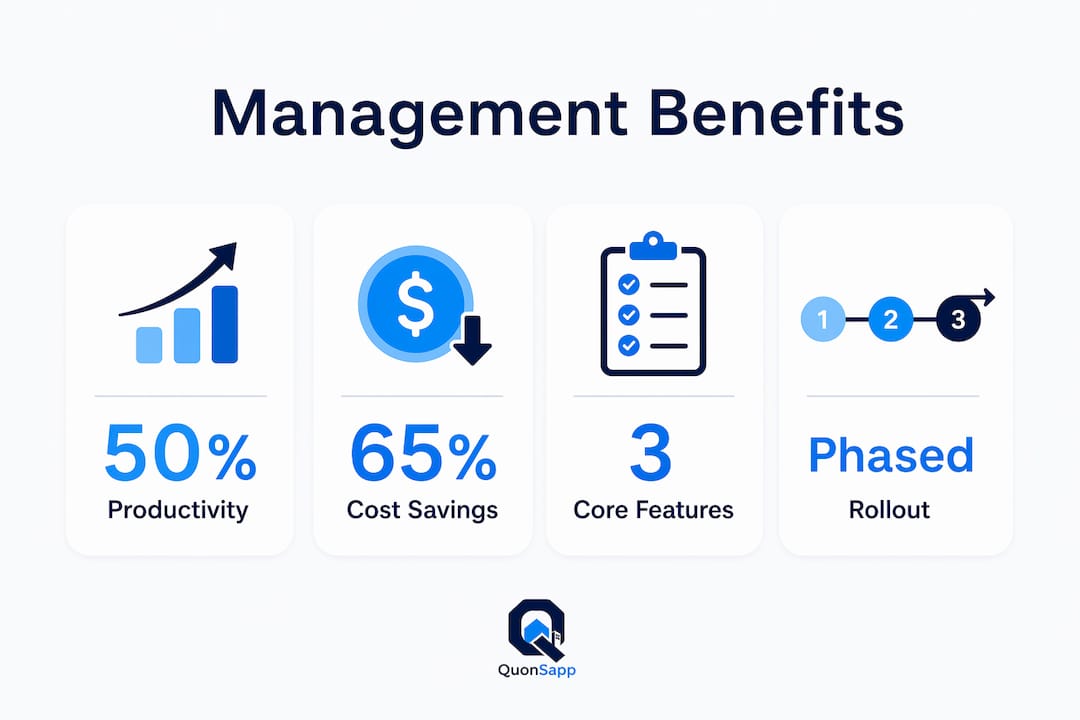
The efficiency gains from switching to a digital platform are well documented. Firms using advanced real estate operating systems report 50% productivity gains alongside a 65% reduction in software costs through platform consolidation. Those numbers reflect what happens when a team stops toggling between five separate tools and works from one system instead.
| Metric | Impact |
|---|---|
| Productivity gain | 50% increase reported by firms on advanced platforms |
| Software cost reduction | 65% savings through system consolidation |
| Late payment reduction | Automated billing and overdue alerts cut delays |
| Data accuracy | Single source of truth eliminates duplicate entry errors |
| Maintenance response time | Status pipelines reduce time from request to resolution |
Centralizing property management functions eliminates fragmented legacy systems that drive up costs and complexity. A property manager running three separate subscriptions for accounting, maintenance, and tenant communication pays more in licensing fees and loses time switching between platforms. Consolidation solves both problems at once.
AI-enabled analytics provide visibility into pipelines, asset management, and business development opportunities. That means a portfolio dashboard can flag which properties have rising maintenance costs, which units are approaching lease expiration, and where collection rates are slipping, all without a manual audit. Decisions that once required a spreadsheet review now surface automatically.
Integrated digital workflows enhance communication and data accuracy across teams. When a maintenance technician closes a work order on mobile, the resident receives a push notification, the manager sees the update on the dashboard, and the record is timestamped automatically. No phone calls, no follow-up emails, no lost paperwork.
Pro Tip: Before switching platforms, document your current average maintenance response time and on-time payment rate. These two numbers give you a concrete baseline to measure improvement against after 90 days on a new system.
What factors should you consider when selecting real estate management tools?
Choosing the right platform requires more than comparing feature lists. The wrong choice costs you time during migration and money in retraining. Work through these criteria before committing:
- Usability: Staff at every level, from front desk to maintenance crews, must be able to use the system without constant support. A complex interface defeats the purpose of going digital.
- Feature coverage vs. your actual needs: A 200-unit HOA needs violation tracking and board voting tools. A single-family rental portfolio needs lease management and payment processing. Match features to your specific workflows.
- Scalability: Good property management software must be scalable to accommodate portfolio growth and changing business needs. A platform that handles 20 units should handle 200 without a full migration.
- Integration capability: Check whether the platform exports payroll data to ADP, Paychex, or QuickBooks, and whether it connects to your existing accounting tools.
- Security and compliance: Resident data, payment records, and lease documents require role-based access controls and audit logs. Confirm the platform logs every action with a timestamp and user ID.
- Cost structure: Understand whether pricing is per unit, per seat, or flat rate. Factor in transaction fees on payments, which can add up quickly at scale.
The table below maps common evaluation categories to the questions worth asking during a demo:
| Evaluation category | Key question to ask |
|---|---|
| Onboarding and migration | Can you bulk-import existing resident data from CSV? |
| Mobile access | Do staff and residents get a native iOS and Android app? |
| Payment processing | Are funds deposited directly to your account, or held by an intermediary? |
| Maintenance workflow | Can you attach before-and-after photos to each work order? |
| Reporting | Does the dashboard show occupancy, revenue, and labor costs in one view? |
| Multi-property support | Can you manage all properties from a single account? |
Reviewing cloud-based property management options side by side on these criteria narrows the field quickly and prevents you from paying for features you will never use.
How to implement a digital property management system effectively
Assess your current workflows first
Start by mapping every manual process you run today. List where data lives, who touches it, and where delays or errors occur most often. Common pain points include rent collected by check, maintenance requests tracked in email threads, and lease dates stored in spreadsheets. This audit tells you exactly what the new system needs to replace and gives you a clear picture of what success looks like.
Plan data migration before you go live
Moving resident records, lease dates, and payment histories into a new platform takes more time than most managers expect. Export all existing data to CSV files, clean up duplicate entries, and verify that lease dates and balances are accurate before importing. A messy migration creates confusion for residents on day one and erodes trust in the new system immediately.
Train staff and residents in phases
Successful adoption involves phased implementation, staff training, and carefully planned integration to minimize disruption. Start with your internal team. Get managers and maintenance staff comfortable with the platform before residents ever log in. Then introduce the resident portal with a clear one-page guide explaining how to pay rent, submit maintenance requests, and access documents. Residents who understand the portal from day one generate far fewer support questions.
Set measurable goals and iterate
Define two or three specific targets before launch. Examples include reducing average maintenance response time from five days to two, or cutting late payments by 30% in the first quarter. Review these metrics at 30, 60, and 90 days. If a workflow is not performing, adjust it rather than waiting for the annual review cycle.
A common pitfall is trying to activate every feature at once. Teams that go live with payments, maintenance, scheduling, and HOA voting simultaneously often revert to old habits because the change feels too large. Activate core features first, stabilize operations, then add modules one at a time.
Pro Tip: Run a parallel period of two to four weeks where both the old system and the new platform operate simultaneously. This gives your team a safety net and surfaces data gaps before you fully cut over.
Key takeaways
Digital property management delivers measurable gains in productivity and cost control when platforms are chosen carefully and implemented in phases.
| Point | Details |
|---|---|
| Define your baseline | Document current response times and payment rates before switching platforms. |
| Prioritize consolidation | One platform covering payments, maintenance, and leases outperforms three separate tools. |
| Scale matters from day one | Choose software that handles your current portfolio and your projected growth. |
| Phase the rollout | Activate core features first, then add modules after operations stabilize. |
| Measure after 90 days | Review on-time payment rates and maintenance response times to confirm real gains. |
Why the shift to digital operations is irreversible
I have spent years watching property managers resist going digital, usually because the migration feels like more work than the problem it solves. That instinct is understandable. It is also wrong, and I say that from direct observation rather than theory.
The managers who delay digital adoption do not stay static. They fall further behind. Paper-based rent collection and email-based maintenance tracking do not scale. The moment a portfolio crosses 30 or 40 units, the manual system starts breaking down. Payments get missed. Maintenance requests fall through the cracks. Lease renewals get forgotten. The cost of those failures, in lost rent and resident turnover, far exceeds the cost of any software subscription.
What surprises most managers after they make the switch is how quickly the analytics change their decision-making. Knowing which properties have the highest maintenance costs per unit, or which residents have the longest history of on-time payments, shifts the conversation from reactive to proactive. You stop putting out fires and start preventing them.
The one mistake I see consistently is choosing a platform based on price alone. The cheapest option rarely covers the full workflow, which means you end up adding tools and recreating fragmentation. Spend the extra time evaluating whether the platform handles your specific property type, whether it has a real mobile app for field staff, and whether payments go directly to your account or sit in an intermediary. Those three questions separate platforms that work from platforms that frustrate.
The property management industry is moving toward fully integrated, AI-assisted operations. Managers who build digital habits now will adapt to those advances far more easily than those who wait.
— ERNEST
QuonSapp brings your property portfolio into one place
Managing multiple properties across disconnected tools creates the exact inefficiencies that digital operations are designed to fix. QuonSapp is built specifically for HOA managers, building supervisors, front desk staff, and maintenance workers who need one platform that covers every daily task.

QuonSapp handles resident payments with direct-to-manager Stripe deposits, maintenance work orders with photo documentation, lease tracking with renewal alerts, HOA violation reporting, staff scheduling with GPS clock-in, and portfolio analytics, all from a single dashboard. The native iOS and Android apps keep field staff connected, and real-time sync means every update is visible across the entire team instantly. If you are ready to replace fragmented tools with one property management platform built for real operations, QuonSapp is worth a close look.
FAQ
What is digital property management?
Digital property management is the practice of using cloud-based software to automate and centralize property operations, including rent collection, maintenance tracking, lease administration, and tenant communication. It replaces manual processes and disconnected tools with a single integrated platform.
How much can digital property management reduce costs?
Firms using advanced real estate operating systems report a 65% reduction in software costs through platform consolidation. Combining multiple subscriptions into one platform eliminates redundant licensing fees and reduces administrative labor.
What features should property management software include?
Core features include automated rent collection, maintenance request tracking, lease management, resident profiles, portfolio analytics, and document storage. Platforms that cover all of these in one product eliminate the need for separate tools and reduce data entry errors.
How do I manage properties digitally without disrupting current operations?
Use a phased rollout: migrate data first, train staff before residents, and activate core features before adding advanced modules. Running the old and new systems in parallel for two to four weeks reduces the risk of disruption during the transition.
Is cloud-based property management secure for storing resident data?
Reputable cloud-based platforms use role-based access controls, encrypted data storage, and full audit logs that record every action with a timestamp and user ID. Always confirm these security features are present before committing to a platform.