
An HOA special assessment is a mandatory, one-time or temporary fee levied on members to cover a specific expense that regular dues and reserve funds don't cover. If you just received a notice, your first move is to request three documents: the formal assessment notice, the board vote minutes, and the most recent reserve study. These tell you whether the charge is legitimate, correctly calculated, and properly authorized.
The financial stakes are real. Unpaid special assessments can result in recorded liens against your property and, in extreme cases, foreclosure proceedings. If you can't pay in full, ask for an installment plan before the due date passes.
Your CC&Rs and state law govern every aspect of this process, from how much notice the board must give to whether a homeowner vote is required. Acting quickly and requesting the right records puts you in the strongest possible position.
Table of Contents
- What actually counts as an HOA special assessment?
- Why do HOAs levy special assessments?
- How assessments are calculated, billed, and collected
- What are your legal rights when an assessment is levied?
- How special assessments affect buying and selling a home
- Tax treatment of HOA special assessments
- Step-by-step: what to do when you receive an assessment notice
- How well-run HOAs prevent or reduce special assessments
- Key Takeaways
- The view from the board side
- QuonSapp helps boards manage assessments without the chaos
- Useful sources to verify rules and tax treatment
What actually counts as an HOA special assessment?
A special assessment is a charge outside your regular monthly or quarterly dues, tied to a specific, defined expense. It is not a permanent dues increase. It ends when the expense is paid.
Regular dues fund ongoing operations: landscaping, utilities, management fees, and routine maintenance. Reserve funds are pooled savings earmarked for predictable large-ticket replacements, like a roof or elevator. A special assessment steps in when neither of those buckets is enough.
Here's where the line sits in practice:
- Regular dues: Monthly landscaping contract, pool chemicals, insurance premiums.
- Reserve fund draw: Planned pool replastering after 15 years, scheduled roof replacement.
- Special assessment: Emergency pool deck collapse after a storm, a lawsuit settlement, or a reserve fund so depleted it can't cover a necessary capital project.
Your CC&Rs define the boundary. Most governing documents specify which expenses qualify for a special assessment and which must come from reserves. If the board is funding something reserves should cover, that's worth questioning at the next meeting.
Some state laws add another layer. Reserve shortfalls often trigger assessments when boards have deferred maintenance or set dues too low for years. The assessment is the symptom; the underfunded reserve is the underlying problem.
Why do HOAs levy special assessments?
Boards don't levy assessments because they want to. They do it because the money isn't there and the work can't wait.
The most common triggers fall into a few clear categories:
- Emergency repairs: A storm collapses a retaining wall, a pipe bursts in a shared corridor, or a parking structure develops a structural defect. Insurance may cover part of it, but deductibles and uncovered losses often land on members.
- Capital replacements: A community pool or elevator reaches end of life before the reserve fund is fully funded.
- Reserve shortfalls: Years of artificially low dues leave reserves unable to absorb a major project. The board levies an assessment to bridge the gap.
- Unexpected legal costs: A lawsuit against the association, or one the association must file, generates legal fees not budgeted for.
- Insurance gaps: A claim exceeds policy limits, or a policy lapses and a loss occurs during the gap.
Chronic underfunding is the most predictable cause. A board that has kept dues artificially low for years to avoid member complaints is almost certain to levy a special assessment eventually. Savvy buyers treat a thin reserve fund as a warning sign, not a minor detail.
Poor governance compounds the problem. Deferred maintenance turns a $30,000 repair into a $120,000 replacement. When that bill arrives, the only tool left is a special assessment.

How assessments are calculated, billed, and collected
How your share is determined
Most CC&Rs allocate assessments one of three ways: equally per unit, by percentage of ownership interest, or by square footage. Equal-per-unit splits are most common in condominium communities. Percentage-of-interest allocations appear in planned unit developments where unit sizes vary significantly.

A simple example: a 100-unit community needs $200,000 for a parking structure repair. Under equal allocation, each unit owes $2,000. Under a percentage model, a unit with a 1.5% interest owes $3,000.
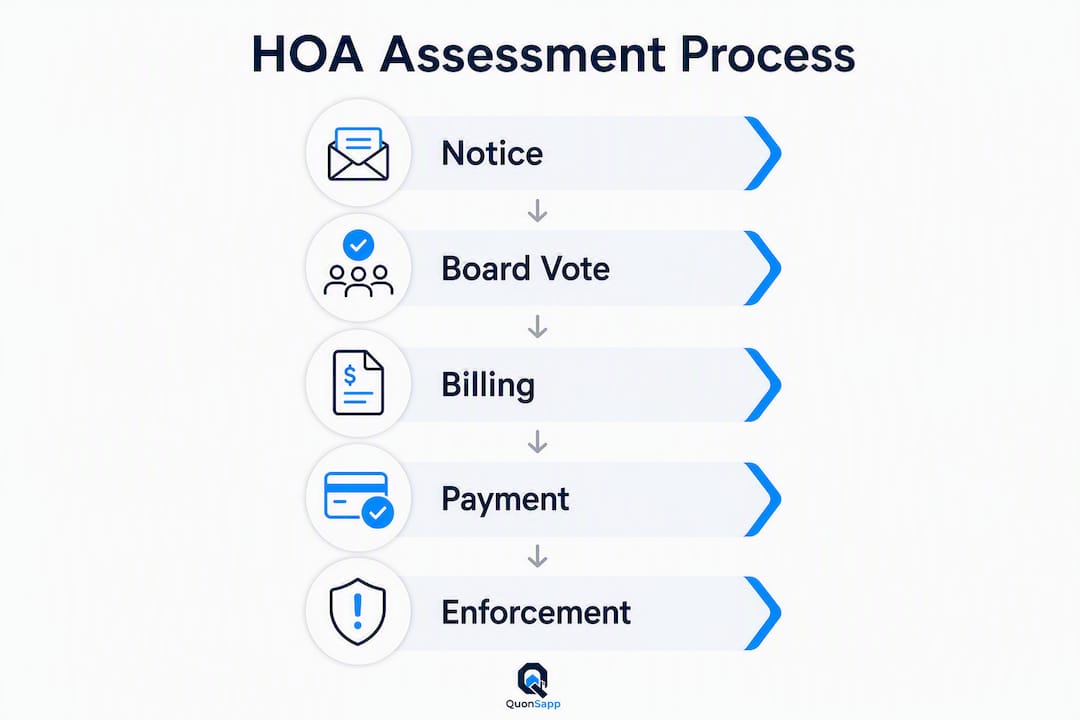
The billing and collection timeline
- Board votes to levy the assessment and records the resolution in meeting minutes.
- Written notice is sent to each member, stating the amount, purpose, and payment deadline.
- Invoice is issued with a due date; most associations allow a grace period before late fees apply.
- Late fees and interest accrue on unpaid balances after the grace period.
- A lien may be recorded against the property for persistent nonpayment.
- Collection escalates to an attorney or agency if the lien goes unresolved.
Under California's Davis-Stirling Act, associations must publish written collection policies annually and follow specific procedures before recording a lien. Colorado's CCIOA goes further, requiring associations to offer payment plans before forwarding a delinquent account to an attorney or collection agency.
Payment options
| Payment Method | Typical Terms | Best For |
|---|---|---|
| Lump sum | Due in 30 days of notice | Homeowners with liquid savings |
| Installment plan | Typically over 6 to 12 months | Homeowners needing cash-flow relief |
| Board-approved financing | Varies by association | Large assessments in well-run communities |
Pro Tip: Ask for an installment plan in writing before the due date. Many boards will approve one rather than pursue collection. Request that interest be capped and get the repayment schedule in your assessment notice or a separate written agreement.
What are your legal rights when an assessment is levied?
Your rights come from three sources: your CC&Rs and bylaws, your state's HOA statute, and general property law. All three matter.
State-level variation is significant
- California: The Davis-Stirling Act imposes strict notice requirements, requires boards to levy assessments sufficient to maintain common areas, and authorizes both judicial and nonjudicial foreclosure for unpaid amounts.
- Colorado: The CCIOA requires associations to offer payment plans and ledger access before escalating collection, and sets rules on how payments are applied.
- Texas: Texas law does not automatically grant associations the right to charge assessments unless the governing documents say so. Collection powers and limits are tied to statute and CC&Rs, and vary by county.
The FHWA confirms that special assessments are authorized across all states, but the specifics depend entirely on state enabling legislation and local governing documents.
Records to request immediately
- The formal special assessment notice (date, amount, purpose, payment deadline)
- Board meeting minutes from the vote authorizing the assessment
- The most recent reserve study
- Your unit's payment ledger
- The association's collection policy
How to challenge an assessment
Procedure is your strongest tool. If the board skipped a required homeowner vote, failed to provide adequate notice, or levied an amount that exceeds CC&R caps, the assessment may be procedurally defective. Document every gap before the payment deadline.
Your escalation path typically runs: written objection to the board → internal dispute resolution → state-mandated mediation (required in some states) → litigation. Consult a licensed HOA attorney in your state before filing anything formal. The cost of a one-hour consultation is almost always less than the cost of a procedural mistake.
How special assessments affect buying and selling a home
For buyers, an undisclosed or pending special assessment can turn a good deal into an expensive surprise. For sellers, an unpaid assessment can complicate or delay closing.
What sellers must disclose
Sellers are generally required to disclose active or pending special assessments in their disclosure packets. Unpaid assessments can transfer to the buyer at closing unless the contract explicitly addresses them. This is not a technicality to overlook.
Buyer due diligence checklist
- Request the seller's HOA disclosure packet, including any pending or approved assessments.
- Ask for the last two years of board meeting minutes to spot discussions about upcoming capital projects.
- Review the reserve study. A reserve funded below 70% of its target is a meaningful risk factor.
- Confirm whether any assessment has been levied but not yet invoiced.
- Ask the HOA management company directly whether any assessments are planned or under discussion.
Negotiation options at closing
Buyers and sellers have real room to negotiate. Common outcomes include:
- Seller credit: The seller credits the buyer at closing for the full outstanding assessment amount.
- Seller pays in full before closing: Clears the lien and simplifies the transaction.
- Contingency language: The purchase contract includes a contingency allowing the buyer to renegotiate or exit if a new assessment is levied before closing.
- Delayed payment arrangement: The buyer assumes the assessment but negotiates an installment plan with the board post-closing.
Tax treatment of HOA special assessments
The tax answer depends on how you use the property and what the assessment funds.
For a primary residence, special assessments are generally not deductible as a current expense. However, if the assessment funds a capital improvement to common areas (a new roof, structural repairs, elevator replacement), you may be able to add your share to your home's tax basis. A higher basis reduces your taxable gain when you sell.
For a rental property, the treatment differs. Assessments that fund repairs may be deductible as an ordinary business expense in the year paid. Assessments that fund capital improvements are typically capitalized and depreciated over time.
This is where a CPA earns their fee. The line between a deductible repair and a capitalizable improvement is not always obvious, and the IRS applies specific tests. Save every paid invoice, the original assessment notice, and the reserve study. Bring them to your tax professional before filing.
The IRS does not publish a single rule that covers every HOA assessment scenario. Your specific situation, property type, and state tax rules all affect the outcome.
Step-by-step: what to do when you receive an assessment notice
Your action plan
- Request the full documentation package. Ask the board or management company for the assessment notice, board vote minutes, reserve study, and your unit ledger. You are entitled to these records in most states.
- Verify the calculation. Confirm your share matches the formula in your CC&Rs. Check whether the total project cost is documented and reasonable.
- Request a payment plan in writing. Send a short email to the board or management company before the due date. See the template below.
- Attend the next board meeting. Boards are more responsive to members who show up. You can ask questions on the record and request that your objections be noted in the minutes.
- Escalate if procedures weren't followed. If the board skipped a required vote or failed to provide proper notice, file a written objection and consult an HOA attorney.
Sample email to request an installment plan
When to bring in professionals
- Insurance: If the assessment stems from a covered loss, check whether your HO-6 policy covers your share of the deductible or assessment.
- Accountant: Before the tax year ends, confirm how the assessment affects your basis or deductions.
- Attorney: If the board violated its own procedures or state law, a licensed HOA attorney can advise on your options before you pay or before a lien is recorded.
How well-run HOAs prevent or reduce special assessments
The boards that rarely levy special assessments share a few consistent habits. They commission reserve studies on a regular cycle, typically every three to five years, and actually fund reserves to the levels those studies recommend. They maintain itemized, accessible ledgers so members can see exactly where money goes. And they schedule maintenance proactively rather than waiting for a failure.
Operationally, the checklist looks like this:
- Reserve studies: Commission and update them regularly; fund to the recommended percentage.
- Transparent ledgers: Make itemized financial statements available to members without requiring a formal records request.
- Realistic budgets: Set dues at levels that fully fund operations and reserves, even when members push back.
- Scheduled maintenance: Track capital assets and their expected replacement timelines.
- Notice templates: Maintain ready-to-use templates for assessment notices, vote announcements, and collection letters.
- Vote tracking: Record every board vote and homeowner vote with timestamps and results.
- Payment-plan policies: Adopt a written policy before an assessment is needed, so the process is clear when it is.
- Communication logs: Document all member communications related to assessments to reduce dispute risk.
Pro Tip: Boards that share the reserve study proactively, before an assessment is proposed, face significantly less pushback. Members who understand the financial picture in advance are far more likely to accept a necessary charge.
When a major capital project is unavoidable, transparent boards hold an informational meeting, share the reserve study findings, explain the cost allocation method, and offer a payment plan from day one. That approach doesn't eliminate frustration, but it does reduce formal disputes and legal challenges.
Key Takeaways
HOA special assessments are mandatory charges tied to specific expenses that regular dues and reserves can't cover, and your response in the first 30 days determines most of your options.
| Point | Details |
|---|---|
| Request documents immediately | Ask for the assessment notice, board vote minutes, reserve study, and your unit ledger before the payment deadline. |
| Know your state's rules | California, Colorado, and Texas each have materially different homeowner protections; check your state statute and CC&Rs. |
| Negotiate a payment plan early | Most boards will offer installments over a period commonly ranging from 6 to 12 months if you ask in writing before the due date. |
| Buyers: review reserves before closing | A reserve fund below its target is a reliable predictor of future assessments; treat it as a negotiating point. |
| QuonSapp for boards | QuonSapp's invoicing, ledger access, board voting, and payment-plan tools help boards manage the full assessment lifecycle with less conflict. |
The view from the board side
Managing a special assessment is one of the harder things a board has to do. You're delivering unwelcome financial news to neighbors, often under time pressure from a contractor or a lender, and you know that some members will push back regardless of how carefully you've followed the rules. The boards I've seen handle it well share one trait: they communicate before they have to. They share reserve study findings at annual meetings, not just when an assessment is imminent. They adopt a written payment-plan policy during a calm period, so it's already in place when the crisis arrives. And they keep their ledgers clean and accessible, because a member who can see the numbers for themselves is much harder to convince that something improper is happening. The legal framework matters, but trust is what actually keeps a community functional when the bill arrives.
QuonSapp helps boards manage assessments without the chaos
When a special assessment hits, the administrative load on a board multiplies fast: notices to draft, invoices to send, payment plans to track, votes to document, and member questions to answer. QuonSapp handles all of it in one place. Boards can issue individual or bulk HOA dues and special assessment invoices, track payment status in real time, and give members ledger access directly through the resident portal. Board votes are documented with deadlines and live results. The audit-ready reporting means every transaction is timestamped and traceable, which is exactly what you need if a member challenges the process.

For boards that want to reduce friction and build member trust around the full assessment lifecycle, QuonSapp is built for that job. Visit quonsapp.com to see how it works for your community.
Useful sources to verify rules and tax treatment
The rules governing HOA special assessments vary by state, and the sources below are the most authoritative starting points for your jurisdiction.
- Davis-Stirling Act collection policy guidance: California's primary statutory framework for HOA assessment levying, collection, and lien procedures.
- Colorado Division of Real Estate — HOA assessments and delinquency: Covers CCIOA payment-plan requirements, ledger access rights, and collection rules for Colorado homeowners.
- Texas State Law Library — Property Owners' Associations: Explains how Texas ties assessment authority to governing documents and the limits of collection remedies.
- FHWA Special Assessments Fact Sheet: Confirms that special assessment mechanisms exist under state law across all 50 states, with specifics varying by enabling legislation.
- FindHOALaw — Regular and Special Assessments: Plain-language overview of how assessments are defined, authorized, and collected under typical CC&Rs.
- IRS Publication 530 (Tax Information for Homeowners): The starting point for understanding how capital improvements and assessments affect your home's tax basis. Consult a CPA for your specific situation.
This article is general information, not legal or tax advice. Confirm the current rules for your jurisdiction with your state's HOA statute, your CC&Rs, or a qualified attorney or CPA.