
What is the best property portfolio management software right now?
The strongest property portfolio management software options available in the US market for 2026 are QuonSapp, AppFolio, Stessa, Yardi Breeze, Rent Manager, Entrata, and Buildium. Each platform targets a different slice of the landlord and investor market, from solo owners with a handful of units to enterprise operators managing thousands of doors. Choosing the wrong one costs you more than money. It costs you time, accuracy, and control over your portfolio.

The table below maps each platform to the buyer profile it fits best, along with pricing, core strengths, ease of use, integrations, and support quality.
| Platform | Best For | Pricing | Core Features | Ease of Use | Integrations | Customer Support |
|---|---|---|---|---|---|---|
| QuonSapp | HOA managers, landlords, multi-property operators | Tiered monthly subscription; no per-seat fees | Multi-property dashboard, HOA tools, Stripe payments, maintenance, GPS clock-in, payroll export | High; native iOS and Android apps | ADP, Paychex, QuickBooks-compatible payroll export; Stripe | Email, in-app support |
| AppFolio | Mid-to-large residential and commercial portfolios | Per-unit monthly fee | Leasing, maintenance, online payments, AI leasing assistant | High; polished mobile app | Accounting, screening, marketing tools | Phone, email, chat |
| Stessa | Individual landlords and small investors | Free tier available; premium plans | Income and expense tracking, rent collection, tax reporting | Very high; minimal learning curve | Bank feeds, QuickBooks | Email, community forum |
| Yardi Breeze | Small to mid-size residential and commercial | Per-unit monthly fee | Leasing, maintenance, portals, reporting | High; browser-based | Yardi ecosystem, payment processors | Phone, email, chat |
| Rent Manager | Mid-size to large operators | Per-unit or flat monthly fee | Accounting, leasing, maintenance, custom reporting | Moderate; feature-rich | Open API, 200+ integrations | Phone, email, training |
| Entrata | Large multifamily operators | Custom pricing | Full property lifecycle management, marketing, leasing, accounting | Moderate; enterprise-grade | Broad third-party ecosystem | Dedicated account managers |
| Buildium | Small to mid-size residential portfolios | Tiered monthly plans | Leasing, accounting, maintenance, resident portal | High; clean interface | QuickBooks, Zillow, TransUnion | Phone, email, chat |
Pro Tip: Before committing to any platform, confirm whether the pricing is per unit, per property, or a flat monthly fee. A $1 per unit rate sounds low until you have 300 units.
Table of Contents
- How do these platforms compare on features, pricing, and usability?
- How to choose the right property portfolio management software for your portfolio
- What features and benefits does property portfolio management software deliver?
- What does the research say about efficiency gains from automated portfolio management?
- QuonSapp gives property managers a single platform for every daily task
- Key Takeaways
How do these platforms compare on features, pricing, and usability?
Feature depth and multi-property management
The gap between entry-level and mid-tier platforms shows up most clearly in multi-property management. QuonSapp is built specifically for operators who need a single dashboard across all their properties, with resident profiles, lease tracking, HOA violation management, board voting, and a live interactive property map all in one place. It also handles GPS clock-in and out for field staff, shift scheduling, and payroll export to ADP, Paychex, or QuickBooks-compatible formats. That combination of property management and workforce tools in one subscription is unusual at this price tier.
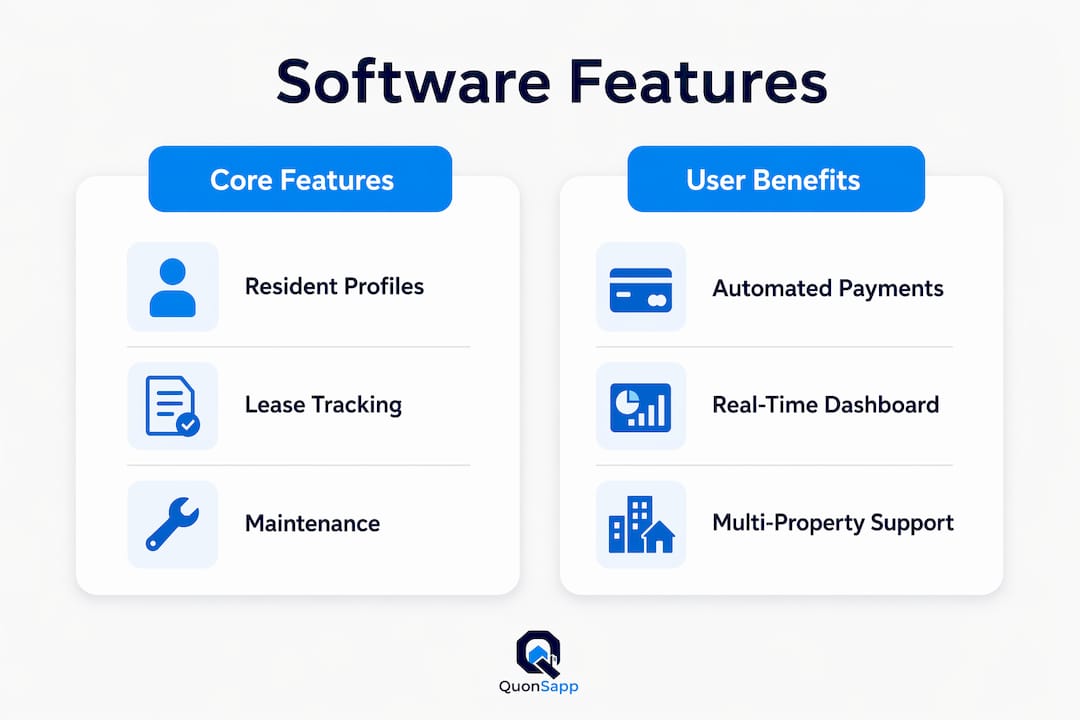
AppFolio and Entrata serve larger portfolios with polished leasing pipelines and AI-assisted tools, but their per-unit pricing climbs quickly for operators above a few hundred units. Yardi Breeze keeps things browser-based and accessible, which works well for smaller teams that do not need deep customization. Rent Manager's open API and 200-plus integrations make it a strong choice for operators who already have a tech stack and need the software to fit into it.
Pricing realities
Pricing for property management software typically ranges from a low per-unit monthly fee for small portfolios to higher monthly fees for mid-size to enterprise operations. Stessa's free tier is genuinely useful for individual landlords tracking income and expenses, though premium features require a paid plan. QuonSapp uses tiered monthly subscription pricing with no per-seat fees for staff or resident accounts, which keeps costs predictable as your team grows.
Payments and financial tools
QuonSapp's payment processing runs through Stripe direct payments, meaning funds land in the manager's account instantly with no intermediary holding period. Residents pay by credit or debit card from the portal, and partial payments are supported with running balance tracking. A flat platform fee per transaction is configurable. That level of payment transparency is a real operational advantage for HOA managers and landlords who deal with frequent, varied payment amounts.

User experience and mobile access
Ease of use and mobile availability consistently rank among the top factors in software adoption. QuonSapp offers dedicated iOS and Android apps for staff, managers, and residents, with real-time sync powered by Convex and offline-friendly core screens for field use. AppFolio and Buildium also earn strong marks for their mobile interfaces. Rent Manager and Entrata are more feature-dense, which means a steeper learning curve but more configurability for complex operations.
Pros and cons at a glance
- QuonSapp: All-in-one for HOA and multi-property operators; includes workforce tools; no per-seat fees. Less established brand recognition than legacy platforms.
- AppFolio: Polished UX and AI leasing tools; per-unit pricing can escalate for large portfolios.
- Stessa: Best free option for individual landlords; limited HOA and workforce features.
- Yardi Breeze: Clean browser-based experience; tied to the Yardi ecosystem for deeper integrations.
- Rent Manager: Deep customization and integrations; moderate learning curve.
- Entrata: Enterprise-grade for large multifamily; custom pricing and dedicated support.
- Buildium: Strong for small to mid-size residential; QuickBooks and Zillow integrations built in.
How to choose the right property portfolio management software for your portfolio
The right platform depends on four things: your portfolio size, the types of properties you manage, your budget, and how much your team will actually use the software day to day.
Evaluation criteria to prioritize
- Portfolio size and property type: HOA communities need violation tracking, board voting, and ARC request workflows. Residential landlords need lease tracking and rent collection. Commercial operators need custom reporting and accounting depth. Match the feature set to what you actually manage.
- Budget structure: Decide whether per-unit pricing or a flat monthly subscription fits your growth plan. Per-unit pricing is predictable at low volume but expensive at scale.
- Integration needs: If you already use QuickBooks, ADP, or Paychex, confirm native compatibility before signing up. Switching accounting systems mid-implementation is painful.
- Mobile requirements: If your staff works in the field, a native mobile app with offline capability is not optional. Web-only platforms create friction for maintenance crews and front desk staff.
- Customer support model: Enterprise platforms often assign dedicated account managers. Smaller platforms rely on email and community forums. Know what you need before a problem arises.
Red flags to watch for
- Pricing that is not publicly listed, which often signals custom quotes that favor the vendor.
- No free trial or demo environment, making it impossible to test the interface before committing.
- Per-seat fees for staff accounts, which can double your monthly cost as your team grows.
- Onboarding that requires weeks of professional services before you can use basic features.
Questions to ask vendors before buying
- What is included in the base plan versus add-ons?
- How long does onboarding typically take for a portfolio of my size?
- Is data export available if I decide to switch platforms later?
- What happens to my data if I cancel?
Implementation timelines vary by portfolio complexity. Simpler portfolios can be up and running within a few days. Larger, more complex operations may need a couple of weeks to migrate data and train staff. Ask for a realistic timeline in writing.
Pro Tip: Run a parallel test during the trial period. Keep your existing system active and run the new software simultaneously for two to four weeks. You will catch data gaps and workflow friction before they become real problems.
What features and benefits does property portfolio management software deliver?
The core value of a real estate portfolio management system is replacing disconnected spreadsheets and manual processes with a single platform that keeps every property, resident, and dollar in one place.
Automated rent collection and bookkeeping
Automated rent collection eliminates the back-and-forth of manual invoicing. Residents receive invoices directly in their portal, see overdue balances highlighted, and pay by card without calling the office. On the manager side, every payment posts to the ledger automatically with a timestamp and method record. That kind of automated accounting reconciliation reduces manual data entry errors and keeps financial reporting accurate for tax filing.
Real-time dashboards and KPI tracking
Consolidated portfolio data creates a foundation for institutional-grade decision making by surfacing KPIs like EBIT margins, weighted average unexpired lease term (WAULT), and gross and net yields in real time. Without a unified platform, pulling those numbers means exporting from multiple systems and reconciling them manually, which introduces errors and delays. A live dashboard removes that lag entirely.
Lease tracking and resident management
Lease start and end dates, renewal alerts, move-out tracking, and resident profiles with emergency contacts, pet fees, and parking details all belong in one system. When a lease is expiring in 60 days, the software flags it. When a resident submits a maintenance request, it routes to the right staff member or vendor automatically.
Maintenance and work order management
Work order management with photo documentation before and after each job gives you a defensible record for every repair. Vendor directories, staff assignment, and a status pipeline from submitted to completed keep jobs from falling through the cracks. For HOA operators, inspection tracking with notes and photo evidence adds another layer of documentation that protects the board.
Key benefits at a glance
- Reduced manual errors through automated bookkeeping and payment reconciliation
- Faster rent collection with online portals and overdue alerts
- Better maintenance accountability through photo documentation and status tracking
- Improved resident satisfaction from self-service portals and real-time communication
- Stronger financial reporting with audit trails and exportable records
- Time savings from bulk invoicing, automated alerts, and integrated payroll tools
What does the research say about efficiency gains from automated portfolio management?
The financial case for adopting property investment portfolio management software is well documented. Real estate investors using automated property management software save up to $4,000 annually and recover over 100 hours per year by eliminating manual spreadsheets and consolidating bookkeeping. That is time that goes back into finding deals, managing relationships, and growing the portfolio rather than reconciling ledgers.
Efficiency snapshot: Investors who consolidate portfolio data into a single platform gain real-time access to KPIs that are nearly impossible to extract accurately from disconnected systems, according to Moody's CRE.
The audit trail is another underappreciated benefit. Software-generated audit logs record every action with a timestamp and user ID, which matters enormously during tax season and in any dispute with a resident or vendor. Manual systems leave gaps that are hard to explain to an accountant or a court.
| Efficiency Metric | Impact |
|---|---|
| Annual cost savings | Up to $4,000 per investor on average |
| Time recovered per year | 100-plus hours from eliminating manual spreadsheets |
| Financial reporting accuracy | Improved through automated reconciliation and audit trails |
| KPI accessibility | Real-time access to EBIT margins, WAULT, gross and net yields |
| Decision-making speed | Faster with consolidated dashboards versus disconnected systems |
Platforms that incorporate data normalization and validation reduce the risk of errors that compound over time. A single misclassified expense in January can distort your year-end net yield calculation and affect how you price your next acquisition. The accounting software for property management category has matured to the point where these protections are standard in mid-tier and above platforms.
For HOA managers specifically, the ability to generate board-ready reports, track dues collection rates, and document violations with timestamps creates a level of transparency that manual processes simply cannot match. Residents and board members both benefit from knowing the data is accurate and accessible.
QuonSapp gives property managers a single platform for every daily task
If you manage HOA communities, multi-unit residential buildings, or a mixed portfolio, QuonSapp is built for exactly that workload. Most platforms in this space handle either property management or workforce management, not both. QuonSapp covers resident profiles, lease tracking, online rent and HOA dues collection via Stripe, violation reporting, board voting, ARC requests, maintenance work orders with photo documentation, staff scheduling, GPS clock-in, and payroll export to ADP, Paychex, or QuickBooks-compatible formats. All of it runs from a single dashboard, with native iOS and Android apps and real-time sync across every device.

The pricing model is a flat monthly subscription with no per-seat fees for staff or resident accounts, which means your cost stays predictable as your team and portfolio grow. For operators who manage multiple companies, the Organization Network feature links parent and sub-organizations with consolidated billing and data ownership controls. You can also connect with tools like HOA Letter AI to handle resident communications without leaving your workflow. Start your free trial at QuonSapp and see how much of your week you get back.
Key Takeaways
The best property portfolio management software for 2026 consolidates resident management, automated payments, maintenance tracking, and real-time financial reporting into one platform, saving investors significant amounts of money and time annually.
| Point | Details |
|---|---|
| Top platforms for 2026 | QuonSapp, AppFolio, Stessa, Yardi Breeze, Rent Manager, Entrata, and Buildium each serve different portfolio sizes and operator types. |
| Pricing range | Software typically costs $1–$10 per unit per month for small portfolios and $200–$1,000-plus per month for larger operations. |
| Efficiency gains | Automated platforms save investors up to $4,000 annually and recover over 100 hours per year compared to manual spreadsheet management. |
| Critical evaluation factors | Match the platform to your property type, budget structure, integration needs, mobile requirements, and support model before committing. |
| QuonSapp's advantage | QuonSapp covers property management and workforce tools in one subscription with no per-seat fees, built for HOA managers and multi-property operators. |