
A leasing agent is defined as a real estate professional who specializes in marketing vacant units, screening applicants, and securing signed leases. A property manager, by contrast, takes over where the leasing agent stops. The core distinction is focus and duration: leasing agents prioritize vacancy rates and lead-to-lease conversion, while property managers prioritize net operating income (NOI), maintenance efficiency, and long-term tenant retention. For property owners and investors, confusing these two roles leads to coverage gaps, unexpected costs, and legal exposure. Getting the leasing agent vs property manager decision right is one of the most consequential choices you will make as an owner.
What are the primary responsibilities of a leasing agent vs property manager?
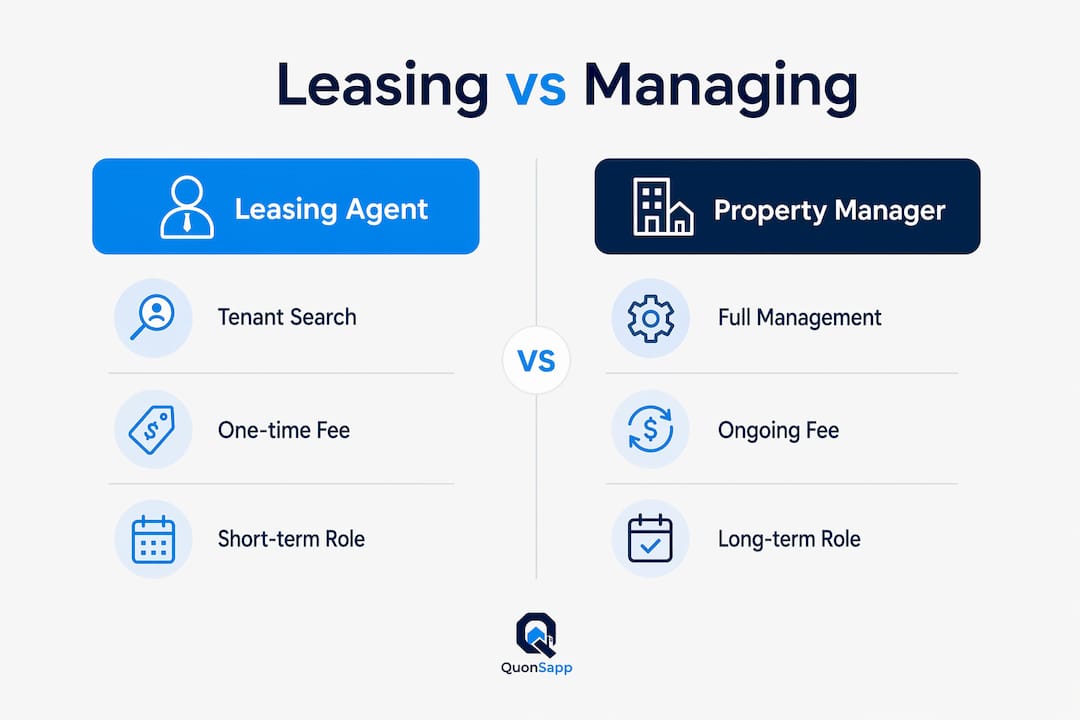
Leasing agents end their role the moment a lease is signed and the tenant moves in. That boundary is not a limitation. It is by design. Their entire job is tenant acquisition, and they are built for it.
Core leasing agent duties include:
- Marketing vacant units across listing platforms and social channels
- Conducting property showings and answering prospective tenant questions
- Screening applicants through background checks and credit verification
- Negotiating lease terms and coordinating the signing process
- Handing off the tenancy to the owner or property manager at move-in
Property managers carry a fundamentally different mandate. They manage the complete tenancy lifecycle from move-in through move-out, covering every operational layer in between.
Core property manager responsibilities include:
- Collecting rent and enforcing payment terms
- Scheduling and overseeing maintenance and repairs
- Conducting regular property inspections with documented records
- Handling tenant disputes and legal compliance issues
- Managing vendor relationships and service contracts
- Coordinating lease renewals and managing move-out procedures
The practical gap between these roles becomes clear in a real scenario. A leasing agent finds you a qualified tenant for your two-bedroom unit in three weeks. The lease is signed. The agent's job is done. Six months later, the tenant reports a plumbing leak, misses a rent payment, and wants to negotiate a lease renewal. Every one of those issues falls on you unless you have a property manager in place.
Pro Tip: If you hire a leasing agent without a property manager, write out every operational task you will personally handle before the tenant moves in. Most owners underestimate the workload until they are fielding a 10 PM maintenance call.

Property managers also handle legal compliance and dispute resolution throughout the lease term. That includes enforcing lease clauses, managing security deposit accounting, and navigating local landlord-tenant law. For owners without legal backgrounds, this alone justifies the cost of full management.
How do the cost structures differ between leasing agents and property managers?
The fee models for these two roles reflect their different scopes of work. Understanding both helps you project true costs over a 12-month period, not just the upfront expense.
| Service | Fee Structure | Typical Amount | When You Pay |
|---|---|---|---|
| Leasing agent | One-time placement fee | ~100% of first month's rent | At lease signing |
| Property manager | Monthly ongoing fee | 5%–12% of monthly rent collected | Every month |
| Property manager (setup) | Onboarding fee | Varies by firm | At contract start |
| Leasing agent (renewal) | Renewal fee | 25%–50% of one month's rent | At each renewal |
Leasing agents charge a one-time placement fee roughly equal to one month's rent. That looks affordable on day one. The math changes when you factor in tenant turnover.
If a leasing-only arrangement produces one tenant turnover per year on a $2,000 per month unit, you pay $2,000 in placement fees annually, plus vacancy loss during the gap between tenants. A property manager charging 10% of collected rent costs $200 per month, or $2,400 per year. The difference narrows quickly, and the property manager delivers ongoing operational coverage that the leasing agent never provides.
Leasing agent fees may appear cheaper initially but generate "churn" costs over time. Property managers, through tenant retention and legal protections, help stabilize long-term income. That stabilization has real dollar value that does not show up in a simple fee comparison.
Pro Tip: When evaluating property management software to support either role, review fee structures and features across platforms before committing. The right tools reduce administrative overhead for both leasing and management tasks.
When should property owners choose leasing agents versus property managers?
The right choice depends on four factors: your proximity to the property, the number of units you own, your tolerance for operational involvement, and your legal risk appetite.
Choose a leasing agent only if:
- You live within 30 minutes of the property and can respond to tenant issues personally
- You own a single unit and have the time to manage it yourself
- You have experience handling maintenance coordination, rent collection, and lease enforcement
- You want to minimize monthly fees and are confident in your retention rates
Choose a property manager if:
- You own more than three units or manage properties across multiple locations
- You live more than an hour from the property
- You lack the time or expertise to handle maintenance, legal compliance, and tenant disputes
- You want to protect net operating income through professional retention practices
Owners with multiple properties or who live more than an hour away benefit measurably from full-service property management. The operational complexity of managing multiple units, vendor relationships, and legal requirements scales faster than most owners expect.
One underappreciated factor is tenant retention. Landlords who rely only on leasing agents often assume their involvement ends after lease signing. It does not. Every maintenance request, late payment, and lease dispute lands directly on the owner. That reality catches many first-time investors off guard, especially when managing from a distance.
The decision is not permanent. Many owners start with a leasing agent for a single property, then transition to full property management as their portfolio grows. Recognizing that inflection point early saves significant time and money.
What are the career and skill differences between leasing agents and property managers?
Understanding who these professionals are helps you evaluate them more accurately when hiring.
-
Sales orientation vs. operational discipline. Leasing agents are sales professionals. They thrive on high-energy environments, prospect outreach, and closing deals. Property managers are operators. They manage budgets, vendor contracts, maintenance schedules, and legal documentation. These are genuinely different personality profiles.
-
Entry-level vs. experienced roles. Leasing agents are typically entry-level positions in the property management industry. Property managers are experienced professionals who have developed analytical, financial, and legal expertise over time. Treating them as equivalent roles leads to mismatched expectations.
-
Career progression. Many professionals begin as leasing agents and transition into property management roles. That progression reflects a shift from sales skills to operational and financial management skills. A leasing agent with two years of experience is building toward a property manager role, not already in one.
-
How skill differences affect your experience as an owner. A leasing agent will communicate with you frequently during the vacancy period, then go quiet after signing. A property manager communicates consistently throughout the tenancy, reporting on maintenance, financials, and compliance. The nature of your relationship with each professional is fundamentally different.
-
Licensing requirements. In most U.S. states, both leasing agents and property managers require real estate licenses, though the specific requirements vary by state. Verify licensing before hiring either professional. An unlicensed property manager creates legal exposure for you as the owner.
Knowing these distinctions helps you ask better questions during interviews and set accurate expectations for what each professional will deliver.
Key takeaways
A leasing agent fills vacancies; a property manager protects your asset, your income, and your legal standing across the full life of every tenancy.
| Point | Details |
|---|---|
| Role scope | Leasing agents handle tenant acquisition only; property managers cover all ongoing operations. |
| Cost comparison | Leasing fees are one-time; management fees of 5%–12% monthly provide continuous operational coverage. |
| Best fit by portfolio size | Single-unit local owners may manage alone; owners with 3+ units or remote properties need full management. |
| Career and skill gap | Leasing agents are sales-focused and entry-level; property managers are operational and experienced professionals. |
| Long-term income stability | Property managers reduce churn costs and protect NOI through retention and legal compliance. |
The uncomfortable truth about leasing-only arrangements
I have watched property owners make the same mistake repeatedly. They hire a leasing agent, fill the vacancy quickly, and feel like the hard work is done. Then the calls start. The tenant has a leak. The rent is three days late. The neighbor filed a noise complaint. None of that was in the leasing agent's contract, and none of it was in the owner's plan.
Relying solely on leasing-only services for multi-unit properties often results in higher long-term costs due to tenant turnover and inadequate handling of complex legal and maintenance issues. That finding matches what I see in practice. The churn costs alone, vacancy loss plus repeated placement fees, can exceed the annual cost of full property management within two or three tenant cycles.
My honest assessment: if you own more than two units or travel frequently, a leasing-only arrangement is a false economy. The monthly management fee feels like an expense. It is actually insurance against the far larger costs of poor tenant retention, deferred maintenance, and legal missteps.
The owners who get this right treat property management as an investment in asset preservation, not a line item to cut. They also use tools that give them visibility into what their managers are actually doing. Transparency and accountability are what separate good management relationships from expensive ones.
— ERNEST
How QuonSapp supports leasing and property management workflows
Whether you work with a leasing agent, a property manager, or handle operations yourself, the right platform makes every role more effective.

QuonSapp is built for property owners and managers who need real operational control across their entire portfolio. Lease tracking with renewal alerts, online resident applications with background check workflows, work order management from submission to completion, and a full payment ledger per resident are all included in one platform. Owners who want visibility without micromanaging get exactly that. Managers who need to run multiple properties from a single dashboard get the tools to do it efficiently. Explore QuonSapp to see how it fits your current setup, whether you are managing one unit or fifty.
FAQ
What is the main difference between a leasing agent and a property manager?
A leasing agent focuses exclusively on tenant acquisition and lease signing, then exits the relationship. A property manager handles all ongoing operations, including rent collection, maintenance, legal compliance, and tenant retention, throughout the full lease term.
How much does a property manager typically charge?
Property managers charge 5%–12% of monthly rent collected as an ongoing fee, plus an occasional onboarding or renewal fee. Leasing agents charge a one-time placement fee roughly equal to one month's rent.
Can a leasing agent also manage my property?
Some real estate professionals hold licenses that allow them to perform both functions, but the roles require different skill sets. Confirm in writing exactly which services are included before signing any agreement.
When does hiring only a leasing agent make financial sense?
A leasing-only arrangement makes sense when you own a single unit, live nearby, and have the time and experience to handle maintenance, rent collection, and legal issues yourself. For owners with multiple properties or remote investments, full property management delivers better long-term value.
Do leasing agents and property managers need to be licensed?
In most U.S. states, both roles require a real estate license, though specific requirements vary by state. Always verify licensing status before hiring either professional to protect yourself from legal liability.