
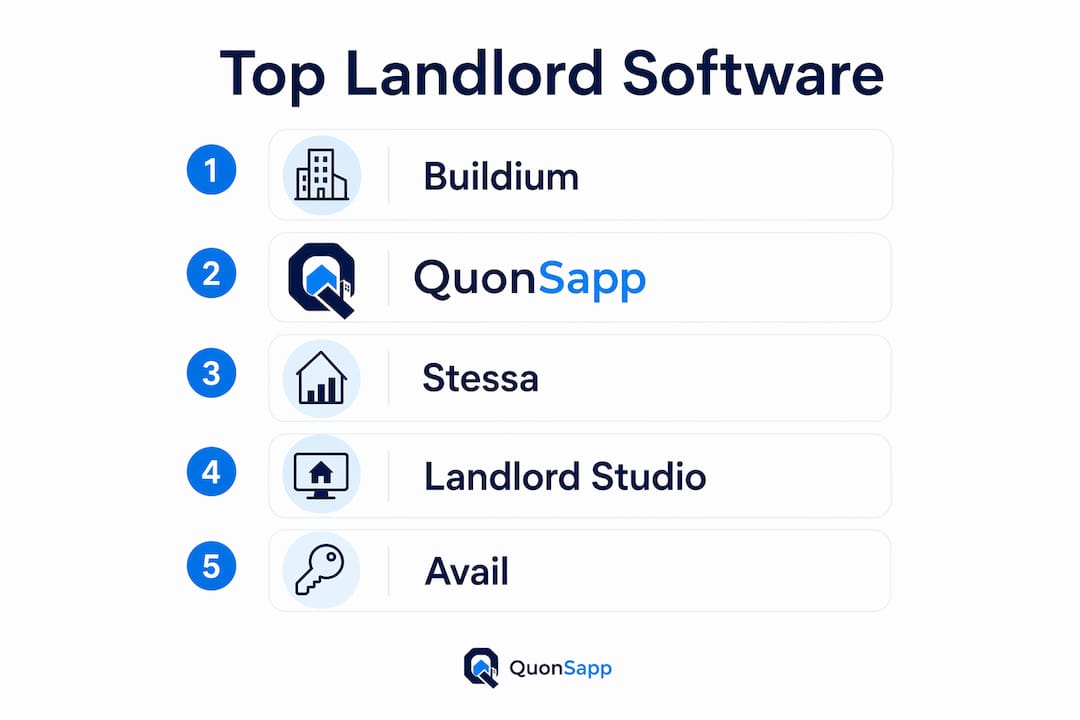
The best landlord accounting software for small to mid-sized portfolios in 2026 comes down to five platforms worth your attention: QuonSapp, Stessa, Landlord Studio, Avail, and Buildium. Each handles the core job of tracking rental income and expenses, but they diverge sharply on tax automation, tenant management depth, mobile capability, and price. If you manage a relatively small number of units and want everything in one place, including HOA tools, maintenance tracking, and online payments, QuonSapp is a strong all-in-one option. Stessa leads on free-tier accounting. Landlord Studio wins on mobile-first receipt capture. Avail is the go-to for independent landlords who prioritize tenant screening. Buildium scales well for larger portfolios with professional management needs.
| Software | Key Features | Pricing | Usability | Mobile App | Tax Support | Best For |
|---|---|---|---|---|---|---|
| QuonSapp | Multi-property dashboard, lease tracking, Stripe payments, HOA tools, maintenance, audit log | Tiered subscription, no per-seat fees | High — purpose-built for property managers | iOS & Android | Accounting overview, invoicing, payment analytics | HOA managers, landlords, multi-property portfolios |
| Stessa | Income/expense tracking, bank sync, Schedule E reports, rent collection | Free tier available; Pro paid | High — landlord-focused, single-entry | iOS & Android | Schedule E automation, CPA-endorsed | Independent landlords, buy-and-hold investors |
| Landlord Studio | Receipt capture, bank sync, expense tracking, tenant management | Paid plans by unit count | High — mobile-first design | iOS & Android | Tax reports, Schedule E | Landlords managing on the go |
| Avail | Tenant screening, lease creation, online rent collection, maintenance requests | Free and paid tiers | Moderate — tenant-centric | iOS & Android | Basic income/expense reports | Independent landlords, single-family rentals |
| Buildium | Full property management, accounting, maintenance, owner portals | Paid plans starting mid-range | Moderate — feature-rich but steeper learning curve | iOS & Android | Tax reports, 1099 filing | Mid-sized portfolios, professional managers |
Table of Contents
- How does each landlord accounting software platform compare in depth?
- How do you choose the right landlord bookkeeping software?
- What features should landlord accounting software include?
- Why specialized landlord software outperforms generic accounting tools
- QuonSapp covers your full property portfolio, not just the books
- Key Takeaways
How does each landlord accounting software platform compare in depth?
Choosing the right platform means looking past the feature list and asking how each tool actually performs on the tasks you do every week: reconciling rent payments, categorizing repair expenses, preparing for tax season, and keeping tenant records current. Here is how the five leading options stack up when you dig in.
QuonSapp
QuonSapp is built from the ground up for property managers, HOA boards, and landlords who need more than a spreadsheet but less complexity than enterprise software. Its accounting dashboard tracks revenue, expenses, and balances across every property in your portfolio from a single screen. Online rent and HOA dues collection runs through Stripe, with payments landing directly in your account, no intermediary holding period. The $1.00 flat platform fee per transaction is configurable: you can pass it to tenants at checkout or absorb it from your payout.

Beyond accounting, QuonSapp covers lease tracking with renewal alerts, maintenance work orders with photo documentation, staff GPS clock-in/out, and a full audit log. For landlords who also manage HOA communities, violation tracking, fine management, board voting, and ARC request workflows are all built in. Multi-company support lets parent organizations link sub-orgs with consolidated billing, which is rare at this price point. The native iOS and Android apps sync in real time, and core screens load even with weak connectivity in the field.
Stessa
Stessa built its reputation on making rental property bookkeeping genuinely accessible to landlords without accounting backgrounds. Its free tier covers income and expense tracking, bank sync, and basic reporting. The paid Pro tier adds Schedule E automation, premium reports, and priority support. CPA-endorsed workflows and a landlord-specific chart of accounts mean you are not retrofitting a generic tool to fit rental property needs. User reviews on Capterra consistently highlight ease of setup and the quality of tax reporting as standout strengths.
Landlord Studio
Landlord Studio's strongest differentiator is its mobile-first design. Receipt capture from your phone, real-time bank sync, and expense categorization work as well on a job site as they do at a desk. The platform covers tenant management, lease tracking, and maintenance requests alongside its accounting core. Tax reports including Schedule E are generated automatically. It prices by unit count, so costs scale predictably as your portfolio grows.

Avail
Avail focuses on the tenant relationship side of landlord management: online applications, background and credit checks, lease creation, and maintenance request tracking. Its accounting features cover income and expense reporting but stop short of Schedule E automation on the free tier. For landlords who prioritize finding and vetting tenants over deep financial reporting, Avail's free plan delivers strong value. The paid Unlimited Plus tier removes per-unit fees and adds premium screening reports.
Buildium
Buildium is the most feature-complete option on this list, covering property accounting, maintenance management, owner and tenant portals, and 1099 filing. User reviews on G2 and Capterra note that the platform rewards landlords who invest time in setup, but the learning curve is steeper than Stessa or Landlord Studio. Pricing starts at a moderate monthly rate and scales with unit count, making it more suited to larger portfolios where the feature depth justifies the cost.
| Feature | QuonSapp | Stessa | Landlord Studio | Avail | Buildium |
|---|---|---|---|---|---|
| Automated expense tracking | Yes | Yes | Yes | Basic | Yes |
| Bank sync | Yes | Yes | Yes | No | Yes |
| Schedule E reports | Via accounting overview | Yes (Pro) | Yes | No | Yes |
| Online rent collection | Yes (Stripe) | Yes | Yes | Yes | Yes |
| Tenant screening | Yes (application workflow) | No | Basic | Yes | Yes |
| Maintenance tracking | Yes (full work orders) | Basic | Yes | Basic | Yes |
| HOA management | Yes | No | No | No | No |
| Mobile app | iOS & Android | iOS & Android | iOS & Android | iOS & Android | iOS & Android |
| Multi-property dashboard | Yes | Yes | Yes | Limited | Yes |
| Audit log | Yes | No | No | No | Limited |
| Multi-company support | Yes | No | No | No | No |
| Free tier | No | Yes | No | Yes | No |
| CPA endorsements | N/A | Yes | Yes | No | Yes |
| Data security | Multi-layer, audit log | Encryption | Encryption | Encryption | Encryption |
| Customer support | Help center, in-app | Knowledge base, email | Live chat, email | Email, help center | Phone, chat, email |
How do you choose the right landlord bookkeeping software?
The right platform depends on four variables: what your portfolio actually needs, how much you are willing to spend, how you prefer to work, and where you expect to be in three years. Getting this decision right saves you from migrating data mid-year, which is painful and time-consuming.
- Portfolio size and complexity. A landlord with three single-family rentals has different needs than one managing 30 units across mixed residential and HOA communities. Free or entry-level tools like Stessa's free tier work well at the small end. Mid-sized portfolios with staff, vendors, and HOA obligations need a platform like QuonSapp or Buildium that handles operational complexity alongside accounting.
- Tax preparation requirements. If Schedule E automation matters to you, confirm it is included in the plan you are actually buying, not just the paid upgrade. Stessa and Landlord Studio both automate Schedule E, but Stessa's version is gated behind the Pro tier. Buildium includes 1099 filing, which is valuable if you pay contractors.
- Usability and accounting method. Single-entry bookkeeping is generally sufficient for rental property investors and far easier to manage than the double-entry accounting built into generic tools like QuickBooks. Purpose-built landlord software defaults to single-entry, which means less setup friction and fewer categorization errors.
- Integration with banks and payment platforms. Direct bank sync eliminates manual data entry and reduces reconciliation errors. Stripe-based rent collection, as used by QuonSapp, means payments clear faster and land directly in your account. Confirm that the platform syncs with your specific bank before committing.
- Scalability and support. Pricing for landlord software typically scales with portfolio size, features, and access levels. Free options exist but often lack advanced tax tools and dedicated support. If you plan to grow, choose a platform where the next pricing tier does not require a full migration. Check whether customer support includes live assistance or only a self-service knowledge base.
- Mobile capability. If you are ever on-site, between properties, or away from a desk when a maintenance issue surfaces, mobile quality matters more than most landlords expect before they need it.
Pro Tip: Before signing up for any platform, download the mobile app and test receipt capture and rent payment tracking on your phone. A platform that feels clunky on mobile will slow you down every time you are in the field, regardless of how polished the desktop version looks.
Whether you handle your own books or work with a professional, understanding the DIY vs. professional bookkeeping tradeoff helps you decide how much automation you actually need from your software.
What features should landlord accounting software include?
Purpose-built property accounting tools pack a specific set of capabilities that generic software simply does not offer out of the box. Here is what to look for and why each feature earns its place.
- Automated income and expense tracking. Every rent payment, repair bill, and management fee should be categorized automatically, either through bank sync or payment platform integration. Manual entry is where errors accumulate and tax season becomes a scramble.
- Property-level accounting. Tracking income and expenses at the individual property level, not just across the portfolio as a whole, is what makes Schedule E preparation accurate. You need to know that Unit 4B generated $14,400 in rent and $2,100 in repairs, not just that your portfolio did.
- Schedule E tax reporting. Landlord accounting platforms that generate Schedule E reports automatically, with CPA-endorsed workflows, reduce tax filing complexity and save meaningful time each year. This is one of the clearest separators between purpose-built and generic tools.
- Online rent collection and payment processing. Integrated payment gateways let tenants pay by card or ACH directly through a portal. Payments reconcile automatically against open invoices, which eliminates the manual matching step entirely.
- Tenant screening and lease management. Background and credit check workflows, lease start/end tracking, renewal alerts, and move-out documentation belong in the same platform as your accounting. Switching between apps to find a lease date while reconciling a security deposit is avoidable friction.
- Maintenance and repair tracking. Work orders with photo documentation, vendor assignment, and status pipelines give you a complete record of every repair. That record matters at tax time when you are categorizing capital improvements versus deductible repairs.
- Real-time financial dashboards. Net operating income, rent roll, overdue balances, and cash flow should be visible at a glance. Interactive reports let you spot a problem property before it becomes a cash flow issue.
- Data security. Leading platforms use multi-layer encryption and access controls to protect tenant financial data and personal information. An audit log that records every action with a timestamp adds an additional layer of accountability.
- Mobile app with receipt capture. A mobile-first approach boosts productivity for landlords managing finances on-site or between properties. Photograph a receipt at the hardware store and have it categorized before you get back to your truck.
Why specialized landlord software outperforms generic accounting tools
Generic accounting software like QuickBooks or FreshBooks is built for businesses with employees, invoices, and inventory. Rental property accounting has a fundamentally different structure, and forcing it into a general-purpose tool creates unnecessary complexity.
Purpose-built landlord accounting software includes automated Schedule E reporting, property-level income and expense tracking, integrated bank synchronization, and mobile receipt capture as standard features. In a generic tool, you would build these capabilities manually through custom categories, workarounds, and third-party add-ons, and then hope your CPA can make sense of the output.
The bookkeeping method itself is a telling example. Single-entry bookkeeping is generally sufficient for rental property investors and significantly less complex than the double-entry accounting that generic business software requires. Double-entry demands that every transaction affect two accounts simultaneously, which is appropriate for a business with accounts payable, payroll, and inventory but is overkill for a landlord tracking rent in and repairs out. Purpose-built platforms default to single-entry, which means landlords without accounting backgrounds can manage their books accurately without hiring a bookkeeper for routine tasks.
Experts agree that landlord accounting software focusing on simplicity and landlord-specific features enables investors without accounting backgrounds to manage portfolios confidently.
Bank integration is another area where the gap is visible. Landlord-specific platforms allow property-level bank accounts to sync directly to bookkeeping, so each property's cash flow is tracked separately without manual allocation. In QuickBooks, achieving the same result requires a chart of accounts setup that most landlords would need professional help to configure correctly.
Many landlord accounting platforms also offer built-in tax reports and CPA-endorsed functionality that reduce filing complexity. That endorsement matters: it signals that the output is formatted the way tax professionals actually want to receive it, not just that the numbers add up. For a landlord filing Schedule E on five properties, that distinction can mean the difference between a one-hour tax prep session and a two-day reconciliation project.
Mobile-first landlord apps also outperform desktop-based generic tools for on-the-go management. Tracking receipts, monitoring rent payments, and logging maintenance requests from the field is a workflow that generic software was never designed to support well. If you want to understand how professional bookkeeping services can complement your software choice, that context is worth exploring before you decide how much to automate versus delegate.
QuonSapp covers your full property portfolio, not just the books
Most landlord accounting tools stop at the financials. QuonSapp goes further, connecting accounting with every other operational layer of property management in one platform.

For landlords and HOA managers who want a single system rather than a stack of disconnected apps, QuonSapp delivers multi-property accounting alongside lease tracking, online Stripe-powered rent collection, maintenance work orders with photo documentation, staff scheduling with GPS clock-in, and HOA-specific tools including violation tracking, board voting, and ARC request workflows. The accounting dashboard shows revenue, expenses, and balances across all properties in real time. Payment analytics track on-time rates, overdue balances, and collection trends without any manual reporting.
Security is built in from the start: a full audit log records every action with a timestamp and user ID, and data ownership controls let multi-company organizations decide exactly what sub-organizations can see. The native iOS and Android apps sync instantly, and core screens stay accessible even with limited connectivity.
QuonSapp's tiered subscription pricing scales with your portfolio, with no per-seat fees for staff or resident accounts. That structure makes it predictable as you grow. If you are managing properties across multiple communities or expanding into HOA management, the QuonSapp platform is worth a close look. You can also explore how it compares to other property management accounting tools before making a decision.
Key Takeaways
The best landlord accounting software combines property-level financial tracking, Schedule E automation, and integrated tenant management to give small to mid-sized landlords accurate books and less time spent on manual tasks.
| Point | Details |
|---|---|
| Purpose-built beats generic | Landlord-specific software includes Schedule E automation and single-entry bookkeeping that generic tools require manual workarounds to replicate. |
| Mobile capability matters | A mobile-first app with receipt capture and real-time rent tracking is essential for landlords who manage properties in the field. |
| Pricing scales with portfolio | Free tiers work for small portfolios, but mid-sized landlords need paid plans with advanced tax tools and dedicated support. |
| Security and audit trails | Leading platforms use multi-layer encryption and full audit logs to protect tenant data and financial records. |
| QuonSapp for full-stack management | QuonSapp combines accounting, lease tracking, Stripe rent collection, HOA tools, and maintenance tracking in one platform with no per-seat fees. |