
Which online rent payment platforms should you use in 2026?
The right rent payment platform does more than move money. It automates reminders, enforces late fees, protects your banking details, and keeps a clean ledger your accountant will actually appreciate. The platforms below cover every major use case, from solo landlords managing two units to property management firms overseeing hundreds.
| Platform | Best For | Key Features | Pricing | Security | Integrations |
|---|---|---|---|---|---|
| Buildium | End-to-end property management | Accounting, tenant comms, rent collection | Paid plans | SOC2 | QuickBooks, Open API |
| Propertyware | Mid-to-large portfolios | Advanced reporting, automation | Paid plans | SOC2 | Open API, accounting tools |
| PayYourRent | Streamlined rent collection | RentDefense™ controls, privacy protection | Paid plans | Encrypted | Merchant account |
| Baselane | Integrated banking + payments | Same-day funding, merchant accounts | Free/Paid | Encrypted | Plaid, Stripe |
| DoorLoop | Small to mid-size managers | Tenant portal, mobile-friendly | Paid plans | SOC2 | QuickBooks, Zapier |
| Avail | DIY independent landlords | Screening, 1099-K support, lease tools | Free/Paid | Encrypted | Realtor.com |
| Landlord Studio | Small landlords | Expense tracking, tax reports | Free/Paid | Encrypted | Xero, bank feeds |
| TurboTenant | Free listing + rent collection | Tenant screening, credit reporting | Free/Paid | Encrypted | Stripe |
| TenantCloud | Multi-property online management | Maintenance, invoicing, payments | Free/Paid | Encrypted | Stripe, QuickBooks |
| Rentec Direct | Growing landlords needing all-in-one | Tenant portal, financial reporting | Paid plans | SOC2 | Tenant screening APIs |
| Zillow Rental Manager | Zillow ecosystem landlords | Free ACH, credit reporting | Free/Paid | Stripe, Plaid | Zillow listings |
| QuonSapp | HOA managers, multi-property landlords | Stripe payments, HOA dues, work orders, GPS clock-in | Subscription | Stripe, Audit Log | ADP, Paychex, QuickBooks |
| RentRedi | Mobile-first landlords | Split payments, credit building | Paid plans | Encrypted | Plaid, Stripe |
| PayHOA | HOA boards | HOA dues, community management | Paid plans | Encrypted | ACH, card processing |
| eRentPayment | Reliable payment processing | Merchant account, fraud protection | Paid plans | Encrypted | Merchant APIs |
| Apartments.com Rental Manager | Apartment landlords | Tenant screening, multichannel listings | Free/Paid | Encrypted | Apartments.com network |
| Innago | Budget-conscious landlords | No monthly fees, lease automation | Free | Encrypted | Stripe, Plaid |
| PayRent | Simple, private rent collection | Partial payment blocking, privacy controls | Free/Paid | Encrypted | ACH, card |
| ClearNow | Mid-to-large property managers | Lease tracking, automated notifications | Paid plans | Encrypted | ACH |
| PayPal | Occasional online payments | Widespread adoption | Free/Paid | Encrypted | Limited |
| Zelle | Fast no-fee transfers | Bank-to-bank speed | Free | Bank-level | Limited |
| Venmo | Informal rent exchanges | P2P simplicity | Free/Paid | Encrypted | None |
| CashApp | Casual payments | P2P transfers | Free/Paid | Encrypted | None |
Dedicated platforms like Buildium, Rentec Direct, and QuonSapp offer the full stack: automated ledgers, late fee rules, and tenant portals. Generic apps like Venmo, Zelle, and CashApp handle transfers but lack landlord protections that professional collection requires.

What features actually separate the best rent payment systems?
Not every platform earns the "all-in-one" label. The gap between a basic payment link and a purpose-built electronic rent payment service shows up fast once you have more than a handful of tenants.
Automation and payment controls
The most practical differentiator is what happens when a tenant is late or tries to pay a partial amount. Platforms like PayRent offer RentDefense™ controls that let you block partial payments outright and keep your personal banking details completely hidden from tenants. Dedicated platforms also handle automated late fee enforcement, ledger synchronization, and 1099-K tax reporting, none of which generic peer-to-peer apps support.

Baselane goes further with integrated merchant accounts that provide same-day funding, a real advantage over standard ACH transfers that can hold funds for several business days. Zillow Rental Manager offers free ACH collection and automated tenant reminders, making it a strong entry point for landlords already embedded in the Zillow ecosystem.
Security standards
SOC2 compliance and end-to-end encryption through partners like Stripe and Plaid are the baseline for any platform handling sensitive financial data. Buildium, DoorLoop, and Rentec Direct all carry SOC2 certification. Zillow partners with both Stripe and Plaid specifically to keep tenant payment details private from landlords, and vice versa.
Privacy protection works both ways. Online rent payment services let tenants pay without ever seeing a landlord's bank account number or personal address. That layer of separation reduces fraud risk and keeps disputes cleaner.
Payment methods supported
Most professional platforms support ACH bank transfers, debit cards, and credit cards. Platforms integrated with Stripe can also accept mobile wallets like Apple Pay and Google Wallet, which matters as more tenants pay from their phones. Credit card fees typically run 2.5%–3% and are usually passed to the tenant, while ACH transfers are often free or carry a small flat fee.
Here is a feature breakdown across the leading platforms:
- Automated recurring payments: Buildium, DoorLoop, TenantCloud, Avail, Rentec Direct, QuonSapp, RentRedi, Innago, PayRent, ClearNow, Zillow Rental Manager
- Late fee enforcement: Buildium, Propertyware, DoorLoop, Rentec Direct, TenantCloud, QuonSapp, PayRent, ClearNow
- Partial payment blocking: PayRent (RentDefense™), PayYourRent, QuonSapp (configurable)
- 1099-K / tax reporting: Avail, Buildium, Rentec Direct, Landlord Studio, TenantCloud
- HOA dues management: QuonSapp, PayHOA, eRentPayment
- Credit reporting for tenants: TurboTenant, RentRedi, Zillow Rental Manager, Avail
- Mobile wallet support (via Stripe): QuonSapp, DoorLoop, TurboTenant, TenantCloud
- Free for landlords: Innago, TurboTenant (base), Zillow Rental Manager (ACH), Avail (base)
Pricing models
Innago charges no monthly fee and passes a small transaction cost to tenants. TurboTenant's base plan is free for landlords, with tenants covering ACH and card fees. Avail offers a free tier and a paid "Unlimited Plus" plan with faster payments and waived ACH fees. Buildium and Propertyware operate on paid monthly subscriptions scaled to portfolio size. QuonSapp uses subscription pricing based on portfolio size with no per-seat fees for staff or resident accounts, and a flat $1.00 platform fee per transaction that you can pass to tenants or absorb yourself.
Pro Tip: Before committing to a platform, calculate your total annual cost including transaction fees multiplied by your payment volume, not just the monthly subscription rate. A "free" platform charging 2.9% per card transaction can cost more than a $50/month subscription for a landlord with 20 units.
How to choose the best online rent payment platform for your needs
Choosing among the best online rent payment systems comes down to five practical questions, not feature checklists.
What payment methods do your tenants actually use?
ACH is the cheapest option for both sides, but some tenants prefer cards or mobile wallets. If your tenant base skews younger or rents in a competitive urban market, a platform supporting Apple Pay and Google Wallet through Stripe gives you an edge. Platforms that accept multiple payment methods consistently see higher on-time payment rates because tenants can pay the way they prefer.
How fast do you need funds?
Standard ACH typically settles in 2–3 business days. Platforms with integrated merchant accounts, like Baselane, can deliver same-day funding. If cash flow timing matters for your mortgage or vendor payments, that difference is worth paying for.
What does onboarding actually look like?
Most professional platforms require linking a business checking account and sending tenant portal invitations by email. Merchant account approvals typically complete within one business day, and tenants can be set up and paying within a few days of your account going live. Ask any vendor specifically about their verification process and whether you can run a test transaction before going live with all tenants.
What are the red flags to avoid?
- Platforms with no partial payment controls, leaving you exposed to short payments
- Generic peer-to-peer apps (Venmo, PayPal, CashApp) that charge business fees with no option to pass them to tenants
- No SOC2 certification or clear encryption disclosure
- Hidden per-transaction fees buried in the terms of service
- No automated late fee capability, forcing you to chase tenants manually
- Zelle's bank-to-bank model, which requires sharing personal information and has no dispute resolution for misdirected payments
Does it integrate with your existing tools?
If you already use QuickBooks, Xero, or a property management accounting system, confirm the platform syncs automatically. Manual data entry between a rent collection app and your accounting software defeats the purpose of automation. Buildium, DoorLoop, and Landlord Studio all offer direct QuickBooks or Xero integration. QuonSapp exports payroll-ready timesheets to ADP, Paychex, and QuickBooks-compatible formats, which matters for managers with on-site staff.
Pro Tip: Ask vendors whether their platform supports partial payment rules before signing up. The ability to block or flag partial payments is one of the most underrated protections for landlords, and not every platform offers it.
Why online rent collection gives landlords a real operational edge
Tenants are 62% more likely to pay on time when using digital payments compared to checks or cash. That single figure explains why the shift from paper to electronic rent payment services has accelerated so sharply.
The operational benefits compound quickly:
- Automated reminders reduce the number of late payments without any manual follow-up from you
- Recurring payment schedules mean tenants set it and forget it, removing the friction of monthly action
- Automated late fees apply exactly when your lease says they should, with no awkward conversations
- Digital ledgers give you a timestamped payment history per tenant, which is invaluable during disputes or eviction proceedings
- Faster fund availability through merchant-account-integrated platforms improves your cash flow predictability
Security is the other half of the equation. Platforms built on Stripe and Plaid integrations encrypt every transaction and keep tenant banking details completely separate from landlord accounts. You never expose your routing number, and tenants never see your personal information. That separation protects both parties and reduces the surface area for fraud.
Generic apps create real exposure. Venmo and PayPal are not designed for business rent collection. They charge business fees that you cannot pass to tenants, and they leave you open to partial payments with no recourse. Zelle moves money fast, but it requires sharing personal bank details and offers no dispute resolution if a tenant sends funds to the wrong account.
The 1099-K reporting requirements for landlords add another reason to use a dedicated platform. Avail, Buildium, and Rentec Direct all generate the necessary tax documentation automatically. Handling that manually through a generic payment app is a compliance risk most landlords do not need.
QuonSapp: built for managers who run more than just rent collection
QuonSapp sits in a different category from standalone rent collection apps. It is a full property portfolio management platform where online rent and HOA dues collection is one module among many, all connected in real time.
On the payment side, QuonSapp processes credit and debit card payments directly through Stripe, with funds landing in the manager's Stripe account instantly. There is no intermediary holding period. The $1.00 flat platform fee per transaction is configurable: you choose whether tenants pay it at checkout or it comes out of your payout. Partial payments are supported with running balance tracking, and overdue invoices are flagged automatically in the resident portal so tenants see exactly what they owe.
Beyond payments, the platform covers the full operational picture:
- Lease tracking with renewal alerts and move-out tracking
- HOA dues with bulk-send to all active residents and fine management tied to violation records
- Work order management with staff or vendor assignment, status pipeline, and before/after photo documentation
- GPS clock-in/out for on-site staff, with time tracking and payroll export to ADP, Paychex, or QuickBooks
- Amenity booking with resident self-service and manager approval workflows
- Audit log capturing every action with timestamp and user, which is critical for compliance and dispute resolution
- Multi-company network linking parent organizations to sub-orgs with consolidated billing and data ownership controls
The platform runs on Convex for real-time data sync across every device, and core screens load even with weak connectivity in the field. That matters for building supervisors and maintenance staff who are not always near a strong signal.
Pro Tip: If you manage a portfolio that includes both rental units and HOA communities, QuonSapp's combined rent and dues collection under one dashboard eliminates the need for two separate platforms and two separate billing relationships.
For landlords comparing cloud-based property management options, QuonSapp's best-for segment is clear: HOA managers, building supervisors, and multi-property landlords who need payment collection woven into a broader operational system, not bolted on as an afterthought.
Key Takeaways
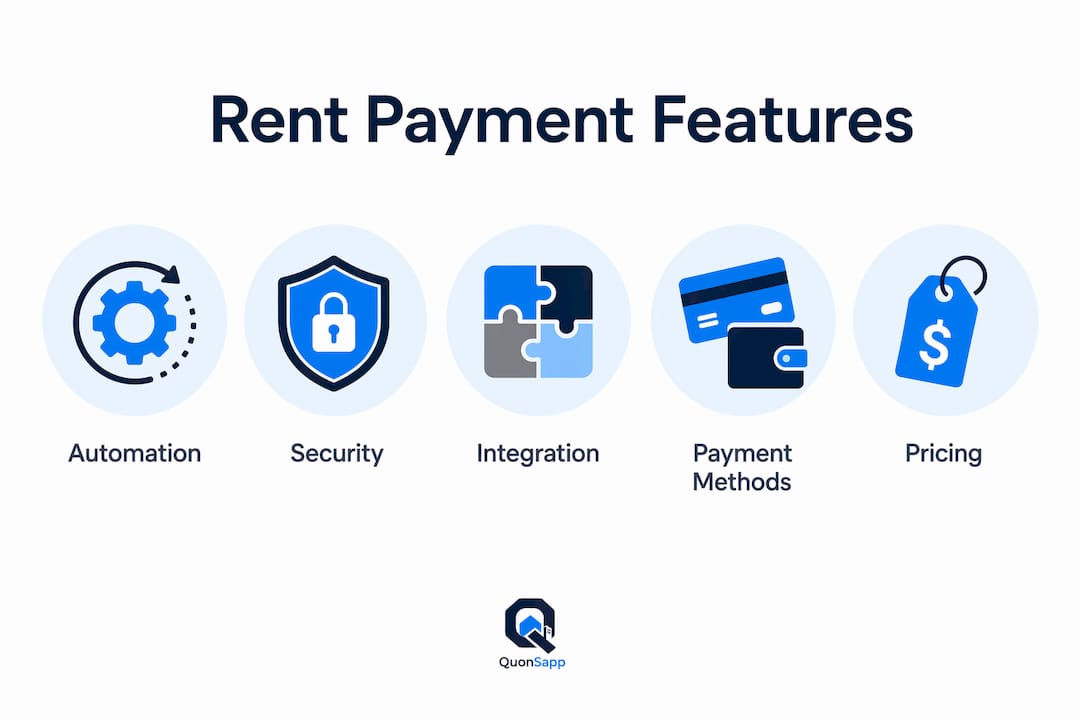
The strongest online rent payment platforms combine automation, security, and integration rather than offering payment collection alone.
| Point | Details |
|---|---|
| Tenants pay on time more often digitally | Tenants are 62% more likely to pay on time with digital payments versus checks or cash. |
| Dedicated platforms outperform generic apps | Venmo, PayPal, and CashApp lack late fee enforcement, partial payment controls, and 1099-K reporting. |
| Security baseline matters | SOC2 compliance and Stripe or Plaid integration are the minimum standard for protecting tenant financial data. |
| Total cost of ownership beats sticker price | Factor transaction fees multiplied by payment volume, not just the monthly subscription, before choosing a platform. |
| QuonSapp fits multi-property and HOA operations | QuonSapp combines Stripe-powered rent and HOA dues collection with lease tracking, work orders, and GPS staff management in one platform. |
The future of rent payments is already here, and most landlords are behind it
The conventional wisdom in property management circles is that rent collection is a solved problem. Pick any app, send a link, get paid. That framing misses what is actually happening in the market right now.
The platforms pulling ahead in 2026 are not winning on payment processing alone. They are winning because they connect rent collection to the rest of the operational picture: maintenance workflows, lease renewals, compliance documentation, and staff management. A landlord who collects rent through Innago but tracks work orders in a spreadsheet and manages leases in a separate tool is still running three disconnected systems. The friction is just less visible.
The credit-reporting angle deserves more attention than it gets. Platforms like RentRedi, TurboTenant, and Zillow Rental Manager now report on-time rent payments to credit bureaus. That gives tenants a genuine incentive to pay on time and pay in full, beyond the threat of a late fee. Landlords who offer this feature tend to see better payment behavior without any enforcement action on their part.
Mobile wallets are the next adoption curve. Apple Pay and Google Wallet support through Stripe is still a differentiator today, but it will be table stakes within two years. Platforms that have not built that integration yet are already behind the tenant expectation curve in urban markets.
The security picture is also tightening. Regulatory pressure on payment platforms is increasing, and SOC2 compliance is moving from a nice-to-have to a baseline expectation for any platform handling financial data at scale. Landlords who chose a platform based on price alone and skipped the security audit will face that reckoning sooner than they expect.
What QuonSapp represents is the direction the whole category is moving: payment collection as one function inside a broader operational system, not a standalone app. The landlords who will manage portfolios most efficiently in the next five years are the ones building integrated workflows now, not patching together separate tools for each function.
QuonSapp brings rent collection and property management together
Running a property portfolio means juggling payments, maintenance, compliance, and staff, often across multiple properties at once. Most rent collection apps solve one piece of that. QuonSapp solves the whole thing.

With QuonSapp, rent and HOA dues flow directly into your Stripe account with a flat $1.00 per-transaction fee, no intermediary delays, and full invoice history per resident. Lease tracking, work order management, GPS staff clock-in, amenity booking, and a complete audit log all live in the same platform. Subscription pricing scales with your portfolio size, with no per-seat fees for staff or resident accounts, so adding team members does not change your bill.
If you manage multiple properties, an HOA community, or a team of on-site staff, QuonSapp's property management platform gives you the operational control that standalone payment apps simply cannot match. Visit quonsapp.com to explore plans and get started.