
What are the biggest property management trends shaping 2026?
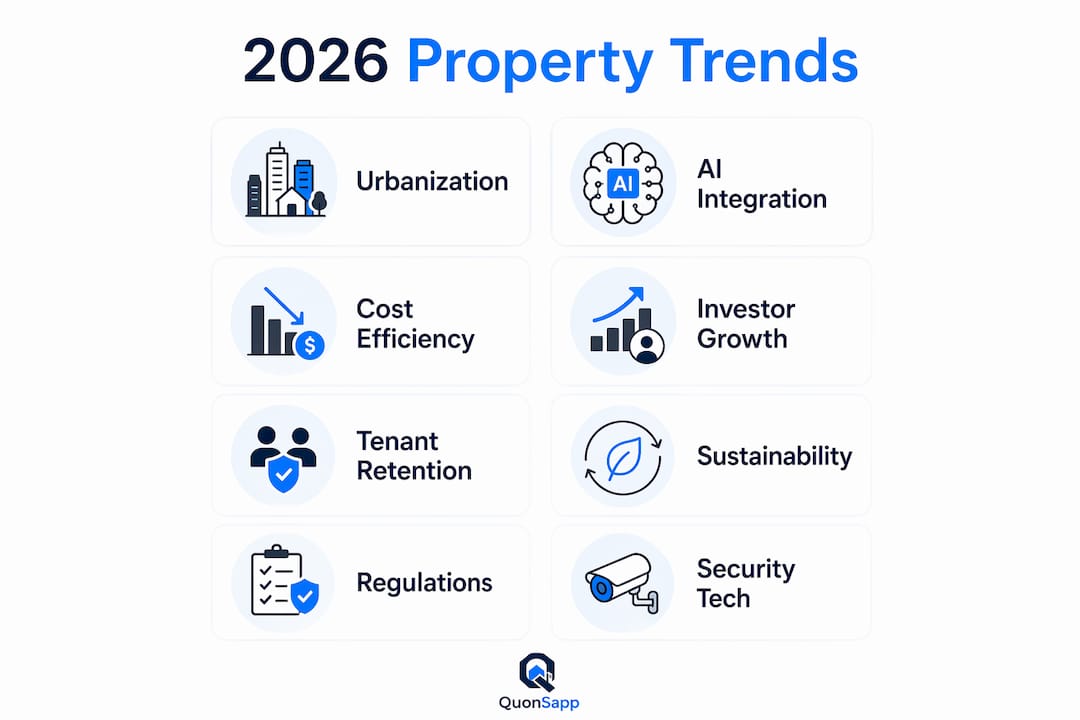
The defining shift in 2026 is this: property management has moved from reactive operations to proactive, technology-driven portfolio strategy. The U.S. property management industry reached $139.9 billion in revenue this year, and the firms pulling ahead are not just adopting new tools. They are rethinking how they deliver value to residents, investors, and their own teams.
Here is what is driving the industry right now:
- AI and automation are active across leasing, screening, maintenance triage, and resident communication, compressing response times and reducing staff burnout.
- Resident experience platforms now consolidate the entire tenant lifecycle, from application to move-out, replacing fragmented tool stacks.
- Rising operational costs, led by insurance premiums climbing over 10% in two years, are forcing smarter portfolio decisions and vendor consolidation.
- Ancillary revenue has evolved from a side project into a core business model, with per-door benefit packages generating diversified income.
- Investor demand for professionalization is pushing firms toward measurable ROI, compliance automation, and data-driven reporting.
The firms winning in 2026 treat these priorities as connected, not as separate line items.
1. How urbanization and demographics are reshaping rental demand
Millennials and Gen Z now make up the largest share of the renter pool, and their expectations are reshaping what professionally managed properties must offer. Urbanization and demographic shifts are driving higher demand for managed properties in metropolitan centers, while workforce mobility is making flexible lease terms a practical necessity rather than a perk.
What this means for your portfolio strategy:
- Metro concentration rewards managers who specialize in high-density markets where demand for professionally managed units outpaces supply.
- Flexible leasing is no longer a niche offering. Mobile workers, remote employees, and young professionals expect month-to-month or short-term options alongside traditional 12-month leases.
- Diverse tenant demographics require specialized service models. A single-family rental portfolio in a suburban market has different retention drivers than a multifamily building near a university.
- Supply growth in many metros is intensifying competition, making retention efforts as important as new leasing.
Pro Tip: Track your portfolio's demographic mix annually. Knowing whether your residents skew toward early-career renters or established households tells you which amenities and lease structures will drive the highest renewal rates.
2. How AI and technology are transforming daily operations
AI in property management has moved well past the chatbot stage. AI leasing assistants now handle real-time inquiry responses across SMS, email, and web chat, qualifying leads and scheduling showings without a human in the loop. A prospect who inquires at 9 PM on a Tuesday gets a response immediately, not the next morning after they have already toured a competing property.

The maintenance side is equally compelling. Automated preventative maintenance programs reduce HVAC-related work orders by up to 50%, according to a National Rental Home Council study. The logic is simple: when air filters arrive at residents' doors on a schedule with installation instructions, residents actually change them, and the HVAC system runs as designed.
At the commercial scale, Noda's agentic AI platform claims to have eliminated 80% of manual workflows and cut average issue resolution time by 40% across its deployed portfolio. Kate Henningsen, CEO of Noda, put it plainly: "Every building in a portfolio is leaving net operating income on the table right now, because no team has the capacity to find and fix operational waste at the speed and scale the problem demands."
Beyond off-the-shelf platforms, a growing number of property managers are building their own internal workflow tools using platforms like Cursor and Replit. These custom tools fill the gaps that standard property management software does not prioritize, such as lease-renewal triage workflows that flag at-risk renewals based on payment history and work order patterns. You no longer need to be a developer to ship working software. You need to be able to describe the problem clearly.
You can explore how cloud-based property management software is evolving to support these capabilities across portfolio sizes.
3. How rising operational costs are forcing smarter decisions
Every major cost line in property management has climbed over the past two years, and the pressure is not easing. 39% of property managers now rank rising insurance costs as a top operational threat heading into 2026, up from 29% the year before. Insurance sits alongside occupancy concerns as the industry's two biggest financial pressures.
The strategic responses taking hold across the industry:
- Vendor consolidation reduces admin overhead and locks in better pricing. Bundled service models replace relationships with dozens of individual providers.
- Portfolio stress testing before adding doors, factoring in insurance exposure, maintenance costs, and local regulatory risk.
- Ancillary income adoption to offset fee compression. Per-door benefit packages are now a portfolio strategy, not a side product.
- Technology investment to improve efficiency and reduce the labor costs tied to manual processes.
Over 70% of property management professionals reported increased fraud attempts and data security challenges in the past year, adding compliance costs to an already pressured expense structure. Firms that automate identity verification and insurance tracking are absorbing these challenges without adding headcount.
For managers dealing with cost pressure across affordable portfolios, affordable housing property management software options have expanded considerably in 2026.

4. Why investor demand is accelerating industry professionalization
The U.S. property management industry has a significant revenue base attracting capital that comes with expectations. Investors want asset protection, operational transparency, and measurable ROI, and they are increasingly choosing property managers who can demonstrate all three through technology and data.
- Compliance systems are now a baseline requirement, not a differentiator. Investors expect automated tracking of insurance, lease compliance, and regulatory requirements.
- Data analytics for decision-making have moved from nice-to-have to table stakes. Portfolio dashboards showing occupancy rates, maintenance metrics, and dues collection in real time are what sophisticated investors expect to see.
- Professional credentialing and industry benchmarks matter more as the market professionalizes. Firms that can show performance against industry standards attract better clients.
- Portfolio stress testing is becoming standard practice before taking on new properties, reflecting a shift from growth-at-any-cost to profitable, manageable expansion.
77% of property managers expect their portfolio unit count to increase in 2026. Among AI users specifically, that growth expectation rises to 29% portfolio growth on average, compared to 12% for non-users. The correlation between technology adoption and growth confidence is hard to ignore.
5. How flexible leasing and tenant engagement platforms drive retention
Tenant retention has become the most direct path to protecting revenue in a market where vacancy rates are rising and new construction is flooding supply in many metros. 71% of renters consider resident benefits important when choosing a rental, which means the lease itself is no longer the only retention lever.
The shift toward flexible leasing and digital engagement is showing up across the industry:
- Flexible lease terms accommodate remote workers, seasonal residents, and young professionals who cannot commit to rigid 12-month agreements.
- Digital resident onboarding replaces manual paperwork with guided digital flows covering lease terms, benefit selection, and move-in tasks in a single sequence. Integrated onboarding platforms improve lease understanding and increase tenant satisfaction.
- Resident portals for payments, maintenance requests, and community announcements give tenants self-service access that reduces inbound calls and improves satisfaction scores.
- Tenant benefit packages bundled with leases, covering services like credit building, identity protection, renters insurance, and air filter delivery, address multiple resident needs at once.
Ancillary income programs built around these packages have shifted to success-based pricing models, meaning the platform earns when the property manager earns. That structural change is what is pushing adoption past the early adopter curve. For a deeper look at generating revenue beyond management fees, the ancillary income guide from Postal Solutions covers the 2026 landscape in detail.
Pro Tip: Resident portals that surface overdue invoices prominently, like QuonSapp's built-in overdue alerts, reduce the time your team spends chasing payments and give residents a clear view of their balance at any moment.
6. Why sustainability and green building initiatives are gaining traction
Green building is no longer a premium differentiator. It is becoming a baseline expectation from both residents and institutional investors. Energy efficiency, reduced utility costs, and environmental certifications like LEED and ENERGY STAR are showing up in leasing conversations and investor due diligence alike.
For property managers, the practical entry points are operational rather than structural. Preventative HVAC maintenance, the same programs that cut work orders by up to 50%, also reduce energy consumption directly. The EPA reports an additional 10% reduction in energy bills when air filters are changed on schedule, value that residents feel in their monthly utility costs. Water conservation programs, LED lighting upgrades, and smart thermostat installations represent low-capital improvements that improve asset value and appeal to environmentally conscious renters.
Investors increasingly factor sustainability metrics into asset valuations. Properties with documented energy performance data and green certifications tend to command better financing terms and attract higher-quality tenants.
7. How regulatory changes and compliance trends are reshaping operations
Regulatory complexity is increasing across virtually every U.S. market. Rent control measures, state-level insurance mandates, fair housing updates, and new data privacy requirements are adding compliance layers that manual processes cannot reliably track. The firms handling this well are investing in systems that automate compliance tracking rather than relying on spreadsheets and calendar reminders.
Three areas seeing the most change right now:
Renters insurance compliance has moved from a lease requirement to a tracked, automated process. Verifying coverage across hundreds of units manually is not practical. Programs that automatically verify and maintain coverage records are replacing the manual chase-and-check cycle.
Rent reporting and credit building are now required or incentivized in several states. Offering credit building through rent payments has also become a genuine retention tool. Residents who see their credit scores improve are more likely to renew and more likely to pay on time.
Data security and fraud prevention are now compliance priorities, not just IT concerns. With over 70% of property management professionals reporting increased fraud attempts, identity verification and application fraud detection have moved into the core compliance stack.
8. What security technology advancements mean for your portfolio
Security technology in property management has expanded well beyond door locks and cameras. The threat landscape now includes digital fraud, identity theft, and application manipulation alongside traditional physical security concerns.
On the physical side, smart access control systems, video intercom platforms, and package management solutions have become standard in competitive multifamily properties. Residents expect keyless entry, video-verified visitor access, and real-time package notifications. Tools like QuonSapp's package tracking and visitor pass features address this directly, logging carrier information, notifying residents, and creating a documented chain of custody for every delivery.
On the digital side, the priorities are identity verification at application, payment fraud prevention, and data security across resident records. With fraud attempts rising sharply, screening tools that verify documents rather than just the data inside them are closing a gap that costs portfolios real money. Automated audit logs, role-based access controls, and encrypted resident data storage are now baseline expectations from both residents and investors.
Maintenance tracking software that documents before-and-after photos and timestamps every work order also serves a security function, creating a defensible record for insurance claims and liability disputes.
QuonSapp brings together resident management, lease tracking, online payments via Stripe, maintenance work orders, HOA tools, staff scheduling, and security features like package tracking and visitor passes into one platform built for property managers who run properties every day.

Explore QuonSapp and see how it fits your portfolio.
Key Takeaways
The most important shift in 2026 property management is that technology, resident experience, and revenue diversification are no longer separate priorities. They are the same strategy.
| Point | Details |
|---|---|
| AI drives measurable gains | Automated maintenance programs cut HVAC work orders by up to 50%; agentic AI platforms report 80% reduction in manual workflows. |
| Insurance costs are the top threat | 39% of property managers rank rising insurance premiums as a top operational threat heading into 2026. |
| Resident benefits influence leasing | 71% of renters consider resident benefits important when choosing a rental, making benefit packages a direct retention tool. |
| AI users expect faster growth | Property managers using AI expect portfolio growth of 29% on average, compared to 12% for non-users. |
| Compliance automation is now required | Over 70% of property management professionals reported increased fraud attempts, making automated identity verification and security tracking a baseline operational need. |