
What is the best way for landlords to collect rent?
The best way to collect rent as a landlord in the US is through purpose-built property management software that processes ACH payments with tenant self-enrolled autopay and automated reminders. This approach keeps fees low, creates a defensible payment ledger, and removes the manual follow-up that drains your time every month.
Here is why this method outperforms every alternative:
- ACH via landlord platforms is the most cost-effective and reliable method. Many platforms process ACH free or for a small flat fee, making it far cheaper than card processing.
- Tenant self-enrolled autopay is the single biggest driver of on-time payments. When tenants set up recurring payments themselves through a resident portal, you remove the friction that causes late rent.
- Automated reminders sent before the due date catch forgetful tenants before the problem starts, not after.
- Automated late fees enforce your lease terms consistently, without an awkward conversation every month.
- Integrated ledgers give you timestamped, exportable payment records that hold up in disputes or eviction proceedings.
- Credit and debit cards carry roughly 3% transaction fees and introduce chargeback risk. Reserve them for tenants who genuinely lack a bank account.
- Peer-to-peer apps like Venmo, Zelle, or Cash App are convenient but lack defensible rent ledgers and do not support partial payment controls or automated late fees.
- Cash and checks require manual processing, create reconciliation errors, and offer no automation whatsoever.
- Your lease agreement must explicitly name accepted payment methods and due dates. Some states, including California under Civil Code Section 1947.3, require landlords to offer at least one non-electronic payment option.
Table of Contents
- What rent collection methods do landlords commonly use?
- What are the pros and cons of each rent collection method?
- How do you get tenants to pay rent on time?
- How does property management software improve rent collection?
- Why does reliable rent collection matter so much?
- What legal considerations apply to rent collection?
- How should you handle late payments and rent defaults?
- How do you protect both parties during rent transactions?
- QuonSapp makes rent collection simpler for every portfolio size
- Key Takeaways
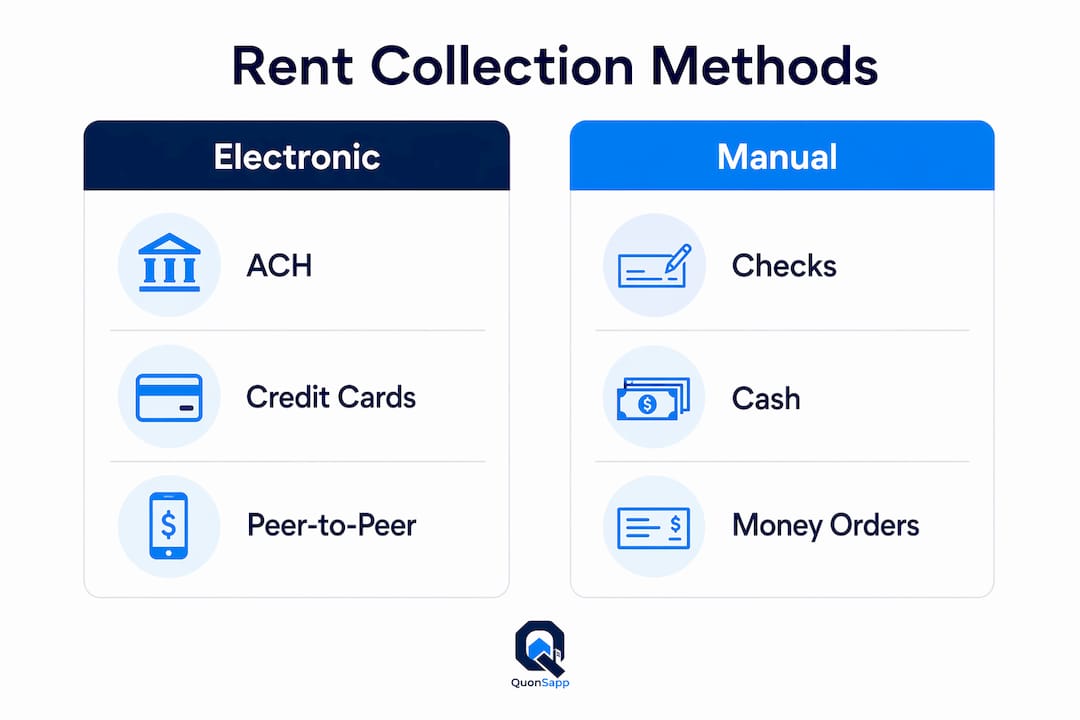
What rent collection methods do landlords commonly use?
Landlords in the US use a wider range of payment methods than most people expect, and each one comes with a different risk profile.
- ACH transfers via landlord platforms. Tenants pay through a resident portal; funds move electronically from their bank account to yours. This is the industry standard for online rent collection.
- Direct bank ACH without software. Some landlords set up ACH transfers directly through their bank. It works, but you lose the integrated invoicing, reminders, and ledger that a platform provides.
- Credit and debit card payments. Convenient for tenants, but the roughly 3% processing fee adds up fast on a $1,500 monthly rent.
- Peer-to-peer apps. Zelle, Venmo, PayPal, and Cash App are popular because they are familiar. The problem is that they were not built for landlord-tenant transactions.
- Cash, checks, and money orders. Still used, especially with older tenants or in markets with lower digital adoption. Each requires manual handling and creates reconciliation risk.
- Property managers or third-party collection services. Some landlords delegate collection entirely. This adds cost but can make sense for larger portfolios or out-of-state owners.
Pro Tip: Even if you prefer ACH, keep one non-electronic option available. Several states mandate it by law, and having it documented in your lease protects you from compliance disputes.
What are the pros and cons of each rent collection method?
ACH via landlord software
ACH is cheap, recurring, and ties directly into your payment ledger. The tradeoff is clearing time: ACH payments typically take a few business days and can be returned for insufficient funds, just like a check. You need a return-handling procedure in your lease. For most landlords, that is a minor inconvenience compared to the automation benefits.
Direct bank ACH
Lower cost than cards, but you are doing the reconciliation manually. No automated reminders, no tenant portal, no late fee enforcement. Fine for a single-unit landlord; increasingly painful as your portfolio grows.

Credit and debit cards
Tenants love the convenience. You will not. The roughly 3% fee on a $1,800 rent payment is $54 per transaction, and chargebacks are a real risk if a tenant disputes a charge. Use cards as a fallback, not a primary method.
Peer-to-peer apps
Fast and free for casual transfers, but they create serious problems for landlords. Venmo and Zelle cannot generate a defensible rent ledger, which makes eviction proceedings harder. These platforms also risk account suspension when used for commercial purposes, and they offer no partial payment controls or automated late fee enforcement.
Cash, checks, and money orders
The oldest methods carry the most risk. Cash leaves no paper trail unless you issue a written receipt every time. Checks bounce. Money orders require trips to the bank. Manual reconciliation across multiple units becomes a genuine burden as your portfolio scales.
Pro Tip: If a tenant insists on paying by check, require certified checks or money orders only. Personal checks introduce unnecessary return risk and delay your cash flow by days.
How do you get tenants to pay rent on time?
Consistent on-time payments come from removing friction and enforcing consequences automatically. Here is what actually works:
- Require autopay enrollment at lease signing. Make self-enrollment in the resident portal a condition of the lease. Tenants who set up recurring payments are far less likely to miss a due date.
- Send automated pre-due reminders. A reminder three to five days before the due date catches tenants who would otherwise forget. Most landlord platforms handle this without any manual effort.
- Define due dates, grace periods, and late fees in the lease. Ambiguity invites disputes. Spell out the exact due date, any grace period, and the late fee amount. Then enforce it automatically.
- Automate late fee enforcement. Manual late fee collection is awkward and inconsistent. Software that applies fees automatically on the day they are due removes the personal dynamic and keeps enforcement uniform.
- Offer credit bureau reporting as an incentive. Landlord platforms that report on-time payments to major credit bureaus give tenants a real financial reason to pay on time. It costs you nothing and motivates the tenants who care about their credit.
- Control partial payments strategically. Allow partial payments when a tenant is catching up on a balance. Block them during active eviction proceedings so partial acceptance does not reset your legal timeline.
- Communicate your payment policy before move-in. Walk new tenants through the portal, the due date, and the late fee policy on day one. Tenants who understand the system from the start are less likely to test it.
How does property management software improve rent collection?
Managing rent collection manually works when you have one or two units. As your portfolio grows, the complexity multiplies fast. Software solves this by centralizing every step of the collection process in one place.
A purpose-built platform like QuonSapp gives you a single dashboard across all your properties. You create invoices for rent, HOA dues, special assessments, and fees per resident. Tenants pay directly through the portal using a credit or debit card, with funds going straight to your connected Stripe account. Every transaction is timestamped and logged in a full payment ledger, so you always have a clear record for disputes or tax reporting.
The automation layer is where the real efficiency gains show up:
- Overdue invoices are highlighted automatically in the tenant portal, so residents see what they owe without you sending a manual reminder.
- Payment analytics let you track on-time rates, overdue balances, and collection trends across your entire portfolio at a glance.
- QuonSapp's configurable fee passthrough means the $1.00 flat platform fee per transaction can be passed to the tenant at checkout or absorbed from your payout. You choose.
- Exportable ledgers and an audit log give you a complete activity trail for every payment, every time.
Pro Tip: Never handle tenant banking credentials yourself. Require tenants to self-enroll in autopay through the resident portal. This protects you from liability and keeps sensitive data out of your hands.
For landlords managing multiple properties, the property management software you choose determines how much time you spend on administration versus actually growing your portfolio. Integrated workflows for lease tracking, maintenance, and payments in one platform eliminate the data entry that manual methods require.
Why does reliable rent collection matter so much?
Rent is your operating income. When it arrives late, inconsistently, or not at all, the downstream effects hit fast. Mortgage payments, insurance, maintenance reserves, and property taxes do not wait for a tenant who forgot to pay.
Beyond cash flow, inconsistent collection creates legal exposure. If you apply late fees unevenly or accept partial payments without a clear policy, you weaken your position in an eviction proceeding. Courts look at the payment history, and a messy ledger with inconsistent enforcement tells a story you do not want told. A clean, automated system protects you on both fronts.
What legal considerations apply to rent collection?
Rent collection in the US is governed by a patchwork of state and local laws, and the rules vary more than most landlords realize.
Several states have specific requirements about how and when rent can be collected. New York's Real Property Law Section 235-e requires landlords to provide written receipts for cash payments. Washington State's RCW 59.18.063 sets specific rules around how landlords must handle rent payments. California's Civil Code Section 1947.3 requires that landlords accept at least one form of payment that does not require a tenant to have a bank account.
Texas landlords should review Property Code Chapter 92 for rules on security deposits and payment handling. Colorado landlords can reference Title 38 for landlord-tenant obligations.
The practical takeaway: always specify accepted payment methods in your lease, verify your state's requirements before going fully electronic, and keep written records of every transaction. A lease tracking system that stores your lease documents and payment history in one place makes compliance documentation far easier.
How should you handle late payments and rent defaults?
Late payments need a consistent, documented response. The moment a payment is missed, the clock starts on your legal options, and how you respond in the first few days shapes what happens next.
Send a written notice the day after the grace period expires. Most states require a formal pay-or-quit notice before you can begin eviction proceedings, and the notice period varies by state, typically three to five days. Document every communication. If you use a platform with a built-in messaging system, those records are automatically timestamped.
For tenants who are temporarily behind, a written payment plan with specific dates and amounts can be a practical alternative to eviction. Put it in writing, have both parties sign it, and track every payment against the plan. If the tenant defaults on the plan, your documentation is already in order.
Accepting partial payments during an active eviction is risky. In many states, accepting any payment can reset the eviction timeline. Know your state's rules before you accept anything once you have filed.
How do you protect both parties during rent transactions?
Security in rent collection goes beyond choosing a reputable platform. It is about building habits that protect tenant data and your financial accounts at every step.
Use a platform that processes payments through a PCI-compliant payment processor. Stripe, for example, handles the payment infrastructure for many landlord platforms and maintains high security standards for card and bank data. Never ask tenants to email or text their bank account numbers. Require self-enrollment through the portal so sensitive credentials never pass through your hands.
For your own accounts, use strong, unique passwords for your property management platform and enable two-factor authentication. Review your payment ledger regularly for any transactions that look unfamiliar. On the tenant side, always issue written receipts for cash payments and keep copies. If you use a digital platform, the transaction log serves as the receipt automatically.

Avoid collecting rent through personal bank accounts or personal payment apps. Mixing personal and business finances creates accounting headaches and can complicate your legal standing if a dispute arises. A dedicated business account connected to your management platform keeps everything clean and auditable. For landlords managing HOA communities, tools like HOA Letter AI can help you generate compliant payment notices and correspondence without starting from scratch each time.
QuonSapp makes rent collection simpler for every portfolio size
If you manage more than a handful of units, the manual approach to rent collection costs you more time than it saves in setup effort. QuonSapp is built for exactly this situation: an all-in-one property portfolio manager that handles online rent collection, invoicing, overdue alerts, and payment analytics from a single dashboard.

Tenants pay directly through the resident portal using any major credit or debit card. Funds go straight to your connected Stripe account with no intermediary and no holding period. The $1.00 flat platform fee per transaction is configurable: pass it to the tenant at checkout or absorb it from your payout. Every payment is logged with a timestamp and method record, giving you a clean ledger for every resident across every property you manage.
QuonSapp also covers lease tracking, maintenance work orders, HOA dues, violation management, staff scheduling, and more. It is the platform for landlords and property managers who want one system that actually covers the full job. Start managing your portfolio with QuonSapp and see how much simpler rent collection gets when everything is connected.
Key Takeaways
Purpose-built property management software using ACH payments with tenant-enrolled autopay and automated reminders is the most reliable and cost-effective way for US landlords to collect rent.
| Point | Details |
|---|---|
| ACH is the best payment method | Low fees, recurring capability, and integrated ledgers make ACH the standard for reliable rent collection. |
| Autopay plus reminders drives on-time payments | Requiring tenant self-enrollment in autopay at lease signing, combined with automated pre-due reminders, is the most effective way to reduce late payments. |
| Legal compliance varies by state | Some states require non-electronic payment options and written receipts; always verify local law and specify accepted methods in your lease. |
| Credit and debit cards carry about 3% fees and are best reserved for tenants without bank accounts due to transaction costs and chargeback risk. | |
| QuonSapp centralizes collection and tracking | QuonSapp processes card payments via Stripe with a $1.00 flat fee per transaction, a full payment ledger, overdue alerts, and analytics across all properties. |