
The strongest Buildium alternatives depend entirely on your portfolio vertical. For HOA boards and mixed-portfolio managers, QuonSapp delivers the most complete HOA-specific feature set available at this price point. For scaling multifamily, AppFolio leads. For small independent landlords, Baselane or TenantCloud keep costs low without sacrificing core functionality.
Here is the shortlist by vertical and standout strength:
- QuonSapp — HOA boards, building supervisors, and mixed-portfolio managers who need violation tracking, board voting, and Stripe direct payments
- AppFolio — Residential and multifamily portfolios of 200+ units that want AI-driven automation and a unified resident experience
- Yardi Breeze — Small-to-mid-sized teams managing a mix of residential and light commercial assets with CAM reconciliation needs
- DoorLoop — Growing residential portfolios that want clean accounting built in and a transparent pricing model
- Propertyware — Single-family managers who need deep workflow customization and an open API
- Rent Manager — Mixed portfolios requiring powerful reporting, CAM support, and advanced accounting
- Entrata — Multifamily and student housing operators running large, resident-experience-focused communities
- TenantCloud — Budget-conscious landlords who want core features without a high monthly minimum
- Avail — Independent landlords managing a handful of units who need listing, screening, and leasing tools at low per-unit cost
- Hemlane — Landlords who want a hybrid software-plus-service model for leasing and maintenance coordination
- RentRedi — First-time landlords and very small portfolios focused on rent collection and tenant communication
- Baselane — Investors and independent landlords who prioritize integrated banking, bookkeeping, and rent collection
Buildium starts at $62/month and gates listing syndication and several features behind that paid minimum, which pushes many small landlords and HOA managers toward alternatives that offer more targeted value.
Table of Contents
- How do the top Buildium alternatives compare at a glance?
- What does each Buildium alternative actually offer?
- How do you choose the right Buildium alternative for your portfolio?
- How do you switch from Buildium without losing data?
- Which alternative fits your portfolio vertical?
- Key Takeaways
- What actually matters when you advise a manager to switch
- QuonSapp fills the HOA and mixed-portfolio gap that Buildium leaves
- Sources and further reading
How do the top Buildium alternatives compare at a glance?
| Tool | Best For | Pricing Model | Core Features | Payments & Banking | Integrations | Mobile & Offline | Migration Difficulty | Trial / Free Tier |
|---|---|---|---|---|---|---|---|---|
| QuonSapp | HOA boards, mixed portfolios, building supervisors | Subscription, tiered by portfolio size | Accounting, leasing, tenant portal, maintenance, HOA tools, work orders | Stripe direct-to-manager, ACH, credit/debit, $1 flat fee | Screening, QuickBooks export, payroll (ADP, Paychex) | Native iOS/Android, offline-friendly, real-time sync | Low-to-moderate; CSV import, audit log | Free trial available |
| AppFolio | Scaling residential and multifamily (200+ units) | Per-unit/month, tiered | Accounting, leasing, AI workflows, resident portal, maintenance | Native ACH and card payments | Background checks, QuickBooks, bank sync | Strong mobile app | Moderate; dedicated onboarding | No free tier; demo available |
| Yardi Breeze | Small-to-mid mixed portfolios with commercial assets | Per-unit/month | Accounting, leasing, CAM reconciliation, maintenance | ACH and card | Screening, bank sync | Mobile app | Moderate | No free tier; trial demo |
| DoorLoop | Growing residential portfolios | Flat monthly tiers | Accounting, leasing, tenant portal, maintenance | ACH, card | Screening, QuickBooks, Zapier | Mobile app | Low-to-moderate | Free demo; no free tier |
| Propertyware | Single-family and small-portfolio customization | Per-unit/month | Accounting, leasing, custom workflows, maintenance | ACH, card | Open API, QuickBooks, screening | Mobile app | Moderate-to-high | Demo only |
| Rent Manager | Mixed portfolios, advanced reporting | Per-unit or flat | Accounting, leasing, CAM, reporting, maintenance | ACH, card | QuickBooks, bank sync, screening | Mobile app | High; complex setup | Demo only |
| Entrata | Multifamily and student housing | Custom enterprise pricing | Accounting, leasing, resident experience, maintenance | Native payments | CRM, screening, ERP integrations | Strong mobile | High; enterprise onboarding | Demo only |
| TenantCloud | Small landlords, budget-conscious managers | Free tier + paid plans | Leasing, basic accounting, maintenance, tenant portal | ACH, card | Screening, QuickBooks | Mobile app | Low | Free tier available |
| Avail | Independent landlords, very small portfolios | Free + per-unit paid tier | Listing, leasing, screening, basic accounting | ACH | Listing syndication, screening | Mobile-friendly web | Very low | Free tier available |
| Hemlane | Hands-off landlords needing leasing/maintenance support | Per-unit/month + service tiers | Leasing, maintenance coordination, tenant portal | ACH | Screening, listing syndication | Mobile app | Low | Free trial |
| RentRedi | First-time landlords, very small portfolios | Flat monthly or annual | Rent collection, tenant communication, basic maintenance | ACH, card | Screening, QuickBooks | Mobile app | Very low | Free trial |
| Baselane | Independent landlords prioritizing banking and bookkeeping | Free core + paid features | Banking, bookkeeping, rent collection, basic reporting | ACH, card, banking | Bank sync, QuickBooks | Mobile app | Very low | Free tier available |
Quick pricing snapshot:
- Independent landlords often find that banking-first platforms like Baselane and entry-tier tools like TenantCloud offer more value per dollar than Buildium for portfolios under 50 units.
- Small-portfolio tools including TenantCloud and Avail market free or low-cost core tiers aimed at landlords with under 50 units.
- Enterprise platforms like Entrata and AppFolio use custom or per-unit pricing that scales with portfolio size.
What does each Buildium alternative actually offer?
QuonSapp
QuonSapp is built specifically for the workflows that most property management platforms treat as afterthoughts: HOA violation tracking, fine management, board voting, ARC request approvals, and amenity booking. Every payment routes directly to your Stripe account with no intermediary holding period and a flat $1.00 platform fee per transaction. The offline-capable mobile app means your maintenance staff and front desk teams stay productive even in buildings with spotty connectivity.
Pros:
- Full HOA toolkit (violations, fines, board votes, ARC requests) in one platform
- Stripe direct-to-manager payments with configurable fee passthrough
- GPS clock-in/out, shift scheduling, and payroll export to ADP, Paychex, or QuickBooks
- Multi-company management with consolidated billing for portfolio networks
Cons:
- Newer platform; fewer third-party integrations than legacy enterprise tools
- Best fit is HOA and mixed-portfolio; pure large-scale multifamily managers may want AppFolio's AI automation depth
Migration effort: Low-to-moderate. CSV bulk import for residents and data, full audit log, and export tools reduce friction.

AppFolio
AppFolio positions itself as the automation-first choice for residential and multifamily portfolios, and its market materials back that up with AI-driven workflows for leasing, maintenance, and resident communication. It works best at scale, typically 200 or more units, where the per-unit cost becomes justifiable against the automation gains.
Pros:
- AI-powered leasing and maintenance automation
- Unified resident experience across the full leasing lifecycle
- Strong accounting and reporting for large portfolios
Cons:
- Per-unit pricing adds up quickly for smaller portfolios
- No free tier; onboarding requires a dedicated implementation process
Migration effort: Moderate. Dedicated onboarding support is available, but data mapping for large portfolios takes time.
Yardi Breeze
Yardi Breeze is the SMB-accessible entry point into the Yardi ecosystem, supporting CAM reconciliation and basic commercial features that most residential-only tools skip. Teams managing a mix of apartments and a few commercial units will find it covers both without forcing a jump to Yardi Voyager's enterprise complexity.
Pros:
- CAM reconciliation for mixed residential/commercial portfolios
- Familiar Yardi data model makes future upgrades to Voyager smoother
- Solid accounting and lease management
Cons:
- Per-unit pricing can feel expensive for very small portfolios
- Limited customization compared with Propertyware or Rent Manager
Migration effort: Moderate. Yardi's data structure requires careful field mapping from Buildium exports.
DoorLoop
DoorLoop's appeal is straightforward: clean interface, accounting built in from day one, and flat monthly pricing tiers that make budgeting predictable. It suits growing residential portfolios where the manager wants everything in one place without a steep learning curve.
Pros:
- Intuitive UI that reduces onboarding time for new staff
- Full accounting suite included, not an add-on
- Transparent flat-tier pricing
Cons:
- Less depth for commercial or HOA-specific workflows
- Fewer native integrations than AppFolio or Rent Manager
Migration effort: Low-to-moderate. Demo and onboarding support included.
Propertyware
Single-family portfolio managers who need to build custom workflows and connect to third-party tools via API will find Propertyware's open architecture genuinely useful. The customization depth is real, not just a marketing claim.
Pros:
- Open API for custom integrations
- Deep workflow customization for single-family operations
- Strong owner reporting tools
Cons:
- Interface feels dated compared with newer platforms
- Setup complexity is higher; plan for a longer onboarding period
Migration effort: Moderate-to-high. Custom field mapping and API configuration add time.
Rent Manager
Rent Manager handles mixed portfolios with a reporting and accounting depth that rivals platforms costing significantly more. CAM reconciliation, percentage rent, and multi-entity accounting are all native. It suits operators who have outgrown simpler tools but do not need full enterprise infrastructure.
Pros:
- Extensive reporting and accounting, including CAM
- Supports mixed residential and commercial in one system
- Strong long-term track record in the industry
Cons:
- Steeper learning curve; implementation takes longer
- Interface is functional but not modern
Migration effort: High. Complex accounting structures require careful data migration planning.
Entrata
Entrata is built for multifamily and student housing at scale, with resident experience tooling (self-service portals, digital leasing, community communication) as a core differentiator. Its enterprise feature set and custom pricing reflect that focus.
Pros:
- Best-in-class resident experience for large multifamily communities
- Integrated CRM, leasing, and maintenance in one platform
- Strong student housing workflow support
Cons:
- Custom pricing with no published rates; expect enterprise-level cost
- Overkill for portfolios under 100 units
Migration effort: High. Enterprise onboarding with dedicated implementation teams required.
TenantCloud
TenantCloud offers a free entry tier that covers listing creation, basic screening, and core bookkeeping, making it one of the few platforms where a landlord with a handful of units pays nothing to get started. Budget-friendly entry tiers like TenantCloud's are specifically aimed at landlords with under 50 units.
Pros:
- Free tier available with core features
- Unlimited units on some paid plans
- Simple enough for non-technical landlords
Cons:
- Reporting and accounting depth limited on lower tiers
- Less suitable for commercial or HOA workflows
Migration effort: Low. Simple data import; minimal configuration required.
Avail
Avail targets independent landlords who need listing syndication, tenant screening, and digital leasing without paying a monthly platform minimum. Its per-unit pricing model keeps costs proportional for very small portfolios.
Pros:
- Free tier with listing and screening tools
- Simple lease creation and e-signature
- Low per-unit cost for small portfolios
Cons:
- Limited accounting depth
- Not designed for portfolios beyond 20–30 units
Migration effort: Very low. Minimal data to migrate at this portfolio size.
Hemlane
Hemlane's hybrid model pairs software with on-the-ground leasing and maintenance coordination services, which makes it genuinely different from pure-software alternatives. Hemlane is frequently highlighted as a hybrid service option for landlords who want leasing and maintenance handled without hiring staff.
Pros:
- Combines software with real human coordination for leasing and maintenance
- Good fit for remote landlords who cannot manage locally
- Transparent per-unit service tiers
Cons:
- Service tiers add cost beyond basic software
- Less suitable for managers who want full control over every workflow
Migration effort: Low. Service onboarding handles much of the setup.
RentRedi
RentRedi keeps it simple: rent collection, tenant communication, and basic maintenance requests at a flat monthly price. First-time landlords and managers with two to ten units will find it covers the essentials without unnecessary complexity.
Pros:
- Affordable flat pricing
- Mobile-first design
- Easy setup for non-technical users
Cons:
- Limited reporting and accounting
- Not scalable beyond small portfolios
Migration effort: Very low.
Baselane
Baselane approaches property management from the banking side first. Integrated business banking accounts, automated bookkeeping, and rent collection in one platform make it the strongest choice for landlords who want their financial operations consolidated. Banking-first tools like Baselane address the specific need independent landlords have for low-cost money management alongside basic property operations.
Pros:
- Free integrated banking with automated bookkeeping
- Rent collection with ACH and card
- Clean financial reporting for tax time
Cons:
- Not a full property management platform; lacks maintenance, leasing depth, and HOA tools
- Best used as a financial layer alongside another tool for operational workflows
Migration effort: Very low.
Pro Tip: When evaluating any of these platforms, ask the vendor to show you a live data export during the demo. If they cannot export your tenant records, lease dates, and payment history in a standard CSV or Excel format within minutes, that is a red flag worth taking seriously before you sign.
How do you choose the right Buildium alternative for your portfolio?
The single most important filter is your portfolio vertical. Evaluating alternatives by vertical and weighting features accordingly is the approach that consistently produces the best fit, because residential managers, commercial operators, and HOA boards prioritize different capabilities entirely.
Decision checklist by portfolio type:
- Solo landlord (1–10 units): Prioritize free or low-cost entry tiers, banking integration, and simple screening. Avail, Baselane, or RentRedi fit here.
- Small portfolio (10–50 units): Look for built-in accounting, maintenance tracking, and transparent pricing. DoorLoop and TenantCloud are strong candidates.
- Multifamily manager (50–500+ units): Automation, resident portals, and per-unit pricing that scales matter most. AppFolio leads this segment.
- Commercial or mixed-use: CAM reconciliation, percentage rent, and two-way accounting integrations with QuickBooks Online, Xero, or NetSuite are non-negotiable. Yardi Breeze and Rent Manager cover this well.
- HOA or mixed portfolio: Violation tracking, fine management, board voting, ARC workflows, and amenity booking are must-haves that most platforms lack. QuonSapp is purpose-built for this.
Demo questions worth asking every vendor:
- Can you show me a live two-way sync with QuickBooks or Xero, not just a one-way export?
- How does your platform handle CAM reconciliation and percentage rent for commercial leases?
- Where do resident payments land, and how long before funds reach my bank account?
- Can I export all tenant records, lease dates, and payment history right now, in CSV?
- What does your onboarding timeline look like for a portfolio of my size?
Red flags to watch for:
- No exportable data or a vendor who delays showing you an export sample
- Single-threaded accounting that cannot handle multi-entity or multi-property reporting
- Limited or undocumented API with no integration roadmap
- Live support that routes to a ticket queue with multi-day response times
Pro Tip: Weight features against administrative overhead. Enterprise-class platforms can create significant admin burden for managers with fewer than 50 units — you may end up paying for functionality you will never use while spending more time on configuration than on managing properties.
How do you switch from Buildium without losing data?
Migration timelines vary by complexity: small portfolios can move in 4–6 weeks, medium deployments typically take 2–3 months, and complex enterprise migrations commonly run 3–9 months. Plan accordingly before you cancel your Buildium subscription.
-
Discovery and scope (Week 1–2). Audit your current Buildium data: number of properties, units, active leases, open work orders, vendor records, and stored documents. Define what must migrate versus what can be archived.
-
Data export from Buildium (Week 2–3). Export the following data sets from Buildium before you do anything else:
- Tenant and owner contact records
- Active and historical lease agreements with start/end dates
- Full payment history and ledger records
- Open and closed work orders
- Vendor directory and contract documents
- Bank account and trust accounting records
- Stored documents (leases, notices, inspection reports)
-
Data mapping and cleaning (Week 3–4). Map Buildium field names to your new platform's schema. Clean duplicate records, standardize date formats, and flag any records with missing required fields before import.
-
Test import (Week 4–5). Import a subset of data (one property, all its units and residents) into the new platform. Verify lease dates, balances, and contact details match the Buildium export exactly.
-
Parallel run (Month 2, or longer for complex portfolios). Run both systems simultaneously for at least one full billing cycle. Successful migrations prioritize planned parallel runs for at least one billing cycle to catch reconciliation issues before they become problems.
-
Full go-live. Migrate remaining properties, notify residents of the new portal, and redirect payment links. Confirm all open work orders transferred correctly.
-
Post-migration reconciliation (30 days after go-live). Reconcile opening balances in the new platform against your final Buildium statements. Verify that all payment records match and that no lease dates shifted during import.
Common friction points: Accounting balance discrepancies caused by trust account timing differences, lease date format mismatches between platforms, and work orders that were in a mid-status state at the time of export. Assign one person as the migration champion who owns data validation at each step.
Which alternative fits your portfolio vertical?
Commercial and mixed-use operators frequently need lease-first platforms with CAM reconciliation and advanced outgoings features that general residential tools typically lack. The table below maps each vertical to its must-have features and the alternatives that cover them.

| Portfolio Vertical | Must-Have Features | Best-Fit Alternatives | When to Add a Supplemental Tool |
|---|---|---|---|
| Residential (single-family) | Lease tracking, maintenance, owner reporting, screening | Propertyware, DoorLoop, RentRedi | Add a dedicated screening tool if applicant-paid screening is a priority |
| Residential (multifamily) | Bulk leasing, resident portal, AI automation, accounting | AppFolio, Entrata | Add a CRM if lead management is a gap |
| HOA / Community Association | Violation tracking, fine management, board voting, ARC requests, amenity booking, dues collection | QuonSapp | Most platforms require a supplemental HOA tool; QuonSapp covers this natively |
| Commercial / Mixed-Use | CAM reconciliation, percentage rent, two-way accounting sync, commercial lease management | Yardi Breeze, Rent Manager | Add Xero or QuickBooks with two-way sync if native accounting is limited |
| Mixed Portfolio (residential + HOA) | Multi-property dashboard, HOA workflows, maintenance, payments, mobile | QuonSapp | Payroll export to ADP or Paychex if staff scheduling is needed |
| Small / Independent Landlord | Low cost, banking, screening, basic bookkeeping | Baselane, Avail, TenantCloud, Hemlane | Add a standalone screening tool if the platform's native option is landlord-paid |
| Student Housing | Bulk leasing, roommate matching, high-turnover workflows, resident communication | Entrata | Add a dedicated communication tool for large student communities |
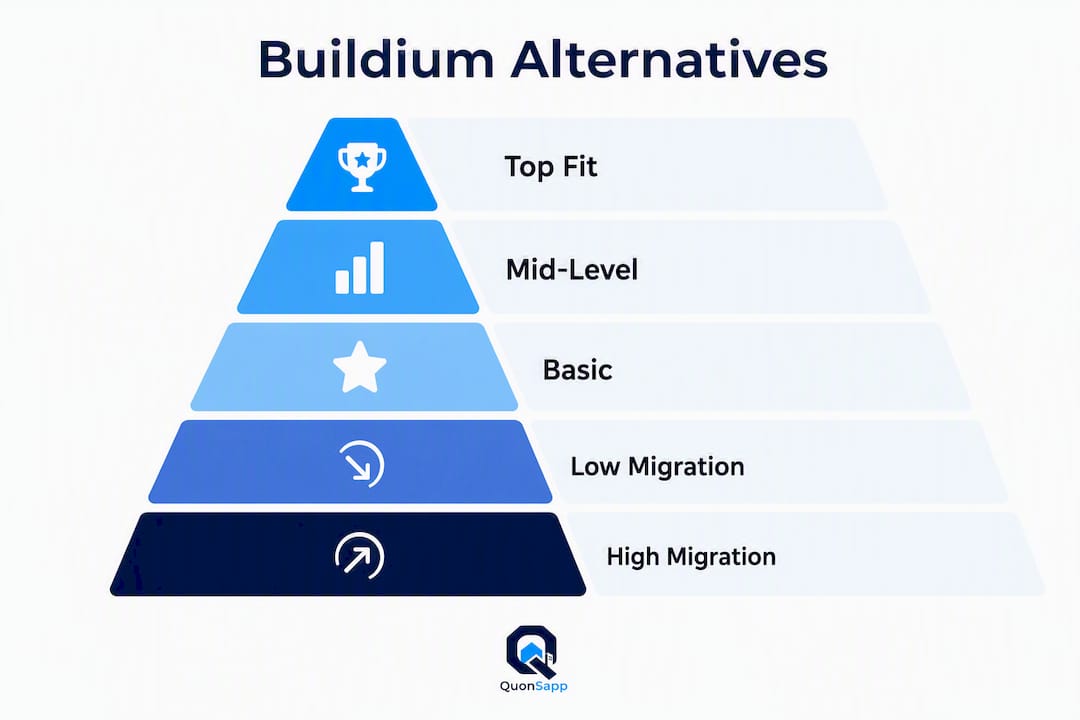
Practical notes on hybrid approaches: All-in-one platforms often lack depth for niche needs like HOA fine tracking or complex CAM reconciliation. Expect to supplement your core platform with a vertical-specific tool rather than searching for a single system that handles every edge case perfectly. The most common supplemental pairings are a dedicated accounting tool (QuickBooks or Xero) alongside a residential platform, or a standalone HOA management module alongside a general property management system. QuonSapp is one of the few platforms where HOA workflows are native rather than bolted on.
Key Takeaways
The strongest Buildium alternative is the one that matches your portfolio vertical first and your budget second. Choosing by feature count alone leads to paying for tools your team will never use.
| Point | Details |
|---|---|
| Match vertical before features | HOA managers need violation and board tools; commercial operators need CAM reconciliation; pick by vertical first. |
| Migration timeline by complexity | Migration timelines vary by complexity: small portfolios may move in a few weeks; medium deployments take a few months; complex enterprise migrations typically require longer periods. |
| Export data before you commit | Request a live data export during every vendor demo to confirm portability before signing. |
| Small portfolios avoid enterprise tools | Platforms built for 500+ units create admin overhead and cost for managers with fewer than 50 units. |
| QuonSapp for HOA and mixed portfolios | QuonSapp covers violations, fines, board voting, Stripe direct payments, and offline mobile in one platform. |
What actually matters when you advise a manager to switch
Most switching decisions I see go wrong in the same way: the manager evaluates platforms by feature count and picks the one with the longest list. Three months later, half those features are unused, the accounting is a mess because the migration was rushed, and the team is back to spreadsheets for the workflows the new platform does not actually support well.
The honest truth about this market is that no single platform is perfect for every vertical. AppFolio is genuinely excellent for large multifamily, but it is administratively heavy for a 20-unit HOA. Baselane is a smart financial layer for independent landlords, but it is not a replacement for a full property management system. The platforms that serve HOA managers well are a short list, and most of them require add-ons or workarounds to handle violations, board votes, and amenity booking natively.
What I tell managers: run both systems in parallel for one full billing cycle, no exceptions. The reconciliation errors that surface in that first month are almost always traceable to lease date mismatches or opening balance discrepancies that a rushed migration missed. Assign one person to own the migration, give them the time to do it properly, and do not cancel Buildium until the parallel run is clean.
The other thing worth saying plainly: pricing transparency matters more than the starting number. A platform that charges $62/month but gates listing syndication, screening, and key integrations behind higher tiers has a different effective cost than one where those features are included. Always ask for the all-in monthly cost at your portfolio size, not the advertised starting price.
QuonSapp fills the HOA and mixed-portfolio gap that Buildium leaves
Most property management platforms treat HOA workflows as an afterthought. Violation tracking, fine management, board voting, and ARC request approvals are either missing entirely or available only as paid add-ons. QuonSapp is built from the ground up for exactly these workflows, alongside the full operational stack that building supervisors and maintenance teams use every day.

Payments route directly to your Stripe account with a flat $1.00 fee per transaction and no intermediary holding period. The native iOS and Android apps work offline, so your staff stays productive in buildings with weak connectivity. Multi-company management with consolidated billing means portfolio networks can manage sub-organizations from a single parent dashboard. For HOA boards and mixed-portfolio managers who have been patching together Buildium with separate HOA tools, QuonSapp replaces that stack with one platform.
Start your free trial at QuonSapp and see how the HOA and mixed-portfolio workflows run in a live environment.
Sources and further reading
The following sources were used to verify claims, pricing signals, and migration guidance in this article. Check vendor pricing pages directly, as rates change, and always request a live data export sample during demos.
- Top 10 Buildium Alternatives & Competitors in 2026 — G2
- Top Buildium competitors for independent landlords — RentSpree
- Best Property Management Software 2026: Top 6 Companies Compared — AppFolio
- Vertical-focused guidance for property management software — Guideflow
- Buildium market share and competitor insights — 6sense
- Top 4 Best Property Management Software Alternatives 2026 — QuonSapp Blog
- Top 6 Buildium Review Alternatives 2026 — QuonSapp Blog
- Top 5 Accounting Software for Property Management Alternatives 2026 — QuonSapp Blog