
Managing rental properties across multiple platforms creates confusion and wastes time for property managers and HOA managers. Many property management software options limit billing flexibility, automation, or customization, leaving growing teams stuck with workarounds or high costs for advanced features. This list covers pricing, automation, integrations, and reporting so property managers and HOA managers can pick a platform that fits their operational growth without hidden limits.
Table of Contents
- QuonSapp
- DoorLoop
- AppFolio Property Management
- Entrata
- Rentvine
- Rent Manager
- Comparison of Alternatives
QuonSapp

At a Glance
The platform routes resident payments straight to the manager's Stripe account with a configurable $1.00 platform fee per transaction. The product combines resident billing, work orders, and a mobile-first field workflow for staff and vendors. Public pages were restricted during review, and some content appeared as a parked or landing page.
Core Features
QuonSapp consolidates multi property portfolio management with Resident Profiles, lease tracking, and online rental applications that include background and credit checks. The system handles billing with full payment ledgers, overdue alerts, partial payments, and Direct-to-Manager Payments into Stripe. Field teams get work order pipelines, photo documentation, GPS clock in and out, a native iOS and Android app, and a document library with audit logs.
Key Differentiator
The most distinctive capability is the payments flow that deposits tenant funds directly into the manager's Stripe account while offering a flat platform fee option. That direct routing removes a middleman and shortens the payment path. Coupled with Real-Time Sync powered by Convex, managers and field staff see the same updated billing and maintenance data instantly.
Pros
QuonSapp groups resident, maintenance, and HOA features in one place so managers keep tenant records, invoices, and violation tracking together. Mobile features target on the ground staff with GPS clocking, offline friendly core screens, and photo attachments on work orders that document before and after conditions. Organization level tools let a parent company link sub orgs, view consolidated stats, and manage billing across linked entities.
Cons
- Public access to the site was limited during review, and several pages appeared as a landing or parked domain, which prevents a full public evaluation.
Who It's For
Property managers, HOA managers, and building supervisors who run multiple properties and want tenant billing, maintenance, and staff scheduling in one system will find this relevant. It fits teams that require mobile field tools such as GPS clock in and offline access. Management companies that need consolidated reporting across linked sub orgs will also benefit.
Unique Value Proposition
Parent and sub org linking with consolidated network stats and per seat billing addresses multi company oversight and reporting needs. That feature lets a parent org monitor occupancy, labor costs, and dues collection across linked management companies without separate dashboards. The model reduces manual aggregation and keeps ownership boundaries clear through data ownership controls.
Real World Use Case
A regional manager collects HOA dues and special assessments via the tenant portal with payments landing directly in the manager's Stripe account. Maintenance requests arrive with photos, get assigned to on site staff, and show GPS verified clock ins during repairs. The parent company then reviews consolidated occupancy and collection metrics across its linked sub orgs for monthly reporting.
Website: https://quonsapp.com
DoorLoop
At a Glance
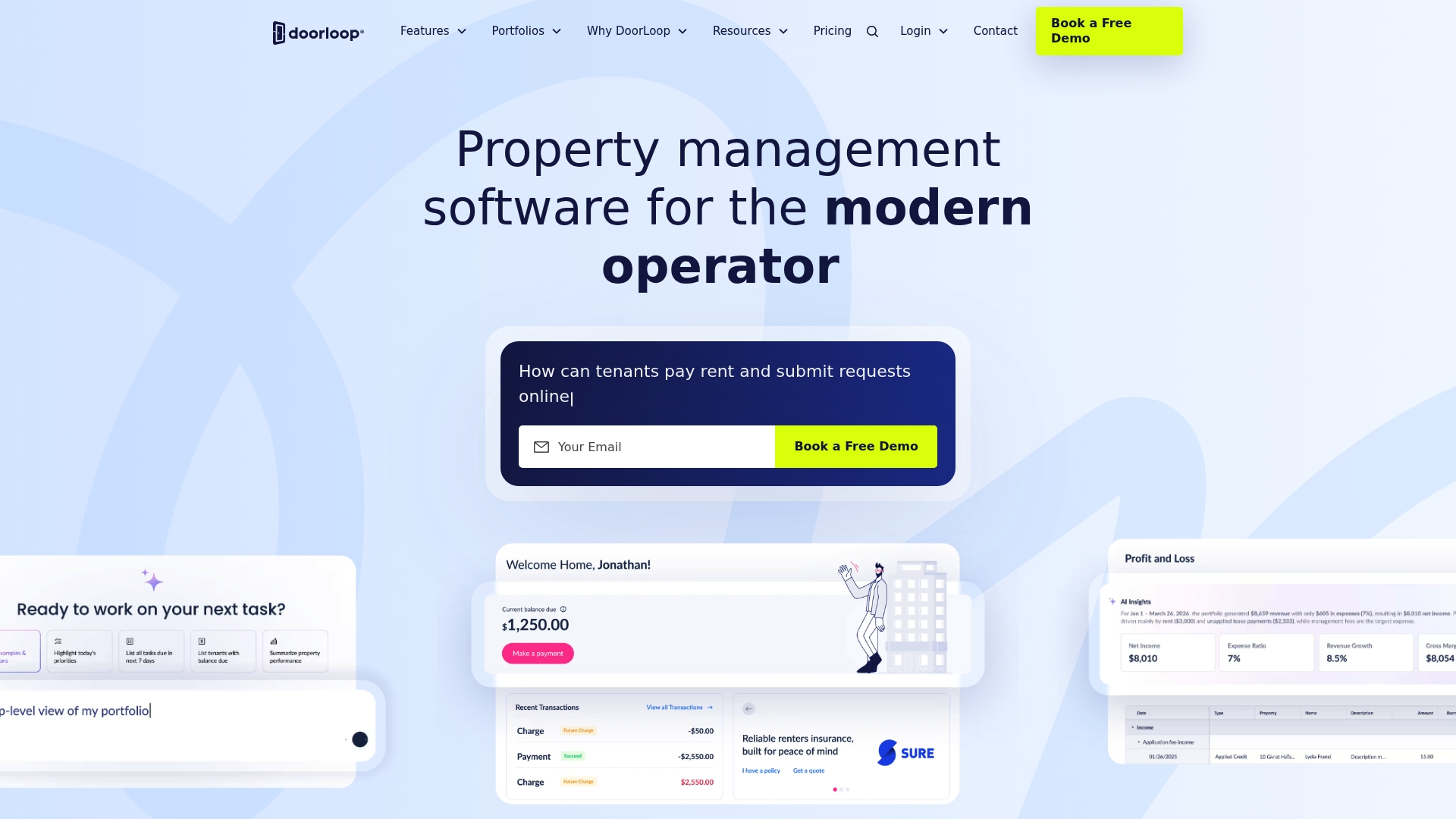
Starting at $69/month, DoorLoop scales pricing by unit count and add-ons. The product supports residential, commercial, HOA, and affordable housing portfolios. It also bundles inspections and an AI assistant to automate routine tasks.
Core Features
DoorLoop combines leasing, accounting, maintenance, tenant screening, and online rent collection in a single web and mobile experience. The platform offers owner portals, bank sync, real-time financial reporting, and a work order pipeline with photo documentation. Automation tools include an AI assistant, inspection workflows, and configurable process automation.
Key Differentiator
DoorLoop positions itself as a single platform for growth with embedded automation and AI that reduce repetitive admin work. Its strong multi-portfolio support for HOAs, commercial units, and affordable housing separates it from tools built only for small landlords. The product focuses on replacing multiple point tools with one unified system.
Pros
According to the company, DoorLoop is the industry's #1 highest-rated software based on user reviews and awards. That recognition comes alongside a reported high customer support score and onboarding resources. The interface is intuitive, tenant portals simplify payments and communications, and integrations reduce manual accounting work.
Cons
-
High monthly costs for specific advanced needs may be prohibitive for very small portfolios.
-
Customer support has been reported as unreliable by some users, which can complicate onboarding and troubleshooting.
-
Several users mention onboarding and staff training issues that slow early adoption.
When It May Not Fit
If you manage a handful of units on a tight budget, the per-month cost and add-on fees may not make sense. Teams that rely on guaranteed, high-touch support during rollout could find the reported variability in response quality frustrating. If low ACH fees for tenants are a hard requirement, DoorLoop may not meet that need.
Notable Integrations
DoorLoop integrates with QuickBooks for accounting sync and with Zapier for workflow connectivity. An API option supports custom integrations for reporting and third-party tools. These connections help reduce duplicate data entry between property management and financial systems.
Who It's For
Property managers, landlords, and investors running small to large portfolios who want a single platform for leasing, maintenance, and accounting. Managers who plan to scale across property types or consolidate multiple systems into one will gain the most value. Teams prepared for a structured onboarding process will get faster results.
Real World Use Case
A midsize management firm moved leasing, rent collection, maintenance, and accounting into DoorLoop. The firm eliminated several spreadsheets and a separate vendor portal. That consolidation reduced manual reconciliation and shortened vacancy turnaround time.
Pricing
DoorLoop starts at $69/month with plans that scale by unit count and required features. There is no free plan, but demo options are available to evaluate fit before committing.
Website: https://doorloop.com
AppFolio Property Management
At a Glance
AppFolio includes a built in agentic AI and workflow toolkit that targets repetitive property tasks. According to the company, a firm managing over 10,000 units uses AppFolio for unified tenant and owner communication. That example highlights its suitability for larger portfolios and for teams that need automation at scale.
Core Features
AppFolio bundles a unified login, resident owner and vendor portals, and a full accounting and reporting system that tracks revenue and expenses. The platform exposes workflow automation via Realm-X tools and supports messaging, maintenance, and leasing processes from the same console. These connected features reduce context switching for staff and centralize records across properties.
Key Differentiator
AppFolio sets itself apart with built in agentic AI that can take routine actions and suggest decisions across leasing and maintenance workflows. The automation can move a request through a status pipeline and surface analytics for overdue accounts. That emphasis on automated decision support suits teams that want to reduce manual handoffs.
Pros
AppFolio performs well for mid to large portfolios because it combines workflow automation with robust accounting and reporting. The Realm-X automation and analytics shorten repetitive tasks and provide actionable ledger detail for owners. Tenant facing tools centralize communication with a single login so staff spend less time chasing emails and attachments.
Cons
- Customer support can be hard to reach and issues sometimes take longer to resolve than expected. This slows critical fixes for on site staff.
- Billing and workflow customization options are limited, making unusual fee models difficult to implement. That rigidity can force process changes.
- Users report occasional technical regressions after updates, which can interrupt daily operations.
- Perceived rigidity in billing and process flexibility can frustrate teams with bespoke workflows.
When It May Not Fit
If your portfolio demands deep billing customization or highly tailored workflows, this product may create friction. Smaller teams that need hands on onboarding and rapid live support could find the vendor response model too slow. Organizations that prefer granular control over every invoice line might need a different tool.
Who It's For
Mid to large property management companies seeking a single system for accounting operations, tenant and owner communication, and automation. Teams managing diverse property types and scaling toward enterprise operations will get the most value. Smaller independent managers may find the platform more than they need.
Real World Use Case
A regional management firm uses AppFolio to consolidate maintenance, leasing, and owner reporting across thousands of units. The team routes maintenance through the status pipeline and uses analytics reports to reconcile owner statements. That setup cuts duplicate entries and keeps owner ledgers aligned with bank deposits.
Pricing
AppFolio uses flexible plans that scale with business size and property type, and pricing varies by feature set. Specific rates require a quote from the vendor and depend on portfolio size and chosen modules.
Website: https://appfolio.com
Entrata
At a Glance
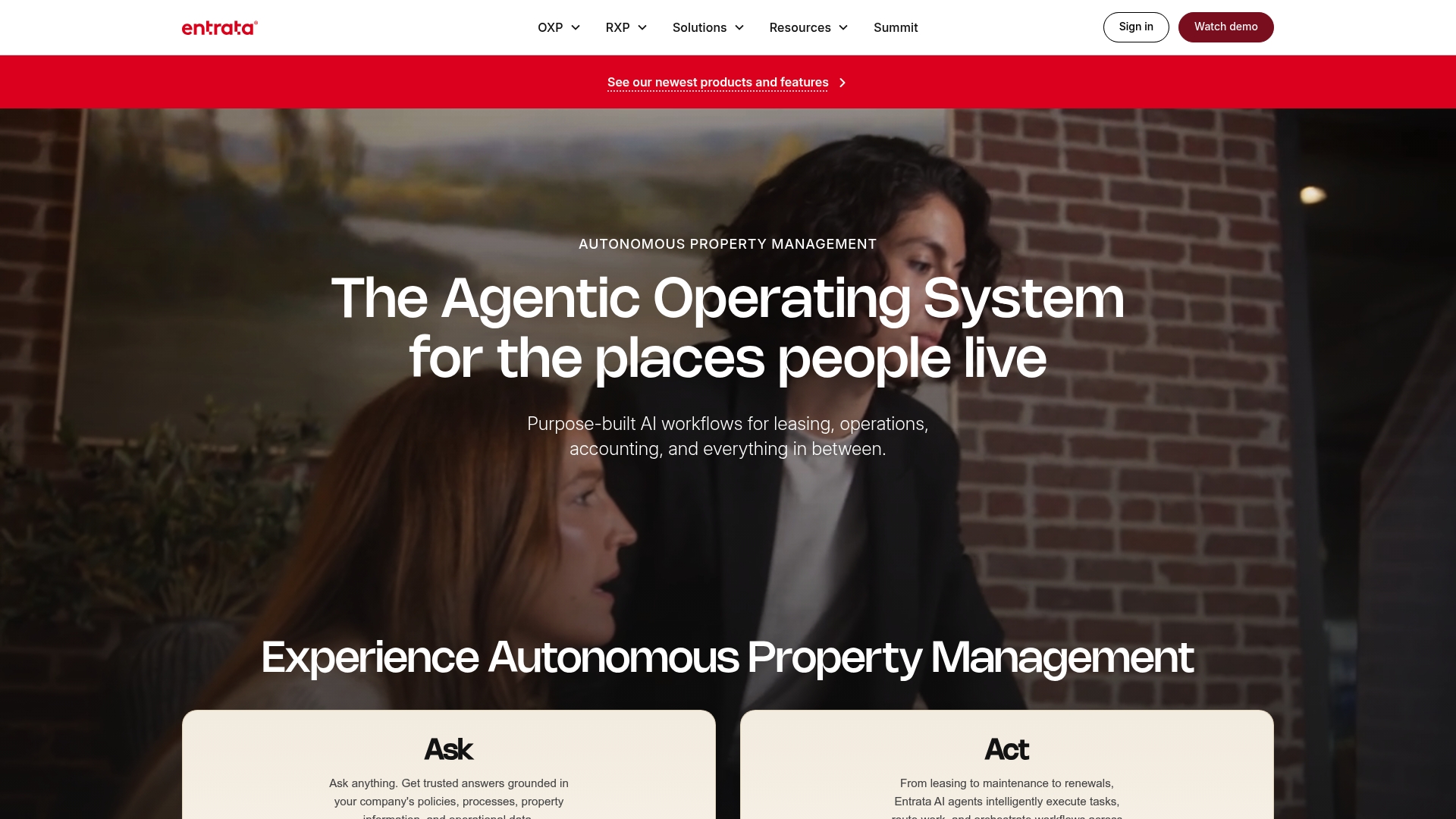
Entrata supports automation levels from assisted to fully autonomous, labeled Level 1–5, which lets teams move routine tasks to higher automation stages. The platform consolidates leasing, operations, accounting, resident services, and analytics into a single data layer. Enterprise customers use modular AI workflows to reduce manual steps for renewals and maintenance.
Core Features
Entrata combines CRM and ERP style workflows with property management functions so leasing, accounting, and operations share one dataset. AI-driven workflows cover leasing, maintenance, and renewals while a mobile-first resident portal handles payments, communications, and service requests. The platform also exposes a Marketplace and APIs for custom extensions.
Key Differentiator
Entrata uses a purpose-built ontology to keep property data consistent across modules and to give AI context for decisions. That data model plus staged automation lets managers move individual tasks from assisted to autonomous execution. The combination focuses on governed operations and auditability for larger portfolios.
Pros
Entrata delivers a single platform for portfolio scale, so teams avoid duplicate records and repeated reconciliations. Its lease lifecycle and renewal tools reduce administrative touchpoints and help preserve revenue. Dashboards expose occupancy, maintenance backlog, and financial metrics in daily ops views, and the system scales to support complex workflows and large datasets.
Cons
- Steep learning curve. New staff will need training to use advanced features and AI workflows effectively.
- Navigation friction. Some common tasks require multiple clicks, which slows routine workflows.
- Performance strain with large datasets. Users report lag when querying vast portfolios.
- Stability concerns. Some customers report occasional crashes and the need for recovery steps.
When It May Not Fit
Small portfolios and single-property landlords will find Entrata more complex than necessary. Teams that require a very simple, fast onboarding experience may prefer lighter systems. Organizations with limited IT support should plan for training and a longer ramp to full adoption.
Notable Integrations
Entrata offers a vendor Marketplace and an API layer to connect third-party systems and internal tools. The platform integrates with payments, identity verification, and accounting tools through those channels. Many customers link back-office systems and vendor compliance tools using the Marketplace or custom API work.
Who It's For
Mid-to-large property management organizations running multi site portfolios will gain the most from Entrata. Teams that need central control over leasing, maintenance, vendor compliance, and resident engagement will benefit. Organizations planning to adopt AI automation and governance at scale will find the feature set appropriate.
Real World Use Case
A regional management firm consolidates leasing, maintenance, and resident engagement into Entrata and automates lease renewals with AI. Maintenance requests route automatically to assigned technicians and vendors through the system. Managers track work order photo documentation and approval flows from a single dashboard, improving visibility across sites.
Pricing
Entrata does not publish standard pricing online. Pricing is typical for enterprise software and requires a sales conversation. Contact Entrata sales to request a quote and to review deployment and module costs.
Website: https://entrata.com
Rentvine
At a Glance
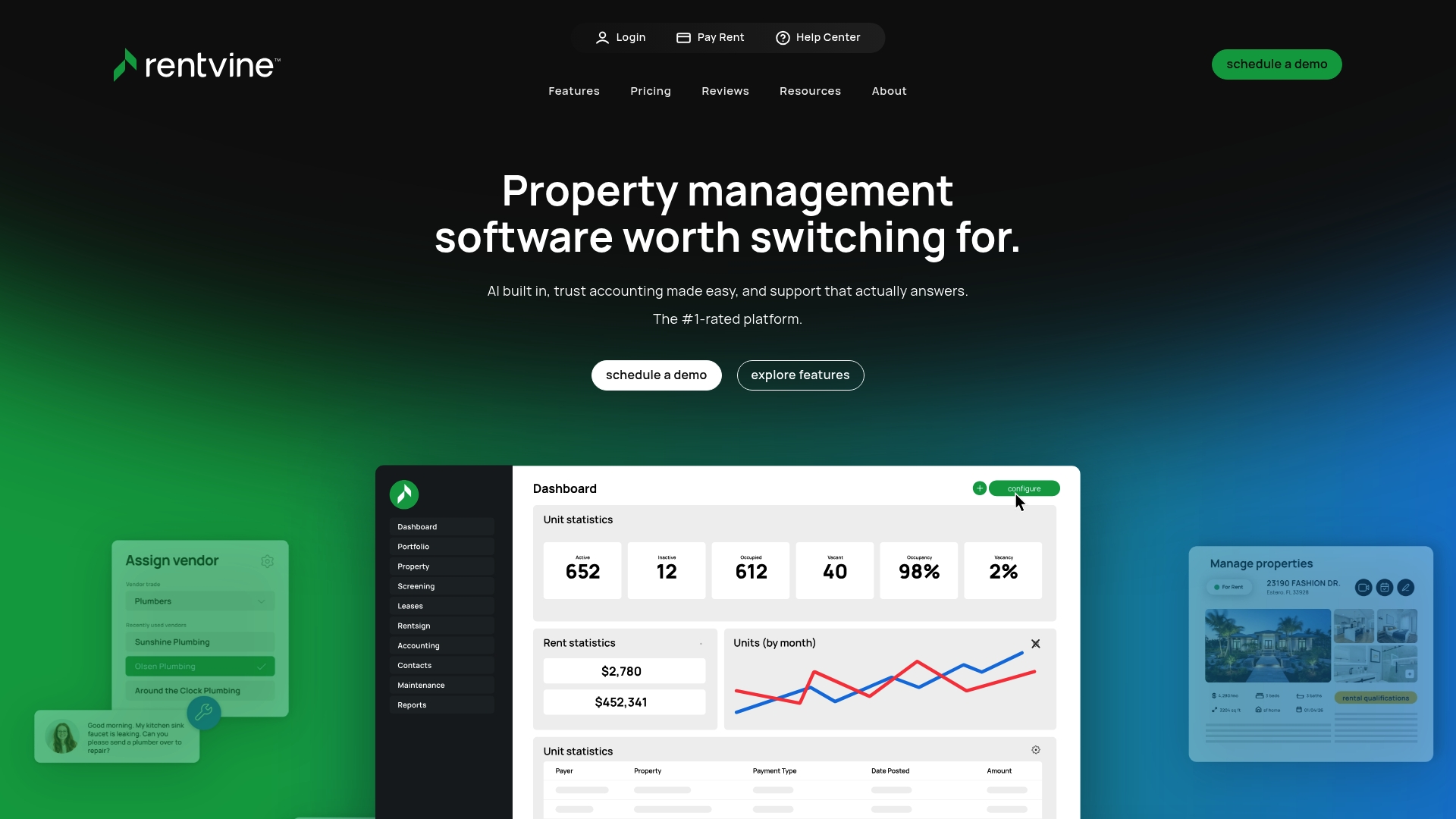
No limits on portfolio size or features in a single plan. According to the company, Rentvine reports high customer satisfaction. It combines open API connectivity, trust accounting, tenant and owner portals, and AI-assisted workflows. That mix targets managers who need deep customization and automated accounting controls.
Core Features
Rentvine's trust accounting automates ledgers, transaction tagging, and maintains an audit trail for owner statements and reconciliations. Owner, tenant, vendor, and applicant portals centralize communication while leasing workflows include eSignatures to speed move ins. Maintenance management uses Fixie AI to triage requests, and open APIs plus integrations with TransUnion, Plaid, and CRS enable screening and bank data flows.
Key Differentiator
The standout is its open API and SDK that let teams build custom automations and integrate third party AI tools. That approach reduces reliance on vendor workflows and supports bespoke reporting and direct data feeds.
Pros
Rentvine offers very responsive and helpful customer support, which accelerates onboarding and configuration. The user interface and dashboards remain intuitive, reducing staff training time across locations. Strong trust accounting aligned with GAAP simplifies owner reporting and reconciliation work for accounting staff. Automation features and portals reduce repetitive administrative tasks and free managers to focus on exceptions and growth.
Cons
-
Mobile app needs improvement for on the go workflows and better usability. Field staff may struggle with complex tasks on small screens.
-
Some common tasks require multiple clicks, which slows power users during high volume processing. Bulk operations are less efficient than expected.
-
Reporting lacks deeper analytics for portfolio level trend analysis or advanced filtering. Exporting to external BI tools is often necessary.
-
Occasional system behaviors can feel confusing and require support intervention. That adds time to issue resolution.
When It May Not Fit
If your team depends on a mature mobile app for field operations, Rentvine may not meet expectations. Power users needing single step bulk edits or batch accounting could find workflows that require many steps inefficient. Organizations that require native analytics and advanced built in portfolio BI may prefer a different product. Teams unwilling to build or buy custom integrations might miss reporting depth.
Notable Integrations
Integrations include TransUnion Tenant Screening, Plaid bank data APIs, and CRS credit and fraud data. An exposed API and SDK let you build custom connectors to accounting, CRM, or business intelligence tools. Those integration options suit teams planning to automate bespoke workflows or embed third party analytics.
Who It's For
Professional property managers and real estate investors managing residential and commercial portfolios fit Rentvine well. Teams that prioritize automated trust accounting and tenant portals will get clear operational value. Organizations planning to develop custom integrations or embed machine learning will benefit from the open API.
Real World Use Case
The vendor describes a regional property management firm using Rentvine for a portfolio of over 1,000 units. They automated rent collection, routed and prioritized maintenance with Fixie AI, and delivered custom owner statements without manual consolidation.
Pricing
Pricing is not publicly listed. Rentvine marks pricing as not applicable and presents product details as informational only.
Website: https://rentvine.com
Rent Manager
At a Glance
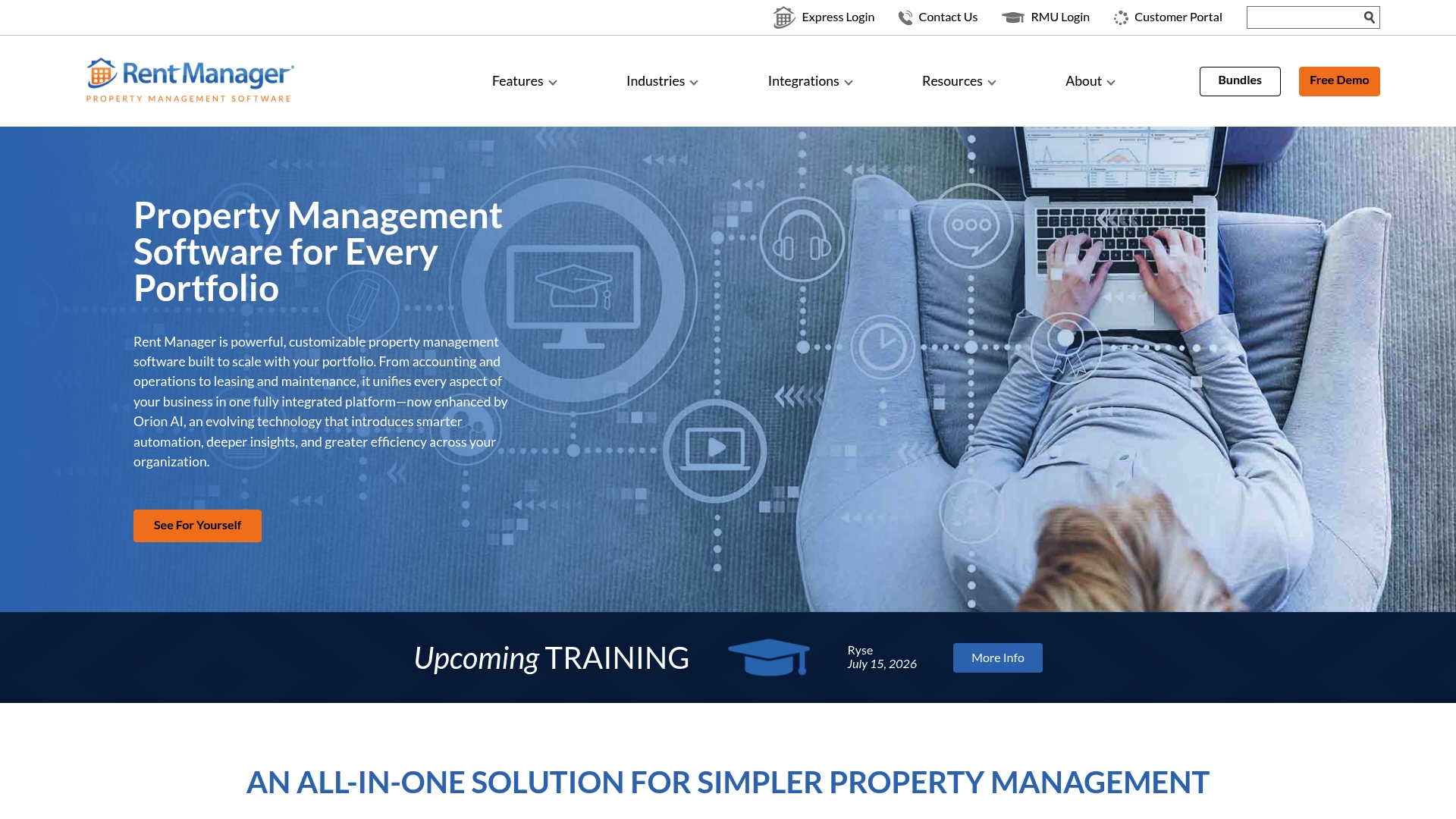
Rent Manager reports over 450 customizable reports available to customers. The reporting depth supports financial, operational, and leasing analysis across property types. The platform combines accounting, leasing, maintenance, and marketing features with training resources and a user conference. That mix makes it a heavy-duty choice for managers running complex portfolios.
Core Features
The system includes a full accounting engine that handles both cash and accrual methods and a broad invoicing workflow. Leasing and marketing tools include resident portals, screening integrations, and ILS advertising. Maintenance capabilities cover work orders, inspections, make ready boards, and mobile access while an open API lets you build custom integrations and automations.
Key Differentiator
Deep customization and a large reporting library set Rent Manager apart. The product layers AI-driven automation on top of its reporting and APIs so teams can automate routine accounting and maintenance tasks. That combination suits organizations that need tailored workflows and detailed operational analytics.
Pros
The platform adapts to varied property types and portfolio sizes, making configuration possible for residential, commercial, student housing, and manufactured housing. Its reporting suite gives managers granular visibility into revenue, expenses, occupancy, and maintenance trends. Rent Manager offers substantial training through Rent Manager University and live events, plus an API that supports third-party integrations and custom tools.
Cons
-
Steep learning curve that requires significant time for staff to become proficient.
-
Dated user interface which can slow day to day navigation and increase training needs.
-
High initial costs and ongoing expenses for add ons and extensive integrations.
-
Complex setup for advanced configurations, especially for large portfolios with custom workflows.
When It May Not Fit
Small landlords or single property owners will likely find the pricing and implementation effort excessive. Teams that need a modern, minimal interface for quick onboarding may prefer a simpler product. If budget for add ons and integrations is limited, this platform may exceed total ownership expectations.
Notable Integrations
The vendor advertises built in integrations with core property management tools and integrations with over 200 third party providers. Those partners cover resident screening, utility billing and IoT solutions. The open API also supports custom connections to accounting and third party services.
Who It's For
Mid size to large property management firms and investors with multiple property types who need configurable workflows and deep reporting. Teams that have in house IT or access to external developers will get more value from the API. Organizations that prioritize analytics and automation over a modern user interface will find this appealing.
Real World Use Case
A regional manager with more than 1,000 units across residential, commercial, and student housing uses Rent Manager to centralize accounting and maintenance tracking. The team runs custom reports for board meetings and automates recurring invoices. Integrations with screening and utility partners reduce manual data entry for leasing staff.
Pricing
Pricing varies by bundle and customization with Basic, Plus, and Premium package options. The platform is generally considered high cost, particularly after add ons and third party integrations are added. Vendors typically quote per bundle and configuration during the sales process.
Website: https://rentmanager.com
Comparison of Alternatives
Property managers evaluating management platforms must weigh unique features such as integrated payment processing and workflow automation against scalability and user support. Different systems prioritize specific needs, influencing their relevance to diverse operational contexts.
Reporting and Financial Analysis Depth
Rent Manager provides exceptional reporting capabilities with over 450 customizable templates, enabling property managers to analyze financial, operational, and leasing trends comprehensively. This level of granularity suits teams overseeing diverse portfolios requiring tailored analytics. In contrast, other platforms offer reporting engines sufficient for smaller or standard portfolios but may lack advanced customization options.
Automation and Scalability
Entrata delivers modular AI-driven automation workflows adaptable to different operation levels. This scalability makes it an excellent choice for organizations planning gradual automation adoption or managing portfolios demanding intricate governance structures. While QuonSapp emphasizes real-time mobile collaboration, Entrata excels in structured automation for large-scale applications.
Best Fit
- Multi-unit managers who need direct payment routing into Stripe should choose QuonSapp for its streamlined transaction processing with a flat $1 fee.
- Larger portfolios prioritizing detailed reporting and financial granular analytics benefit from Rent Manager’s expansive reporting library.
- Teams depending on pre-configured AI-driven automation workflows will find Entrata a preferred option for operational efficiency and scalability potential.
- Institutions requiring detailed tenant screening and affordable per-unit costs should explore DoorLoop.
Our Pick
QuonSapp combines mobile field workflows, direct payment routing into Stripe accounts without intermediary delays, and flexible sub-organization linking for portfolio consolidation. Its cost-effective transaction model makes it highly attractive for multi-property managers preferring simplicity in billing aggregation. However, property managers who prioritize advanced reporting capabilities or governance-tailored automation workflows might achieve better alignment by opting for Rentvine or Entrata.
For property managers evaluating which platform best consolidates payment processing, mobile tools, and HOA oversight, the following comparison provides clarity:
| Product | Core Feature | Key Differentiator | Best For | Pricing | Notable Limitation |
|---|---|---|---|---|---|
| QuonSapp | Consolidates HOA, tenant, and staff management workflows | Direct routing of tenant payments to Stripe accounts | Multiple properties with mobile field tools | Price not published | Limited public site access during review |
| DoorLoop | Combines multidisciplinary portfolio management features | Comprehensive integration of AI for task automation | Scaling portfolios across property types | Starts at $69/month | High cost for advanced needs |
| AppFolio | Unified tenant, owner, and team communication via one system | Built-in AI for workflow task automation | Large portfolios needing accounting tools | Price not published | Limited billing customization |
| Entrata | AI automated workflows covering leases and maintenance | Staged automation levels for task scalability | Enterprise property managers | Price not published | Complex with a steep learning curve |
| Rentvine | Trust accounting and ledger automation | Open API for bespoke third-party system integration | Managers needing deep customization | Price not published | Mobile app usability needs improvement |
| Rent Manager | Advanced reporting with over 450 customizable options | Detailed operational analytics with granular reports | Configurable workflows for diverse properties | High; bundles vary | Requires significant training due to steep learning curve |
What Challenges Arise When Searching for Buildium Review Alternatives?
Managing multiple properties with varied needs creates many demands. The article highlights common obstacles such as consolidating tenant billing, lease tracking, maintenance, and field staff management into a single solution. Property managers, HOA managers, and building supervisors often struggle with systems that separate payments from direct income, limit mobile tools, or fragment reporting across organizations.
QuonSapp offers a unified platform designed specifically for these challenges. Features like resident profiles, direct-to-manager payments landing instantly in your Stripe account, GPS-verified staff clock-ins, and parent/sub-org linking simplify daily operations. This approach reduces delays and administrative complexity while keeping your data current and accessible across devices.

See how QuonSapp lets you manage multiple property portfolios efficiently from a single dashboard. Visit the QuonSapp main page and import your resident data to create invoices and track payments within minutes.
FAQ
How does QuonSapp manage tenant payments?
QuonSapp directs tenant payments straight to the manager's Stripe account while applying a flat platform fee of $1.00 per transaction. This Direct-to-Manager Payments feature simplifies the payment process by eliminating middlemen, making it efficient for property managers. Expect streamlined collections and reduced processing times when using this solution.
What is the difference between QuonSapp and DoorLoop?
DoorLoop excels in its user-friendly interface and high customer support ratings, making it an excellent choice for those who prioritize ease of use. QuonSapp, however, provides a unique capability of managing payments directly into the manager's Stripe account, ideal for those focused on direct transaction oversight. Both platforms serve different needs in property management.
Which platform offers the best mobile features for field staff?
QuonSapp stands out with its mobile-first design, offering field teams GPS clock-in capabilities and offline access. The mobile app also allows for photo documentation on work orders, enhancing on-site task management. This makes QuonSapp particularly beneficial for property managers needing robust mobile capabilities.
Can I use QuonSapp if I manage multiple properties?
Yes, QuonSapp is designed for property managers handling multiple properties, offering features like resident profiles and consolidated management tools. With these capabilities, managers can maintain clear oversight across various locations and ensure organized record-keeping.
How does QuonSapp handle maintenance requests?
QuonSapp provides a work order pipeline that allows for easy assignment and tracking of maintenance requests, equipped with photo documentation and GPS tracking features. This ensures that managers can effectively monitor and respond to maintenance issues while maintaining records before and after service.