
When rent is overdue, your next move matters more than your frustration. Send a concise overdue alert within 24 hours, start a documented escalation timeline, and enable automated follow-ups so nothing falls through the cracks. Automated rent reminders across multiple channels are now considered standard practice for professional landlords, and the difference between a resolved late payment and a costly eviction often comes down to how quickly and consistently you act in the first 72 hours.
Here is what to do right now:
- Record the missed payment in your ledger with the exact amount, due date, and any applicable late fee.
- Send an initial overdue alert by email or SMS today, factual in tone, with a payment link and a clear balance breakdown.
- Enable automated reminders in your property-management system so follow-ups go out on a set schedule without manual effort.
- Prepare the formal notice now, but hold it until the grace period expires per your lease and state law.
Keep the first contact professional and brief. No threats, no legal ultimatums, no emotional language. A simple, factual message with a one-click payment option resolves the majority of late payments before they escalate. QuonSapp automates this entire sequence, from the initial overdue alert through the formal notice stage, with a built-in audit log and direct Stripe payment links that give you both proof and a fast path to collection.
Key Takeaways
Consistent overdue rent alerts, sent through automated multi-channel sequences with embedded payment links, resolve most late payments before they require formal legal action.
| Point | Details |
|---|---|
| Send within 24 hours | Issue the first overdue alert on day 1 with the balance, late fee, and a payment link. |
| Automate the full sequence | Configure pre-due, day-1, day-5, and day-10 triggers so follow-ups run without manual effort. |
| Verify state notice periods | Confirm your state's required days before issuing a pay-or-quit notice to avoid procedural defects. |
| Document everything | Keep certified mail receipts, email headers, portal audit entries, and ledger records for every notice. |
| QuonSapp automates the workflow | QuonSapp covers alerts, payment links, document generation, and audit logging across your full portfolio. |
Table of Contents
- How do overdue rent alerts fit into a full escalation workflow?
- How to set up automated overdue notifications
- Ready-to-use templates for every stage
- U.S. legal checklist: what to verify before sending formal notices
- Proven prevention tactics to reduce future late rent
- How to document notices and payment attempts for court
- How QuonSapp handles overdue alerts from day one
- Why automation is the only professional standard worth holding yourself to
- QuonSapp makes the first 30 days of automation straightforward
- Authoritative U.S. resources and sample forms
- Sources
How do overdue rent alerts fit into a full escalation workflow?
A structured escalation plan turns a stressful situation into a repeatable process. The goal is to move from friendly to formal in measured steps, giving the tenant every reasonable opportunity to pay while building a documented record in case legal action becomes necessary. Eviction Lab data consistently shows that early intervention reduces the likelihood of a formal eviction filing, which benefits both parties.
| Step | Timing (days after due) | Tone | Required contents |
|---|---|---|---|
| Pre-due reminder | 3 days before | Friendly | Amount due, due date, payment link |
| Initial overdue alert | Day 1 | Polite, factual | Amount owed, grace period end date, payment link |
| Formal late notice | Day 5 (or after grace period) | Professional, firm | Amount owed, late fee, payment deadline, consequences |
| Demand / pay-or-quit | Day 10–14 | Legal, neutral | Full balance, statutory deadline, delivery method |
| Certified mail / posting | Same as pay-or-quit | Formal | All of the above, proof of delivery |
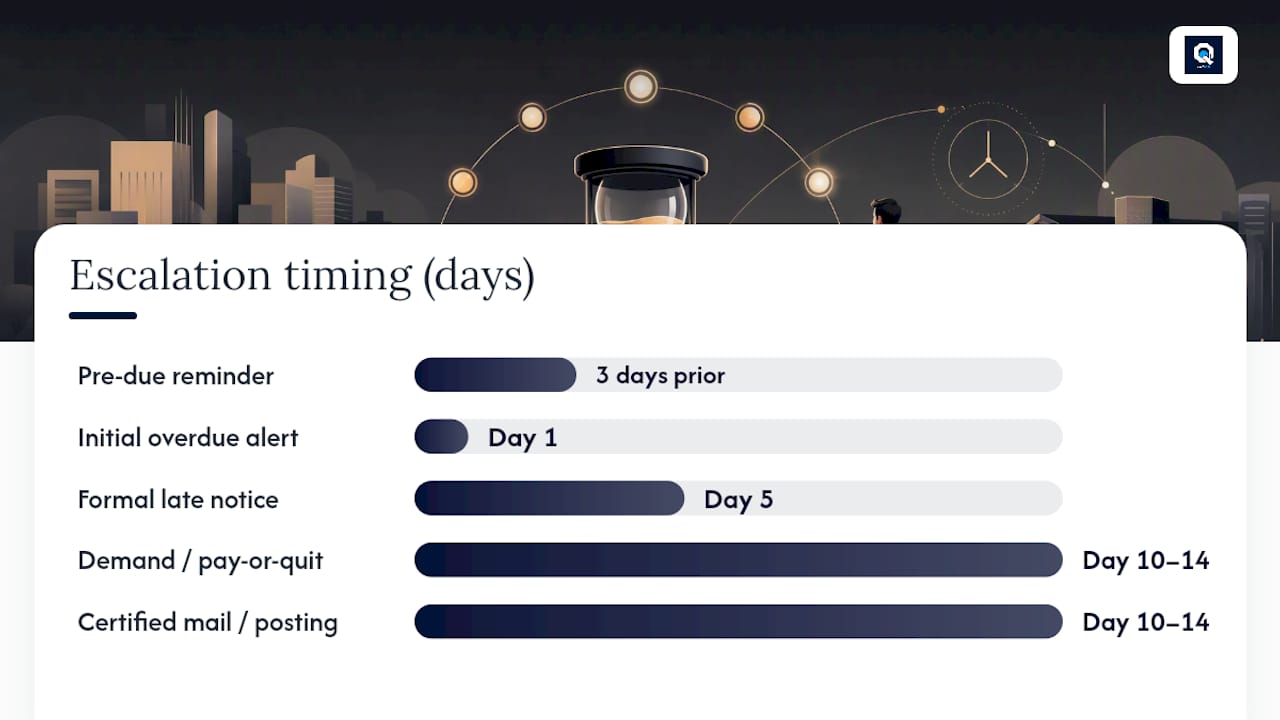
Adjusting the timeline. For a repeat offender, compress the formal notice step to day 3 after the grace period ends. For a tenant with documented hardship who has communicated proactively, you may pause automated nudges and negotiate a payment plan in writing. Local law always sets the floor: some states require a 3-day notice, others a 5-day or 14-day notice before you can file. Check your state statute before issuing any formal notice.
Escalate to legal notices only after the grace period has passed and at least one documented attempt at direct communication has gone unanswered. If a tenant responds and commits to a date, document that promise in writing and pause the automated sequence until that date passes.
How to set up automated overdue notifications
Automation is what separates a professional operation from a reactive one. Setting it up correctly takes about 30 minutes and pays dividends every month.
- Configure a pre-due reminder to fire 3 days before the rent due date via email and SMS. Keep it short: amount due, due date, and a payment link.
- Set an immediate overdue trigger for day 1 after the due date. This fires automatically if no payment is recorded, and it should include the current balance, any late fee that has accrued, and a one-click payment option.
- Schedule a formal notice trigger for day 5 (or the day after your lease's grace period expires). This message should shift in tone to professional and firm, reference the consequences of non-payment, and be sent via email with a simultaneous push notification.
- Add a final automated nudge at day 10 that flags the account for manual review and prepares the pay-or-quit notice for your approval before sending.
- Set a stop condition so automated messages halt the moment a payment is recorded, preventing awkward follow-ups after a tenant has already paid.
Channel mix. Email is the workhorse: it creates a written record and handles longer messages well. SMS drives faster opens and works well for short alerts with a payment link. Mobile app push notifications reach tenants who have the portal installed and are ideal for balance reminders. Certified mail or physical posting is reserved for formal legal notices where proof of delivery is required by your jurisdiction.
Pro Tip: Always embed a one-click payment link and a clear balance breakdown in every automated message. Tenants who can pay in two taps pay faster than those who have to log in separately.
Ready-to-use templates for every stage
Copy, customize, and send. Adjust the bracketed fields to match your property details and local requirements.
Friendly pre-due reminder (3 days before)
Subject: Your rent of $[AMOUNT] is due on [DATE]
Hi [TENANT NAME], just a quick heads-up that your rent of $[AMOUNT] for [UNIT ADDRESS] is due on [DATE]. You can pay securely here: [PAYMENT LINK]. Thanks for being a great tenant — let us know if you have any questions.
Polite overdue alert (day 1)
Subject: Rent payment not yet received for [UNIT ADDRESS]
Hi [TENANT NAME], we haven't received your rent payment of $[AMOUNT] due on [DATE]. Your account currently shows a balance of $[TOTAL DUE]. Please pay at your earliest convenience using this link: [PAYMENT LINK]. If you've already sent payment, please disregard this message. Contact us at [PHONE/EMAIL] if you need assistance.
Formal late rent notice (day 5 or after grace period)
Subject: Formal Notice: Overdue Rent for [UNIT ADDRESS]
Dear [TENANT NAME], this is a formal notice that your rent payment of $[BASE RENT] for the period of [MONTH] remains unpaid as of [DATE]. A late fee of $[LATE FEE] has been applied per your lease agreement, bringing your total balance to $[TOTAL DUE]. Payment in full is required by [DEADLINE DATE]. Failure to pay by this date may result in further legal action, including the issuance of a formal eviction notice. Payment can be made at [PAYMENT LINK] or by [ACCEPTED METHODS]. Please contact us immediately if you are experiencing a hardship.
A standard late rent notice should always include tenant and property details, the exact amount due, days past due, the late fee, and a clear payment deadline.
Demand / pay-or-quit notice
Subject: Notice to Pay Rent or Quit — [UNIT ADDRESS]
TO: [TENANT NAME(S)], [UNIT ADDRESS]. You are hereby notified that you are in default of your rental agreement for failure to pay rent in the amount of $[TOTAL DUE], which was due on [DUE DATE]. You are required to pay the full amount owed OR vacate the premises within [STATE-REQUIRED DAYS, e.g., 3, 5, or 14] days of this notice. Payment may be made to [LANDLORD NAME] at [ADDRESS/PAYMENT LINK]. If you fail to pay or vacate within the required period, legal proceedings may be initiated. Served on: [DATE]. Landlord/Agent: [NAME, SIGNATURE].
Confirm your state's required notice period before sending this notice. New York courts publish a fillable 5-Day Notice of Past Due Rent that serves as a useful model for formal notices. Keep a signed copy and your proof of delivery for every formal notice you issue.
U.S. legal checklist: what to verify before sending formal notices
Getting the notice right the first time avoids procedural defects that can restart the clock or invalidate your filing. Work through this checklist before you send anything beyond a friendly reminder.
- Lease terms: Confirm the exact due date, grace period length, and late fee amount written in the signed lease. Your notice must match these figures.
- State notice period: Verify whether your state requires a 3-day, 5-day, 10-day, or 14-day notice to pay or quit before you can file for eviction. State court tenant guides summarize local nonpayment procedures and required periods.
- Late fee limits: Many states cap late fees as a percentage of monthly rent or prohibit them before a specific number of days past due. Charging an impermissible fee can weaken your notice.
- Delivery method: Confirm whether email satisfies delivery requirements in your jurisdiction. Most states require personal service, posting on the door, or certified mail for formal pay-or-quit notices. Use landlord-tenant forms from your local court to verify the correct procedure.
- Fair Housing compliance: Every notice must be consistent in tone and timing across all tenants. The Fair Housing Act prohibits discriminatory treatment, and HUD guidance requires reasonable accommodations for tenants with disabilities, which may include alternative delivery methods.
- Section 8 / voucher holders: If your tenant holds a Housing Choice Voucher, check HUD's program rules for any additional notice requirements before proceeding.
- Third-party collectors: If you outsource collections, the Fair Debt Collection Practices Act (FDCPA) governs how those communications must be conducted. Aggressive automated outreach from a third party can expose you to liability.
A pay-or-quit notice is not a court filing. It is a prerequisite to filing. Serving the notice correctly starts the legal clock; filing with the court is a separate step that requires its own forms and fees.
Proven prevention tactics to reduce future late rent
The most effective overdue rent alert is the one you never have to send. These habits lower late-payment rates before they become a problem.
- Send a welcome packet at move-in that explains the due date, grace period, late fee, and every accepted payment method. Tenants who understand the rules from day one pay on time more consistently.
- Offer autopay enrollment during onboarding. ACH (bank transfer) and card autopay eliminate the human error of forgetting. Explore online rent payment options that integrate directly with your management workflow.
- Send a pre-due reminder 3 days before every rent cycle, not just when payment is late. This single habit, combined with a payment link, resolves most late payments before they happen.
- Write clear late-fee language in the lease and enforce it consistently. Inconsistent enforcement signals that the policy is negotiable, which encourages repeat lateness.
- Acknowledge on-time payments. A brief "Thank you, your payment was received" message costs nothing and builds goodwill that pays off when you need a tenant's cooperation.
- Offer multiple payment channels. Tenants who can pay by card, ACH, or through a mobile portal have fewer excuses and fewer friction points. Restricting payment to checks or money orders increases late payments.
How to document notices and payment attempts for court
Documentation is your insurance policy. A well-kept record turns a disputed eviction into a straightforward case.
- Save a copy of every notice sent, including the exact text, the date sent, and the method of delivery. Store these in a centralized document library organized by tenant and property.
- Retain certified mail receipts and tracking confirmations. The green return-receipt card (PS Form 3811) is admissible proof of delivery in most jurisdictions.
- Export email headers and SMS logs for every automated message. These show the timestamp, recipient address, and delivery status.
- Log every portal audit entry. A timestamped system record showing when a notice was generated and sent is strong corroborating evidence.
- Record every partial payment with the date received, amount, and running balance. A partial payment can, in some states, reset your notice timeline, so document the circumstances and any written agreement that accompanied it.
- Document every verbal or written promise. If a tenant calls and says "I'll pay Friday," follow up with a written confirmation by email and log the call. Promises that go undocumented are impossible to reference in court.
Good property management accounting software keeps a ledger that timestamps every transaction and every notice, which is exactly the kind of centralized record a judge expects to see.
How QuonSapp handles overdue alerts from day one
QuonSapp maps directly to every step in the escalation workflow described above. Here is how the features connect:
- Overdue Alerts: Tenants see overdue invoices highlighted in the resident portal the moment a payment is missed. No manual flagging required.
- Invoice Management and Payment History: Every invoice carries a full ledger entry with timestamps, amounts, and method records, giving you a court-ready payment history per tenant.
- Push Notifications, Email, and SMS: QuonSapp delivers alerts across all three channels simultaneously, matching the multi-channel approach that best practices recommend for reducing missed payments.
- Document Generator: Generate formal late notices and pay-or-quit letters from pre-built templates, then store them in the Document Library with a single click.
- Audit Log: Every action, from the moment an invoice is created to the moment a notice is sent, is logged with a timestamp and the user who performed it. This log is exportable and admissible as a record of your process.
- Stripe Payment Links: Every automated message can carry a direct payment link. Funds land in your Stripe account instantly, with no intermediary and no holding period.
- Portfolio Dashboard: Track on-time payment rates, overdue balances, and collection trends across every property from one screen, so you catch patterns before they become problems.
The digital property management guide on the QuonSapp blog walks through how to bring these features into a live workflow from day one.
Why automation is the only professional standard worth holding yourself to
Most landlords treat late-rent follow-up as a personal confrontation. That framing creates inconsistency, delays, and emotional friction that makes the situation worse for everyone. The better frame is this: a rent reminder is a customer-service touchpoint, not a conflict. When you automate it, you remove the personal element entirely and replace it with a consistent, professional process that works the same way for every tenant, every month.

The Harvard Joint Center for Housing Studies documents the pressure that rental-market dynamics place on both landlords and tenants. In that environment, a landlord who communicates clearly and consistently is far better positioned, legally and relationally, than one who reacts emotionally or inconsistently. Automation is not about being cold. It is about being fair, documented, and reliable.
The one thing I would push back on in most late-rent guides is the emphasis on templates over systems. A great template sent inconsistently is worth far less than a mediocre template sent automatically, every time, with a payment link attached. Build the system first. Refine the language second.
QuonSapp makes the first 30 days of automation straightforward
Landlords who set up QuonSapp's overdue alert workflow in the first month report a cleaner, more consistent collections process from the start. Here is what the setup looks like in practice:

Sign up or schedule a demo at QuonSapp, then follow these first steps:
- Import your tenants and unit data via CSV or manual entry.
- Create rent invoices per resident and set your due dates and late-fee rules.
- Enable automated pre-due reminders (3 days before) and overdue escalation sequences (day 1, day 5).
- Connect your Stripe account so payment links in every alert go live immediately.
- Run a test escalation to confirm the audit log captures each event with a timestamp.
Within 30 days, your automated reminders are live, a sample escalation has run end-to-end, and every notice is stored in a searchable audit log. That is the foundation of a professional collections workflow, built once and running continuously.
Authoritative U.S. resources and sample forms
Use these primary sources to confirm state-specific rules and download court-approved templates before issuing formal notices.
- 5-Day Notice of Past Due Rent (NY Courts) — fillable model form for formal past-due notices in New York.
- Landlord-Tenant Forms (NY Courts) — full library of court-approved landlord-tenant forms; check your own state court's equivalent site for local templates.
- Tenant's Guide: Nonpayment (NY Courts) — summarizes nonpayment eviction procedure and required notice periods.
- Fair Housing Act (U.S. Department of Justice) — enforcement authority and guidance on non-discriminatory tenant communications.
- Know Your Fair Housing Rights (HUD) — reasonable accommodation obligations and tenant rights.
- Fair Debt Collection Practices Act (FTC) — governs third-party and automated debt-collection outreach.
- America's Rental Housing 2024 (Harvard JCHS) — national rental market data and eviction trend context.
- Eviction Lab ETS Report 2023 — empirical eviction timing and outcome data supporting early intervention.
Always verify your local court's specific forms and timelines before issuing a formal eviction notice. State statutes vary significantly, and a procedurally defective notice can reset your timeline entirely.
Sources
- Rent Reminder Guide for 2026: Best Practices for Landlords
- 5-Day Notice of Past Due Rent
- Fair Housing Act (U.S. Department of Justice)
- Know Your Fair Housing Rights - HUD
- Fair Debt Collection Practices Act (FDCPA) text - FTC
- America's Rental Housing 2024 (Harvard JCHS)
- ETS report 2023 - Eviction Lab
- Landlord-Tenant Forms (NY Courts)
- Tenant's Guide: Nonpayment (NY Courts)
- Late Rent Notice — Rocket Lawyer