
For most property managers evaluating a switch, QuonSapp is the recommended first demo. It covers HOA workflows, maintenance tracking, resident payments via Stripe, GPS staff clock-in, and multi-company consolidation in a single subscription with transparent per-portfolio pricing — no per-seat fees, no algorithmic pricing exposure. If your portfolio skews toward large multifamily enterprise (5,000+ units) or you need deep commercial lease accounting, Yardi Voyager or MRI Software may be a closer fit.
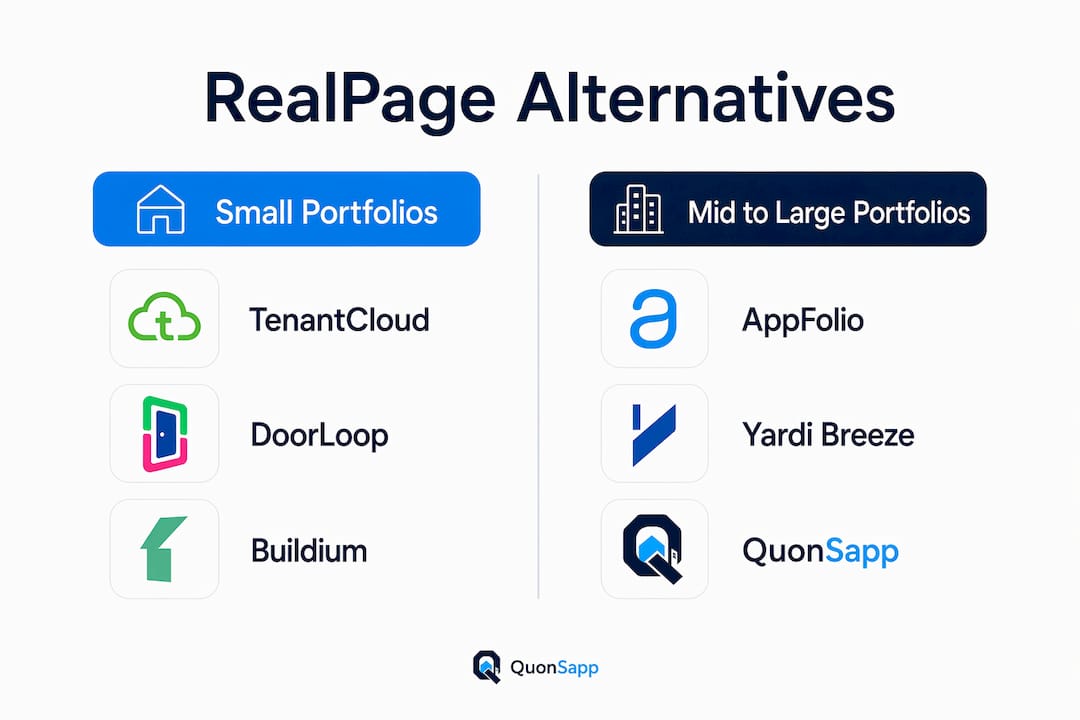
Here is the shortlist of leading RealPage alternatives worth evaluating in 2026:
- QuonSapp — Best for HOA managers, maintenance-heavy portfolios, and multi-company operators who need offline mobile tools and transparent pricing
- AppFolio — Best for mid-market residential managers (50–2,500 units) who prioritize a polished UI and built-in AI leasing tools
- Yardi Breeze / Voyager — Best for managers who need scalable accounting depth, from small portfolios (Breeze) to large enterprise (Voyager)
- Buildium — Best for small-to-mid residential landlords who want an affordable, feature-complete platform with a free trial
- DoorLoop — Best for independent landlords and growing portfolios that want fast onboarding and a clean modern interface
- Rent Manager — Best for mid-to-large operators who need highly configurable accounting and a long track record
- Entrata — Best for large multifamily operators who want a unified platform with marketing, leasing, and operations under one roof
- ResMan — Best for affordable housing and conventional multifamily managers who need compliance-ready reporting
- TenantCloud — Best for small landlords (under 75 units) who want a free or very low-cost starting point
- MRI Software — Best for enterprise commercial and mixed-use portfolios that require deep lease accounting and open API flexibility
If your portfolio is under 50 units and you primarily need rent collection and lease tracking, TenantCloud or DoorLoop offer the fastest path to a working setup. For everything else, the profiles below will help you match the right platform to your actual operations.
Table of Contents
- How do the leading RealPage alternatives compare across the dimensions that matter?
- Vendor profiles: who each platform fits and what to expect at migration
- How do you choose the right RealPage alternative for your portfolio?
- Why QuonSapp is a practical alternative to RealPage for many property managers
- Key Takeaways
- The real calculus of replacing RealPage
- QuonSapp is built for the managers RealPage was not designed for
- Useful sources and further reading
How do the leading RealPage alternatives compare across the dimensions that matter?
Aggregator research consistently shows that buyers who match a platform to their portfolio scale avoid overpaying for features they will never use. The table below maps each vendor across the nine evaluation dimensions most relevant to property managers.
| Vendor | Best For | Key Features | Pricing Model | Ease of Use | Integrations & API | Mobile Apps | Support | Security | Scalability |
|---|---|---|---|---|---|---|---|---|---|
| QuonSapp | HOAs, maintenance-heavy, multi-company | Resident payments (Stripe), work orders, GPS clock-in, board votes, ARC requests, offline app | Per-portfolio subscription tiers; no per-seat fees | High — purpose-built for field staff and HOA boards | Stripe, ADP, Paychex, QuickBooks export | Native iOS & Android; offline-capable | Onboarding support; migration assistance | Audit log; data export; SOC details on request | Multi-company org network; enterprise plan |
| AppFolio | Mid-market residential (50–2,500 units) | AI leasing, online payments, maintenance, reporting | Per-unit monthly fee (published tiers) | High — clean UI, guided onboarding | Open API; screening, payments, accounting | Strong mobile apps | Phone, chat, help center | SOC 2 Type II | Scales to ~2,500 units well |
| Yardi Breeze / Voyager | Small (Breeze) to enterprise (Voyager) | Full accounting, lease management, marketing | Per-unit (Breeze); enterprise quote (Voyager) | Moderate — Voyager has a steeper learning curve | Broad ecosystem; Yardi Marketplace | Mobile apps available | Dedicated support tiers | SOC 1 & 2 | Voyager handles very large portfolios |
| Buildium | Small-to-mid residential | Accounting, maintenance, resident portal, e-leases | Per-unit monthly (published tiers); free trial | High — well-documented, intuitive | Open API; screening, payments | Mobile apps | Phone, chat, email | SOC 2 Type II | Up to ~5,000 units |
| DoorLoop | Independent landlords, growing portfolios | Rent collection, maintenance, tenant portal, reporting | Per-unit monthly (published tiers) | Very high — fast setup, modern UI | QuickBooks, Zapier, open API | Strong mobile apps | Chat, email, onboarding calls | SOC 2 Type II | Small to mid-market |
| Rent Manager | Mid-to-large, highly configurable needs | Deep accounting, work orders, custom reporting | Per-unit or flat-fee (contact for quote) | Moderate — powerful but requires setup | Open API; broad integrations | Mobile apps | Dedicated support; training | SOC 2 Type II | Mid to large enterprise |
| Entrata | Large multifamily operators | Marketing, leasing, operations, resident app | Enterprise pricing (contact for quote) | Moderate — feature-rich, some complexity | Broad ecosystem; open API | Strong mobile apps | Dedicated CSM | SOC 2 Type II | 1,000+ units; enterprise-grade |
| ResMan | Affordable housing, conventional multifamily | Compliance reporting, leasing, accounting | Per-unit monthly (contact for quote) | Moderate | Integrations available | Mobile apps | Support team; onboarding | SOC 2 Type II | Mid to large |
| TenantCloud | Small landlords (under 75 units) | Rent collection, maintenance, lease storage | Free tier; paid plans per unit | Very high — minimal setup | Limited integrations | Mobile apps | Email, community | Not publicly detailed | Small portfolios |
| MRI Software | Enterprise commercial and mixed-use | Open API, deep lease accounting, analytics | Enterprise pricing (contact for quote) | Lower — complex, requires implementation | Highly open; broad ecosystem | Mobile apps | Enterprise support; professional services | SOC 1 & 2 | Large enterprise |
Pricing shapes to know: Most mid-market platforms (AppFolio, Buildium, DoorLoop) publish per-unit monthly fees, which makes cost modeling straightforward. Enterprise platforms (Entrata, MRI, Yardi Voyager, Rent Manager) typically require a quote. QuonSapp uses per-portfolio subscription tiers with no per-seat fees for staff or resident accounts, which tends to favor operators with large teams or high resident turnover.
One context worth keeping in mind: RealPage has faced significant regulatory scrutiny and litigation related to its algorithmic pricing tools, including bans in major U.S. cities and states. Pricing transparency and the absence of algorithmic rent-setting tools are now active evaluation criteria for many buyers, not just a nice-to-have.
Vendor profiles: who each platform fits and what to expect at migration
AppFolio
AppFolio is the go-to for residential managers who want a polished experience without heavy IT involvement. Its AI leasing assistant, built-in screening, and online maintenance requests are genuinely well-integrated. G2 reviewers consistently highlight the UI and reporting as strengths. The per-unit pricing is published and predictable. Migration typically involves a CSV import of tenant and ledger data; AppFolio's onboarding team guides the process, and most mid-market managers complete cutover in a few weeks. The main limitation: it is residential-first, so commercial or mixed-use portfolios will hit gaps quickly.

Yardi Breeze and Yardi Voyager
Yardi covers more ground than almost any competitor, which is both its strength and its complexity. Breeze is a genuinely accessible cloud product for small portfolios. Voyager is a full enterprise platform with accounting depth that rivals dedicated ERP systems. The vendor philosophy contrast between revenue-optimization platforms and accounting-first platforms is clearest here: Yardi leans hard into accounting and compliance. Voyager implementations routinely take several months and often require a certified implementation partner. If you are migrating from RealPage at enterprise scale, budget for that timeline.
Buildium
Buildium hits a sweet spot for residential managers who want a complete feature set without enterprise pricing. It offers a free trial, published pricing tiers, and strong G2 ratings for ease of use. The accounting module handles trust accounting, owner disbursements, and 1099 generation. Data import via CSV is well-documented. One note: Buildium's HOA feature set is functional but less comprehensive than platforms built specifically for community associations.
DoorLoop
DoorLoop is built for speed. Independent landlords and managers with smaller portfolios can be fully operational in days, not weeks. QuickBooks and Zapier integrations cover most accounting and automation needs. Pricing is published per unit. The trade-off is depth: very large or highly complex portfolios will eventually outgrow it. For a cloud-based property management comparison that includes DoorLoop, the QuonSapp blog has a focused breakdown.

Rent Manager
Rent Manager has been in the market long enough to have deep configurability baked in. Its accounting engine handles complex fee structures, and the open API supports a wide integration ecosystem. Mid-to-large operators who need custom workflows and are willing to invest in setup time will find it rewarding. Pricing requires a direct quote. Migration from RealPage can be complex given Rent Manager's data model; plan for a dedicated data-mapping phase before import.
Entrata
Entrata is built for large multifamily operators who want marketing, leasing, and operations in one platform. Its resident app and centralized inbox are standout features. Capterra reviewers note strong support from dedicated customer success managers. Enterprise pricing means you will need a formal RFP process. Implementation timelines are typically a few months for large portfolios. If you manage a large conventional multifamily portfolio and want a single vendor for the full resident lifecycle, Entrata is worth a serious look.
ResMan
ResMan targets affordable housing and conventional multifamily managers who need compliance-ready reporting (HUD, tax credit, Section 8). Its reporting module is a genuine differentiator for regulated portfolios. G2 reviews for Entrata and ResMan often appear together in comparisons of large multifamily platforms. Pricing is per-unit and requires a quote. Migration from RealPage is supported, but compliance data (certifications, income verifications) requires careful field mapping before import.
TenantCloud
TenantCloud is the entry point for small landlords who want to stop managing leases in spreadsheets. The free tier covers basic rent collection and maintenance requests for a small number of units. Paid plans add more units and features. It is not built for HOAs, commercial properties, or multi-company operations. If you are managing under 75 units and your primary need is rent collection and lease tracking, TenantCloud gets you started with minimal friction.
MRI Software
MRI is the enterprise choice for commercial and mixed-use portfolios where lease accounting complexity (percentage rent, CAM reconciliations, multi-currency) is a daily reality. Its open API philosophy means it integrates with nearly anything. The trade-off is implementation cost and timeline: MRI projects typically involve professional services engagements measured in months. For operators who have outgrown every other platform, MRI delivers the depth. For everyone else, the cost and complexity are hard to justify.
QuonSapp
QuonSapp is built from the ground up for the people who actually run properties day to day: HOA managers, building supervisors, front desk staff, and maintenance workers. Its resident payment flow sends funds directly to your Stripe account with a $1.00 flat platform fee per transaction. Work orders include before/after photo documentation, staff or vendor assignment, and a full status pipeline. GPS clock-in/out with time tracking and payroll export to ADP, Paychex, or QuickBooks covers staff operations most platforms leave to a separate HR tool. The multi-company org network lets parent organizations consolidate stats across linked sub-orgs with configurable data-sharing controls.
Pro Tip: If your portfolio includes community amenities (pools, gyms, clubhouses), QuonSapp's amenity booking module with manager approval and max-duration rules handles resident scheduling without a separate tool.
Migration from RealPage: export tenant and ledger data as CSV, map lease, payment, and vendor tables, then pilot-import a single property to validate field mappings before full cutover. Small portfolios typically complete onboarding within several weeks; mid-market portfolios often require a few months including staged cutovers.
How do you choose the right RealPage alternative for your portfolio?
The most common mistake buyers make is evaluating platforms by feature count rather than portfolio fit. Matching product strengths to your scale avoids overpaying and prevents you from landing on a platform that is technically capable but operationally wrong for your team.
A sequential buyer checklist
- Define your unit count and property types. Under 75 units and residential only? Start with TenantCloud or DoorLoop. 75–500 units with HOAs or mixed residential? QuonSapp or Buildium. 500–2,500 units conventional multifamily? AppFolio or Yardi Breeze. Enterprise or commercial? Yardi Voyager, Entrata, or MRI.
- List your non-negotiables. HOA board votes and ARC requests? Violation tracking and fine management? Offline mobile for field staff? GPS clock-in? Narrow the list to platforms that cover these without add-ons.
- Check pricing transparency. If a vendor will not publish pricing, ask for a written quote before investing demo time. Opaque pricing is a red flag post-litigation, especially for algorithmic or revenue-optimization tools.
- Verify accounting export capability. Can you export a full transaction ledger to QuickBooks or a CSV at any time? This matters both for your accountant and for any future migration. See the QuonSapp blog's accounting software comparison for a deeper look at export patterns.
- Test mobile and offline capability. Have a field staff member run a work order from a phone in a low-signal area. If the app fails, that is a real operational gap.
- Confirm security posture. Ask for SOC 2 Type II documentation or equivalent. If a vendor cannot produce it, ask specifically what controls they have in place.
Must-ask demo questions
- Walk me through how a resident pays rent and how that payment hits my accounting ledger. What does the reconciliation look like?
- Show me a work order from submission to completion, including photo attachment and vendor assignment.
- What does a full data export look like? Can I pull all tenant records, ledger history, and lease documents in a standard format today?
- What integrations do you have with screening providers, payment processors, and accounting tools? Can you show me a live example?
- What is the typical onboarding timeline for a portfolio my size, and what does your migration support include?
Red flags to watch for
- No published pricing and resistance to providing a written quote
- No SOC 2 or equivalent security documentation
- Limited or no data export capability (your data should always be yours)
- Algorithmic pricing tools with no opt-out or transparency controls
- Onboarding timelines that are vague or entirely dependent on your team's effort
- No offline mobile capability for field staff
How to weight evaluation criteria by portfolio size
For small portfolios (under 200 units), prioritize ease of use and pricing transparency above all else. For mid-market (200–2,000 units), weight accounting depth, maintenance tracking, and resident payment flow equally. For enterprise (2,000+ units), integrations, API openness, and implementation support become the decisive factors. HOA-heavy portfolios should add board governance tools (votes, ARC, violations) as a hard requirement regardless of size.
Why QuonSapp is a practical alternative to RealPage for many property managers
QuonSapp addresses several of the most common RealPage pain points directly: pricing opacity, limited HOA-specific workflows, and the gap between what a platform offers managers and what it actually gives field staff.
Feature alignment with the evaluation dimensions
| Dimension | QuonSapp Capability |
|---|---|
| Accounting | Invoice management, revenue/expense tracking, payment ledger, overdue alerts, accounting overview dashboard |
| Maintenance | Work order creation with photos, staff/vendor assignment, status pipeline, vendor directory |
| Resident payments | Stripe-powered card payments, direct-to-manager payouts, partial payments, $1.00 flat fee per transaction |
| Reporting & analytics | Portfolio dashboard (occupancy, labor costs, maintenance metrics, dues collection), payment analytics |
| Mobile | Native iOS & Android apps, offline-capable core screens, real-time sync via Convex |
| Security | Full audit log, data export at any time, configurable data-sharing controls per sub-org |
| Multi-company | Parent/sub-org linking, consolidated network stats, sub-org status management, per-seat consolidated billing |
When QuonSapp is the faster path
QuonSapp fits best when your portfolio includes one or more of these signals:
- HOA communities that need violation tracking, fine management, board votes, ARC requests, and bulk dues invoicing
- Staff-heavy maintenance operations where GPS clock-in, shift scheduling, and payroll export to ADP or Paychex are daily needs
- Multi-company structures where a parent organization needs consolidated visibility across linked management companies
- Field staff working in low-connectivity environments where offline mobile capability is a real operational requirement
- Resident-facing amenity management (pools, gyms, clubhouses) that needs booking rules, manager approval, and a calendar view
QuonSapp's direct-to-manager Stripe payment model means every resident payment lands in your account instantly, with no intermediary holding period and a flat $1.00 platform fee per transaction. For HOA managers who have dealt with delayed disbursements from platform-intermediated payment systems, that difference is immediate and concrete.
Migration notes
Export your RealPage data as CSV files covering tenant records, lease dates, payment history, and vendor contacts. Map each field to QuonSapp's import schema before uploading. The recommended approach: pilot-import one property first, verify that lease dates, balances, and resident profiles are accurate, then proceed property by property. QuonSapp's bulk CSV import handles residents and unit data; document uploads (leases, CC&Rs) can be organized in the document library by property after import. For portfolios under 200 units, plan for a 2–6 week onboarding window. Mid-market portfolios (200–2,000 units) should budget 6–12 weeks, including a parallel-run period where both systems are live before full cutover.
Package management is one area where third-party integrations add real value during and after migration. For multifamily properties handling high package volumes, package room management services integrate with resident notification workflows to reduce front-desk load.
Key Takeaways
QuonSapp is the recommended first demo for most property managers replacing RealPage, particularly those managing HOAs, maintenance-heavy portfolios, or multi-company structures with field staff.
| Point | Details |
|---|---|
| Match platform to portfolio scale | Small landlords under 75 units fit TenantCloud or DoorLoop; HOA and mid-market managers fit QuonSapp or Buildium; enterprise fits Yardi Voyager, Entrata, or MRI. |
| Pricing transparency is a hard requirement | Post-litigation scrutiny means opaque pricing and algorithmic rent tools are active red flags; prioritize vendors with published or written-quote pricing. |
| Migration planning determines success | Export CSV data, map fields, and pilot-import one property before full cutover; small portfolios take 2–6 weeks, mid-market portfolios 6–12 weeks. |
| HOA and field-staff features narrow the field | Board votes, ARC requests, GPS clock-in, offline mobile, and payroll export are available in QuonSapp and absent or add-on in most alternatives. |
| QuonSapp as the recommended pick | QuonSapp covers HOA workflows, resident payments via Stripe, maintenance tracking, and multi-company consolidation in a transparent per-portfolio subscription. |
The real calculus of replacing RealPage
Replacing a property management platform is not a software decision. It is an operations decision, a tenant-experience decision, and a total-cost-of-ownership decision that plays out over 12–24 months after go-live.
Most managers I see get this wrong in the same direction: they evaluate platforms on feature lists during a 45-minute demo, then discover six months post-migration that the accounting export does not match their CPA's format, or that their maintenance staff refuses to use the mobile app because it requires a signal they do not have in the field. The feature list looked right. The operational fit was not.
The vendors that consistently perform well post-migration share a few traits: published pricing with no surprise per-seat fees, a data export that works on day one and day 1,000, and a mobile experience that field staff actually adopt. Those are not glamorous criteria. They are the ones that determine whether the switch was worth it.
One practical note on timing: run both systems in parallel for at least two to four weeks before cutting over completely. The cost of a parallel period is real but small compared to the cost of a botched cutover that leaves resident payment history inaccessible during a dispute.
Pro Tip: Before your first demo, pull a sample export from RealPage covering 30 days of payment history and one full lease record. Bring that file to the demo and ask the vendor to show you exactly where each field maps in their import tool. That single exercise will tell you more about migration friction than any feature walkthrough.
QuonSapp is built for the managers RealPage was not designed for
If you manage HOA communities, run a maintenance team in the field, or oversee multiple management companies under one umbrella, QuonSapp was built specifically for your workflow. The resident payment model sends funds directly to your Stripe account with a flat $1.00 fee per transaction. The mobile app works offline. GPS clock-in, shift scheduling, and payroll export to ADP or Paychex are included in the subscription. Board votes, ARC requests, violation tracking, and bulk dues invoicing are native features, not add-ons.

The onboarding process is scoped to your portfolio size. Small portfolios are typically live within several weeks. Mid-market portfolios follow a staged cutover over some months with migration support included. There is no per-seat fee for staff or resident accounts, so your cost stays predictable as your team grows.
Request a demo at QuonSapp.com to see the full workflow, get a migration assessment for your current RealPage data, and confirm which subscription tier fits your portfolio.
Useful sources and further reading
The sources below support the claims in this article and give you places to verify vendor signals, read user reviews, and dig deeper before a demo.
External review and market sources:
- AppFolio reviews on G2 — Verified user reviews covering UI, accounting, and support quality; useful for mid-market residential evaluation
- Entrata reviews on G2 — Large multifamily operator reviews with detail on CSM support and platform depth
- Entrata reviews on Capterra — Additional verified reviews with implementation and pricing feedback
- Buildium reviews on G2 — Small-to-mid residential manager reviews; strong signal on ease of use and accounting
- RealPage alternatives overview — Re-leased — Independent comparison of top nine alternatives with feature summaries
- RealPage alternatives — Software Advice — Aggregated alternatives list with user ratings and category filters
- RealPage competitors — Comparably — Competitor listing used by buyers to identify market alternatives
- Top 20 RealPage alternatives for 2026 — TechJockey — Broader shortlist validation including niche and specialty vendors
- RealPage settlement reporting — Multifamily Dive — Coverage of algorithmic pricing litigation and settlements; relevant to pricing-transparency red flags
- RealPage bans — PEST Stakeholder — Reporting on city and state-level restrictions on RealPage pricing tools
QuonSapp internal resources:
- Digital property management guide for landlords — Overview of operational trade-offs when switching platforms
- Cloud-based property management alternatives — Focused comparison of cloud-native options including DoorLoop
- Accounting software for property management — Deep dive on accounting integrations and export patterns
- Multifamily package room management — Partner resource on package operations and resident notification workflows for multifamily properties