
Yes, you should accept rent by credit card — but only with the right guardrails in place. The recommended approach is a dual-rail strategy: make ACH the free default for recurring rent, and offer card payments as a deliberately priced convenience option. Here is your three-step quick plan:
- Enable Stripe-backed card acceptance through your property-management platform so residents can pay any major card directly from their portal.
- Configure fee passthrough or deliberate pricing so processing costs typically include a percentage plus a small fixed fee per card transaction so they do not erode your margins.
- Set reconciliation and tenant communication steps before launch so ledger entries, payout timing, and resident notices are ready on day one.
QuonSapp handles all three natively: Stripe direct payouts, configurable fee passthrough, and a full payment ledger per resident.
Table of Contents
- Why should you accept credit and debit card payments for rent?
- What decisions do you need to make before enabling card payments?
- How do fees, settlement timing, and state laws affect your setup?
- How do you protect resident payment data and handle chargebacks?
- How do card payments flow into your ledger?
- Step-by-step checklist to enable card payments in your platform
- How do you communicate new payment options to residents and drive adoption?
- What are the most common mistakes and how do you fix them?
- Key Takeaways
- The case for treating card acceptance as an operations upgrade, not just a convenience
- QuonSapp makes card acceptance straightforward for property managers
- Useful sources
Why should you accept credit and debit card payments for rent?
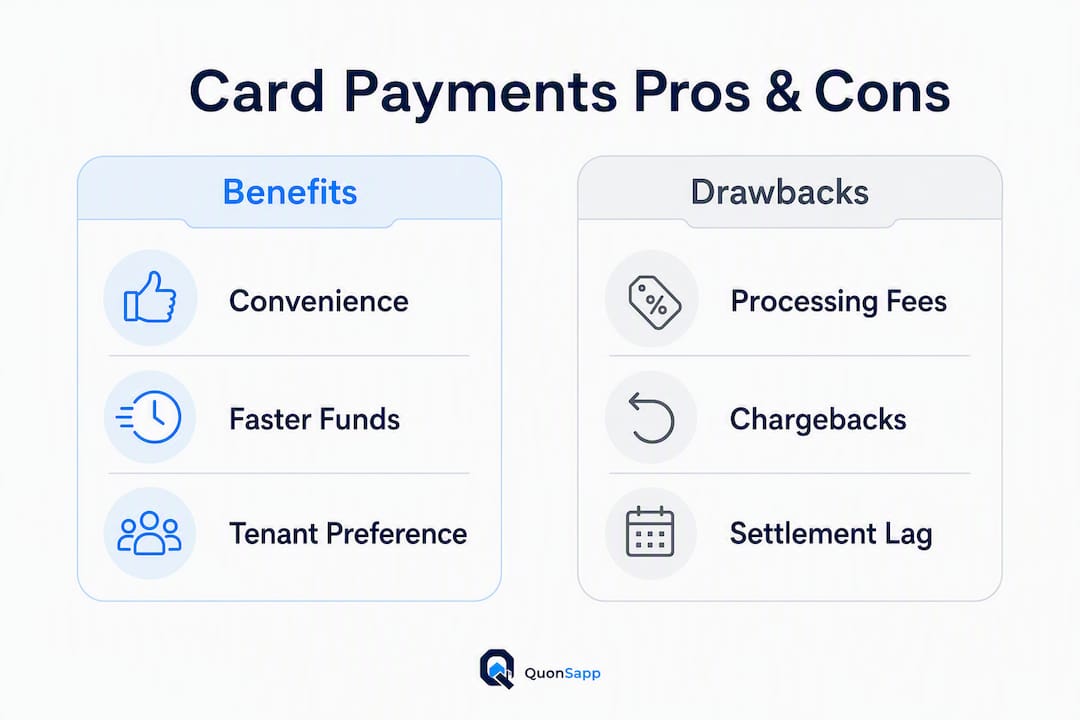
According to a RentRedi survey, 34% of renters prefer paying rent by credit or debit card. In a soft rental market, that preference is a soft differentiator — one more reason a prospective tenant chooses your unit over a comparable one down the street.
Beyond tenant demand, the operational case is strong. Card payments automate receipts, trigger instant ledger updates, and cut manual month-end reconciliation tasks compared to check handling. No more chasing paper, manually posting deposits, or reconciling handwritten records.
Cards are especially valuable in three specific scenarios:
- Move-ins: A new resident can pay a security deposit or first month's rent by card before they have set up ACH.
- Late payments: A tenant who is short on cash may put a late balance on a card to avoid a late fee, which protects your cash flow.
- One-off charges: Special assessments, HOA fines, or maintenance fees are natural card use cases where the recurring-cost argument for ACH is weaker.
For routine monthly rent, ACH remains the better default. Cards earn their place as a secondary, elective rail.
What decisions do you need to make before enabling card payments?
Three policy choices determine whether card acceptance helps or hurts your margins.

Fee model. You can absorb the processing cost, pass it through to residents as a convenience fee, or build it into your pricing. The legal distinction matters: a surcharge is a percentage added to the card transaction and is restricted or banned in some states. A convenience fee is a flat charge for using a non-standard payment channel and is more broadly permitted — but you must always offer at least one fee-free payment method and disclose fees clearly at checkout. Check your state's rules before choosing either approach.
Primary rail default. ACH is the right default for recurring rent because it costs a flat $0.30–$1.50 per transaction versus a percentage-based card fee that scales with rent amount. Design your portal so ACH is the easy, free choice and cards require an extra step.
Merchant underwriting data. Before connecting a processor, gather your portfolio size, number of units, average rent, and expected monthly volume. Providing accurate data upfront prevents account holds or freezes after launch.
Pro Tip: If your portfolio generates significant monthly volume, negotiate with your processor for lower interchange pass-through rates. Volume-based discounts are available and rarely offered proactively.
How do fees, settlement timing, and state laws affect your setup?
| Payment Method | Typical Fee | Settlement Timing |
|---|---|---|
| Credit card | A percentage plus a small fixed fee | 24–48 hours |
| Debit card | A percentage plus a small fixed fee | 24–48 hours |
| ACH / eCheck | A flat fee | 1–3 business days |
Card settlement typically takes 24–48 hours; ACH takes 1–3 business days unless you use a next-day service. Plan due dates for card users a day or two earlier than your standard due date to ensure funds clear before any grace period expires.
Legal caution: Surcharging rules vary by state. Some states restrict or prohibit adding a percentage surcharge to card transactions. A flat convenience fee for a non-standard payment channel is more broadly permitted, but the requirement to offer a free alternative (typically ACH) applies in most jurisdictions. Always disclose the fee amount before the resident completes checkout, and add a payment method addendum to your lease. Consult a local attorney before implementing surcharges.
For disclosure best practices: state the fee in your lease addendum, display it on the payment screen before confirmation, and include it in your tenant onboarding email. Transparency reduces disputes.
How do you protect resident payment data and handle chargebacks?
Stripe's tokenization model means card numbers never touch your servers. When a resident enters card details in the QuonSapp portal, Stripe stores a token — your PCI scope shrinks to the SAQ A level, the lightest self-assessment category. Platform integrations with Stripe are the industry standard for reducing direct card handling and manager liability.
Chargebacks are the main operational risk of card acceptance. Landlords should keep robust documentation to contest disputes, including signed lease and payment addenda, timestamped receipts, communications, and proof of service.
Card networks allow a response window after a chargeback, varying by network. Respond with the full documentation package immediately.
Pro Tip: Enable AVS (Address Verification Service) and CVC checks in your Stripe settings. These two controls reject a large share of fraudulent card attempts before they reach your ledger.
Velocity rules (flagging multiple rapid transactions from one card) and 3-D Secure authentication add another layer for high-value payments like security deposits.
How do card payments flow into your ledger?
The flow from tenant payment to your books has five steps:
| Step | What Happens |
|---|---|
| 1. Authorization | Resident submits card; Stripe confirms funds in real time |
| 2. Capture | Stripe captures the charge; funds leave the resident's account |
| 3. Settlement | Stripe batches and settles; funds available in 24–48 hours |
| 4. Payout | Stripe transfers net amount to your bank account |
| 5. Ledger import | Platform posts payment, fee, and net amount to resident ledger |
Post processing fees as a separate expense line item (e.g., "Payment Processing Fee") rather than netting them against rent income. This keeps your gross revenue figures accurate for reporting. Chargebacks and refunds should be posted as reversals against the original payment date, not as new expense entries.
For landlord accounting software integrations, export in CSV or OFX format and match each payout to your bank statement by the Stripe transfer ID. Reconcile weekly, not monthly, so discrepancies surface before they compound.
Step-by-step checklist to enable card payments in your platform
- Gather underwriting data: portfolio size, unit count, average rent, and projected monthly card volume.
- Review state law on surcharging and convenience fees; decide your fee model.
- Connect Stripe to your property-management platform and complete merchant verification.
- Configure card acceptance: enable major card types, set fee passthrough rules, and activate tokenization.
- Set settlement preferences: choose standard or next-day payout based on your cash-flow needs.
- Run live tests: process a low-value transaction, simulate a refund, and verify the ledger entry and payout timing.
- Update your lease addendum to disclose the convenience fee and the free ACH alternative.
- Send tenant notice with opt-in date, fee disclosure, and instructions for saving a card on file.
- Train staff on monitoring failed transactions, initiating chargebacks, and the escalation path.
- Enable autopay enrollment prompts in the resident portal for both ACH and card.
How do you communicate new payment options to residents and drive adoption?
Start with a clear rollout email sent at least two weeks before the go-live date. The message should cover three things: what is changing, what it costs to pay by card, and how to enroll in ACH for free. Keep it short.
Sample rollout email subject: "New: Pay your rent online by card starting [date]"
Body: "Starting [date], you can pay rent, HOA dues, and fees directly from your resident portal using any major credit or debit card. A convenience fee applies to card payments. ACH bank transfer remains free. Log in at [portal link] to save your preferred payment method."
For ongoing operations:
- Send autopay enrollment reminders 10 days before the first due date of each new lease.
- Automate failed-payment notifications within 24 hours of a decline, with a direct link to update card details.
- Assign one staff member as the point of contact for chargeback responses and processor escalations.
To nudge residents toward ACH, consider waiving the convenience fee for the first card payment during the transition period, then making the fee visible at every subsequent checkout. Most residents will switch to ACH once they see the fee consistently.
What are the most common mistakes and how do you fix them?
Authorization is not settlement. A real-time approval does not mean funds are in your account. Plan for 24–48 hours before treating a card payment as cleared.
Incomplete merchant underwriting leads to account holds. Provide accurate volume and rent data upfront.
Missing fee disclosure creates disputes and potential legal exposure. Disclose before checkout, in the lease, and in your rollout email.
Relying solely on cards for recurring rent erodes margins at scale. Cards belong as a secondary option, not the primary rail.
For declined transactions: check for AVS or CVC mismatch first, then verify the card has not expired, then confirm the billing address matches. Notify the resident within 24 hours with a direct link to update their payment method. If a card fails twice in a row, prompt the resident to add a backup ACH account.
When a chargeback arrives: pull the lease, receipts, and all communications immediately. Submit your response package before the network deadline. If the dispute involves a large amount or a pattern of disputes from one resident, escalate to legal counsel.
Key Takeaways
Enabling credit and debit card payments protects margins when ACH is the free default and cards are a deliberately priced convenience option integrated through Stripe.
| Point | Details |
|---|---|
| Dual-rail default | Set ACH as the free default; offer cards as a paid convenience to protect margins. |
| Card fee range | Credit card processing typically costs a percentage plus a small fixed fee per transaction versus a flat fee for ACH. |
| Settlement timing | Card funds settle in 24–48 hours; ACH takes 1–3 business days — plan due dates accordingly. |
| Legal compliance | Always offer a fee-free payment method and disclose any convenience fee before checkout, per state law. |
| QuonSapp setup | QuonSapp connects Stripe directly, configures fee passthrough, and posts payments to a full per-resident ledger. |
The case for treating card acceptance as an operations upgrade, not just a convenience
The conventional framing around credit card rent payments focuses almost entirely on cost: processors charge 2.5%–3.5%, so landlords resist. That framing misses the larger point.
The real value of accepting cards is what it forces you to build: a proper digital payment infrastructure with real-time receipts, automated ledger entries, tokenized card storage, and a tenant self-service portal. Those capabilities reduce manual work across your entire portfolio, not just on card transactions. The managers who resist cards often also resist the infrastructure that comes with them — and end up spending more time on manual reconciliation and check handling than the processing fee would ever cost.
The dual-rail approach resolves the cost objection cleanly. Make ACH free and easy; make cards available but priced. Residents who want the convenience of a card pay for it. Residents who want to save money use ACH. Your margins stay intact, and you get the operational infrastructure either way.
The one genuine caution: chargebacks. Card disputes are more common and more administratively demanding than ACH returns. The answer is documentation discipline from day one — signed leases, timestamped receipts, and written communications stored where your team can retrieve them in under ten minutes. That habit protects you regardless of payment method.
QuonSapp makes card acceptance straightforward for property managers
Property managers who want to accept rent by credit card without building a custom payments stack get a direct path with QuonSapp. The platform connects your Stripe account directly, so every card payment lands in your account without an intermediary or holding period. You configure whether the $1.00 platform fee is paid by the resident at checkout or deducted from your payout. Partial payments, overdue alerts, and a full per-resident payment ledger come standard.

QuonSapp implements the dual-rail strategy out of the box: residents see ACH as the default free option and cards as the clearly priced alternative. Reconciliation exports sync with QuickBooks-compatible formats, and the audit log timestamps every transaction for chargeback documentation. For HOA boards, bulk dues invoicing and fine management are built into the same portal.
Ready to turn on card payments across your portfolio? Start with QuonSapp and connect your Stripe account in minutes.
Useful sources
The sources below back the key claims in this guide. Third-party sources are listed first; QuonSapp's own content is noted where applicable.
- ACH vs. credit card vs. cash: Which rent payment methods should landlords accept? — (Daily Gazette / Stacker) — Reports the RentRedi survey finding that 34% of renters prefer card payments; useful for tenant demand and retention context.
- Property Management Payment Processing: Complete Guide — (Vida AI Agent OS) — Covers fee ranges for card and ACH, settlement timing, Stripe tokenization, and volume negotiation. Primary source for the fee table and settlement timing data in this guide.
- Best Online Rent Payment Platforms for Landlords (QuonSapp Blog) — QuonSapp's own content on integrated payment platforms, reconciliation automation, and dual-rail strategy. Publisher asset.