
For property managers and landlords who need one platform to handle payments, maintenance, HOA governance, and multi-property operations, QuonSapp is the strongest all-in-one choice. It combines Stripe-based direct-to-manager payments, native mobile apps with offline support, work-order tracking with photo documentation, and full HOA governance tools in a single subscription.
If your needs are narrower, here are the runners-up worth trialing:
-
AppFolio — best for large property management companies that need enterprise automation and unified workflows across hundreds of units
-
Buildium — best for small to mid-size managers who want solid accounting and leasing without enterprise complexity
-
Avail or TurboTenant — best for DIY landlords with small portfolios who want a free starting point before committing to a paid platform
-
Condo Control — best for condo boards and HOA managers focused on resident engagement, violations, and governance workflows
The profiles below give you the evidence behind each pick, plus a decision framework for choosing the right tool at your portfolio size.
Table of Contents
- How do these property management apps compare at a glance?
- How we evaluated these apps
- Top picks: what each app does and who it fits
- How to choose the right property management app for your portfolio
- What does property management software actually cost?
- Which free or DIY apps are worth your time?
- Key Takeaways
- The case for field-first software
- QuonSapp: built for the managers who keep properties running
- Useful sources and further reading
How do these property management apps compare at a glance?
| App | Best For | Key Features | Pricing Model | Mobile / Ease of Use | Scalability |
|---|---|---|---|---|---|
| QuonSapp | HOA managers, building supervisors, multi-property operators | Maintenance work orders, Stripe payments, HOA governance, GPS clock-in, multi-company network | Flat monthly subscription, per-org billing | Native iOS/Android, offline support, real-time sync | Multi-property and multi-company; HOA + rental |
| AppFolio | Large property management companies | Automation, unified leasing, accounting, AI leasing assistant | Per-unit monthly pricing | Strong mobile UX | Enterprise-scale |
| Yardi Voyager | Very large portfolios, enterprise compliance | Deep accounting, compliance, full ERP-style suite | Enterprise quote | Moderate; implementation-heavy | Very large portfolios |
| Entrata | Multifamily operators | Integrated leasing, marketing, operations | Enterprise quote | Good | Mid to large multifamily |
| RealPage | Enterprise revenue management | Analytics, revenue management, AI pricing | Enterprise quote | Moderate | Large enterprise |
| Buildium | Small to mid-size managers | Accounting, leasing, maintenance, tenant portal | Per-unit monthly | Good | Large portfolios |
| Avail | DIY landlords, small portfolios | Listings, screening, lease templates, rent collection | Free core; paid upgrades | Simple, web-first | Very small portfolios |
| TurboTenant | Hands-on landlords | Marketing, screening, leases, rent collection | Free software; flat-fee full service option | Simple | Small portfolios |
| Zillow Rental Manager | Landlords prioritizing listing reach | Listings, screening, rent collection | Free to list; fees apply | Mobile-first | Small portfolios |
| TenantCloud | Small DIY landlords | Listing, screening, accounting basics | Free tier; paid plans | Good | Small to mid |
| DoorLoop | Growing property managers | Modern UX, accounting, automation | Per-unit monthly | Excellent mobile | Small to large |
| Yardi Breeze | Small to mid-size portfolios | Core PM, accounting, maintenance | Per-unit monthly | Good | Small to mid |
| Rent Manager | Managers needing deep configuration | Configurable workflows, reporting, accounting | Per-unit or flat | Moderate | Mid to large |
| Innago | Small landlords | Screening, leases, rent collection | Free | Simple | Very small |
| Apartments.com Rental Manager | Listing-first landlords | Listings, applications, inbound workflow | Free | Simple | Small |
| Hemlane | Self-managing owners needing agent coordination | Hybrid self-manage + local agent showing support | Per-unit monthly | Good | Small to mid |
| Baselane | Finance-focused landlords | Banking, expense tracking, accounting | Free core; paid features | Good | Small portfolios |
| RentRedi | Single-property landlords | Mobile rent collection, screening, leases | Low flat monthly | Mobile-first | Very small |
| Rentec Direct | Small to mid-size managers | Accounting, screening, maintenance | Per-unit monthly | Good | Small to mid |
| Condo Control | Condo boards and HOA managers | Amenity booking, violations, resident communications | Per-unit monthly | Good | Mid to large HOA/condo |
Pricing shapes across this list fall into four categories: free tiers with paid add-ons (Avail, TurboTenant, Innago, Baselane), per-unit monthly pricing (AppFolio, Buildium, DoorLoop, Yardi Breeze, Rent Manager, Rentec Direct, Hemlane, RentRedi, Condo Control), flat organizational subscriptions (QuonSapp), and enterprise quotes requiring a sales conversation (Yardi Voyager, Entrata, RealPage).
The table above omits detailed integration ecosystems and implementation support differences; those are covered in the per-app profiles below.
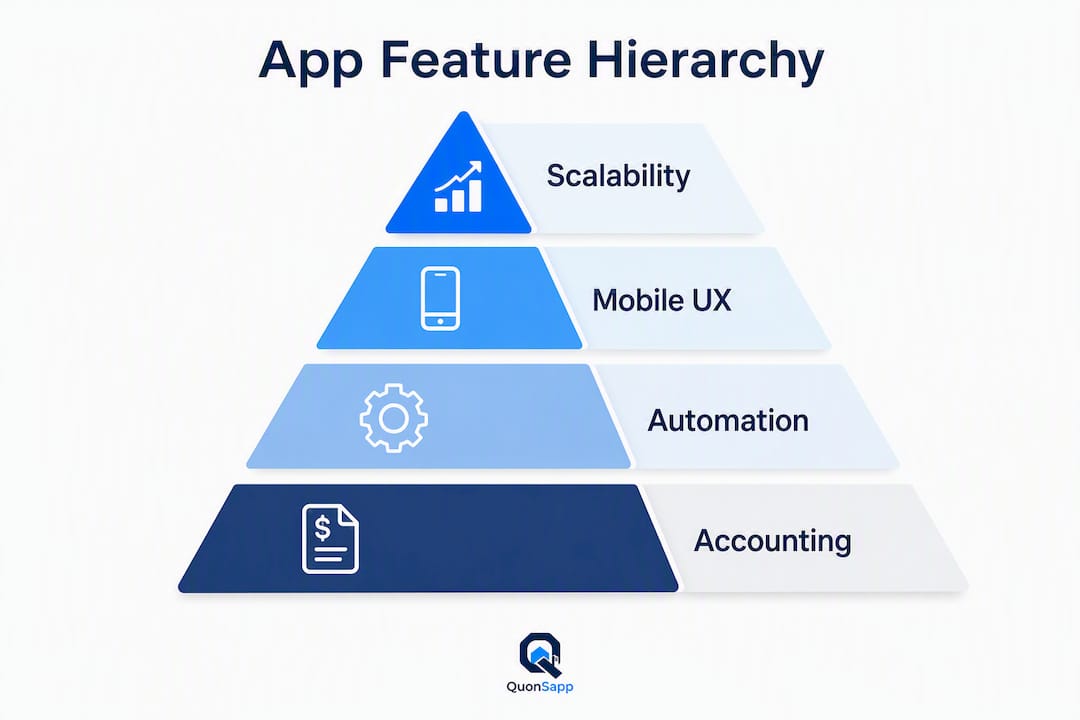
How we evaluated these apps

Selecting the best property management app requires more than reading feature lists. Here is what we assessed and how.
Evaluation criteria:
- Feature coverage: leasing workflows (applications, e-sign, renewal alerts), accounting (invoicing, reconciliation, reporting), maintenance (work orders, vendor assignment, photo documentation), and tenant/resident portal quality
- Mobile and offline capability: native iOS/Android apps, offline data access, GPS clock-in for field staff, and real-time sync
- Payments integration: Stripe or equivalent direct-deposit options, partial payment support, configurable fee passthroughs, and transaction fee transparency
- Automation and AI features: rent reminders, late-fee workflows, maintenance triage, and AI-assisted leasing
- Scalability and portfolio fit: whether the platform suits single-unit DIY landlords, mid-size managers, enterprise operators, or HOA/condo boards
- Integrations and ecosystem: QuickBooks, ADP, Paychex, and third-party listing portal connections
- Support and implementation: onboarding quality, documentation, SLA clarity, and migration assistance
- Pricing transparency: published pricing vs. enterprise-only quotes, hidden fees, and per-unit overage charges
Evidence sources: vendor documentation, product demos, published G2 and Capterra review data, Gartner Peer Insights ratings, and internal product knowledge of QuonSapp's feature set.
Inclusion rules: every app on this list must be available in the US market and must serve rental property managers, landlords, or HOA/condo boards as its primary audience. Consumer-only listing services without management workflows were excluded.

Pro Tip: Before your first demo, map your three most painful manual workflows (rent collection, maintenance dispatch, lease renewals) and use them as a live test scenario. A platform that handles all three smoothly in a 30-minute demo is worth shortlisting; one that stumbles on two of them rarely improves after purchase.
Top picks: what each app does and who it fits
QuonSapp
Best for: HOA managers, building supervisors, and multi-property operators who need field-first maintenance, HOA governance, and direct payment collection in one platform.
QuonSapp is built from the ground up for the people who actually run properties day to day: building supervisors logging work orders from a parking lot, front desk staff issuing visitor passes, maintenance crews updating job status without a reliable signal. The native iOS and Android apps support offline access, so core screens load and queue updates even when connectivity drops. Payments run through Stripe with direct-to-manager payouts and a flat $1.00 platform fee per transaction, with the option to pass that fee to residents or absorb it. HOA-specific tools cover violation tracking, fine management, board votes, ARC requests, and bulk dues invoicing. The multi-company network feature lets parent organizations link sub-orgs, view consolidated portfolio stats, and control data-sharing permissions, which is rare at this price tier.
Pros:
- Integrated maintenance work orders with photo documentation and vendor directory
- Stripe payments with direct payouts, partial payment support, and configurable fee passthrough
- Native mobile apps with offline support and GPS clock-in/out for field staff
Cons:
- Newer platform; fewer published third-party reviews than established competitors
- Accounting overview covers revenue, expenses, and balance tracking but is not a full double-entry accounting system
- Enterprise-scale reporting depth is still maturing
AppFolio
Best for: Large property management companies managing hundreds to thousands of units who need enterprise automation, AI-assisted leasing, and a unified platform.
AppFolio has built a strong reputation among mid-to-large property management companies for its automation depth and polished UX. Its AI leasing assistant handles prospect inquiries, schedules tours, and qualifies leads without staff intervention. Accounting is full-featured, and the platform integrates with major listing portals. Capterra reviewers consistently highlight its reporting capabilities. Pricing is per-unit monthly, which scales predictably for large portfolios but can feel expensive for smaller operators. Implementation typically requires dedicated onboarding support.
Pros:
- AI leasing assistant reduces vacancy-related manual work
- Strong accounting and reporting for large portfolios
- Unified platform covering leasing, maintenance, and accounting
Cons:
- Per-unit pricing adds up quickly for smaller portfolios
- Implementation timeline can run several weeks
- Less suited to HOA governance workflows
Yardi Voyager
Best for: Very large portfolios and enterprise operators who need deep accounting, compliance tracking, and an ERP-style property management suite.
Yardi Voyager is the platform of choice for institutional-grade operators. It handles complex accounting, compliance reporting, and multi-entity structures that smaller platforms cannot match. The trade-off is implementation complexity and cost: pricing is enterprise-quoted, onboarding requires significant configuration, and the learning curve is steep. For portfolios under a few hundred units, Voyager is almost certainly more platform than you need.
Pros:
- Unmatched accounting depth for complex multi-entity portfolios
- Strong compliance and audit trail features
- Long track record in institutional real estate
Cons:
- Enterprise pricing with no published rates
- Heavy implementation burden
- Not suited for small portfolios or HOA-only operations
Entrata
Best for: Multifamily operators who want integrated leasing, marketing, and operations in a single platform.
Entrata targets the multifamily market specifically, with tools that connect marketing campaigns, online leasing, and resident operations. Its resident portal and leasing funnel are well-regarded. Pricing is enterprise-quoted, and the platform is less relevant for single-family landlords or HOA boards.
Pros:
- Strong leasing funnel from marketing to signed lease
- Resident portal with solid communication tools
- Good fit for mid-to-large multifamily
Cons:
- Enterprise pricing; no self-serve trial
- Limited HOA governance features
- Overkill for small portfolios
RealPage
Best for: Enterprise portfolios seeking revenue management, AI-driven pricing, and advanced analytics.
RealPage's revenue management module is its defining feature: it uses market data and occupancy signals to recommend rent pricing in real time. That capability matters most to large operators managing hundreds of units across multiple markets. For smaller operators, the pricing complexity and enterprise-only sales process are barriers.
Pros:
- AI-driven rent pricing and revenue management
- Advanced analytics across large portfolios
- Strong enterprise integrations
Cons:
- Enterprise-only pricing and sales process
- Not designed for small landlords or HOA operations
- Implementation is complex
Buildium
Best for: Small to mid-size property managers who need solid accounting, leasing, and maintenance without enterprise overhead.
Buildium is one of the most widely used platforms in the small-to-mid market, with a strong presence on G2 and Capterra. Its accounting module handles trust accounting, owner distributions, and 1099 generation, which makes it a popular upgrade path from spreadsheets. Maintenance workflows are functional, though less field-focused than QuonSapp's work-order system. Pricing is per-unit monthly with a published starter tier. For managers who need landlord accounting software as their primary driver, Buildium is a credible option.
Pros:
- Full trust accounting, owner distributions, and 1099 support
- Strong G2 and Capterra review base
- Leasing and maintenance in one platform
Cons:
- Per-unit pricing grows with portfolio size
- Mobile experience is functional but not field-first
- HOA governance tools are limited
Avail
Best for: DIY landlords with small portfolios who want a free starting point for listings, screening, and rent collection.
Avail offers free core tools including listings syndicated to multiple sites, state-specific lease templates, online tenant screening, and built-in rent collection. Premium upgrades unlock features like expedited rent payments and custom applications. It works well for hands-on landlords managing a handful of units, but it lacks field maintenance workflows and enterprise accounting.
Pros:
- Free core features with no unit minimum
- State-specific lease templates included
- Clean, simple interface for non-technical landlords
Cons:
- No maintenance work-order system
- Limited accounting depth
- Not designed for HOA or multi-company operations
TurboTenant
Best for: Hands-on landlords who want free software with the option to hand off management for a flat fee.
TurboTenant offers a free software core covering marketing, tenant screening, lease creation, and rent collection. Its optional full-service property management at a flat fee is a genuinely different monetization model: you pay for managed services rather than a software subscription. That structure changes how you should evaluate it on demo. If you want to stay hands-on, the free tier is capable for small portfolios; if you want to hand off operations, the flat-fee service is worth comparing against traditional management fees.
Pros:
- Free software core with no subscription required
- Optional flat-fee full-service management
- Secure payment handling
Cons:
- Free tier lacks maintenance workflows and HOA tools
- Full-service option adds cost that may exceed a paid platform
- Limited scalability for growing portfolios
Zillow Rental Manager
Best for: Landlords who prioritize listing reach and mobile-first listing-to-lease workflows.
Zillow Rental Manager connects landlords to a large listing audience and supports listing, screening, and rent collection via mobile. The platform's primary value is audience reach; its management depth beyond listing and leasing is limited. For landlords whose main pain point is vacancy, the exposure is meaningful. For managers who need maintenance, accounting, or HOA tools, it is not a complete solution.
Pros:
- Large listing audience for faster vacancy fill
- Mobile-first listing and screening workflow
- Free to list
Cons:
- Minimal maintenance and accounting features
- Not suited for multi-property management operations
- Limited HOA or building management tools
TenantCloud
Best for: Small DIY landlords and small property managers seeking an affordable cloud-based solution with listing, screening, and accounting basics.
TenantCloud combines listing syndication, tenant screening, online rent collection, and basic accounting in a cloud platform with a free entry tier. It suits landlords who want more accounting depth than Avail but are not ready for a full platform like Buildium.
Pros:
- Free tier with accounting basics
- Cloud-based with good mobile access
- Covers the full landlord workflow at low cost
Cons:
- Accounting is basic; not a substitute for full property management accounting
- Limited maintenance workflow depth
- Support quality is inconsistent at the free tier
DoorLoop
Best for: Growing property managers who want modern UX, integrated accounting, and automation without enterprise complexity.
DoorLoop has gained traction among growing managers for its polished interface and strong accounting module. It covers leasing, maintenance, tenant portal, and accounting in a single platform with per-unit monthly pricing. Its automation features handle rent reminders and late fees well. The mobile experience is among the better ones in the mid-market.
Pros:
- Modern, intuitive interface
- Strong accounting and automation
- Good mobile experience
Cons:
- Per-unit pricing scales up with portfolio growth
- HOA governance tools are not a focus
- Newer platform with a smaller review base than Buildium
Yardi Breeze
Best for: Small to mid-size portfolios that want Yardi's core features without Voyager's implementation complexity.
Yardi Breeze is the simplified version of Yardi's platform, designed for managers who want core property management and accounting without the enterprise overhead. It covers leasing, maintenance, accounting, and a resident portal. Pricing is per-unit monthly and published, unlike Voyager.
Pros:
- Yardi's accounting engine in a simpler package
- Published per-unit pricing
- Good for residential and commercial small portfolios
Cons:
- Less feature depth than Voyager for complex operations
- HOA governance is limited
- Mobile experience is functional but not field-first
Rent Manager
Best for: Managers who need highly configurable workflows, deep reporting, and flexible accounting.
Rent Manager is one of the most configurable platforms on this list. Its reporting engine and workflow customization appeal to managers with non-standard operations or complex portfolio structures. The trade-off is a steeper learning curve and a UI that feels less modern than DoorLoop or AppFolio.
Pros:
- Deep configuration and custom reporting
- Flexible accounting for complex portfolios
- Strong track record in the mid-market
Cons:
- Steeper learning curve than most competitors
- UI is dated compared to newer platforms
- Implementation requires significant setup time
Innago
Best for: Small landlords who want a simple, free tool for tenant screening, lease management, and rent collection.
Innago is free for landlords, monetizing through tenant-paid screening fees. It covers the core landlord workflow cleanly and without subscription cost. It is not designed for maintenance-heavy operations or HOA management.
Pros:
- Free for landlords
- Clean, simple interface
- Covers screening, leases, and rent collection
Cons:
- No maintenance work-order system
- No HOA or multi-company features
- Limited scalability
Apartments.com Rental Manager
Best for: Landlords who want a listing-first workflow tied directly to the Apartments.com audience.
Apartments.com Rental Manager connects listings directly to the Apartments.com portal, with inbound applicant workflows built around that audience. Its value is the listing channel; its management depth is limited to applications and basic lease tools.
Pros:
- Direct connection to Apartments.com listing audience
- Simple inbound applicant workflow
- Free to use
Cons:
- Minimal management features beyond listing and applications
- No maintenance or accounting tools
- Not suited for ongoing property operations
Hemlane
Best for: Owners who self-manage but occasionally need local agent coordination for showings and leasing support.
Hemlane occupies a hybrid position: it gives self-managing landlords software tools while connecting them to a network of local agents for showings and leasing tasks. That model suits owners who want control but need occasional professional support. Per-unit monthly pricing applies.
Pros:
- Hybrid self-manage plus local agent network
- Good for owners who travel or manage remotely
- Covers leasing, maintenance, and tenant communication
Cons:
- Local agent availability varies by market
- More expensive than pure DIY tools
- Not designed for HOA or large-portfolio operations
Baselane
Best for: Landlords who prioritize banking, expense tracking, and simple accounting over full property management.
Baselane leads with a banking and finance-first approach: it offers landlord-specific bank accounts, expense categorization, and accounting tools alongside basic rent collection. For landlords whose main gap is financial tracking rather than operations, it fills that need well.
Pros:
- Landlord-specific banking and expense tracking
- Free core features
- Clean accounting and reporting for small portfolios
Cons:
- Limited maintenance and leasing workflow depth
- Not designed for HOA or multi-company operations
- Accounting is not a substitute for full property management software
RentRedi
Best for: Single-property landlords and very small portfolios who want mobile rent collection and basic management.
RentRedi is mobile-first and priced at a low flat monthly rate, making it accessible for landlords managing one to a few units. It covers rent collection, tenant screening, and basic maintenance requests. Its simplicity is its strength and its ceiling.
Pros:
- Low flat monthly pricing
- Mobile-first design
- Covers core landlord tasks simply
Cons:
- Limited accounting depth
- Not suited for growing portfolios
- No HOA or multi-company features
Rentec Direct
Best for: Small to mid-size managers who need solid accounting, tenant screening, and maintenance tracking.
Rentec Direct is a dependable mid-market platform with a long track record. Its accounting module handles trust accounting and owner reporting well. It lacks the modern UX of DoorLoop or AppFolio but covers the core workflows reliably.
Pros:
- Solid accounting and owner reporting
- Tenant screening integrated
- Reliable track record in the mid-market
Cons:
- UI is less modern than newer competitors
- Mobile experience is functional but not field-first
- Limited HOA governance tools
Condo Control
Best for: Condo boards and HOA managers who need resident engagement, amenity booking, violation tracking, and governance tools.
Condo Control is purpose-built for condo and HOA operations. It covers amenity booking, violation management, resident communications, package tracking, and board document management. For HOA managers who find that general property management platforms treat governance as an afterthought, Condo Control is a credible specialist alternative to QuonSapp's HOA module.
Pros:
- Purpose-built for condo and HOA workflows
- Strong resident communication and amenity booking tools
- Good governance and document management
Cons:
- Less suited for rental property management workflows
- Per-unit pricing applies
- Maintenance depth is limited compared to full property management platforms
Pro Tip: When evaluating lease-tracking capabilities on any platform, ask the vendor to demonstrate the full cycle: application submission, background check, e-sign, and renewal alert. Platforms that handle all four steps natively save significant time compared to those that rely on third-party e-sign integrations. See our guide on lease tracking alternatives for a deeper comparison.
How to choose the right property management app for your portfolio
The right platform depends on your portfolio size, operational complexity, and the workflows that cost you the most time today. Here is a practical framework.
Match your portfolio size to the right tier
- Single-unit DIY landlords: — Start with a free tool (Avail, TurboTenant, Innago) to cover listings, screening, and rent collection. Upgrade when maintenance requests or accounting reconciliation become time-consuming.
Questions to ask on every demo
- What is the implementation timeline, and what does onboarding include?
- How does data migration work, and can you export all records at any time?
- What payment processor do you use, and who holds the funds before they reach me?
- Does the mobile app work offline, and how does it sync when connectivity returns?
- What is your support SLA, and is phone support included in the base plan?
- Are there per-unit overage charges, and how are they calculated?
Red flags to watch for
- Opaque pricing: if a vendor will not publish a starting price or requires a sales call for basic tier information, budget more time for negotiation and scrutinize the contract carefully.
- No data export: any platform that does not let you export your full resident, lease, and payment history in a standard format (CSV or similar) creates lock-in risk.
- Limited mobile access: for field-heavy operations, a web-only platform or a mobile app that requires constant connectivity is a practical barrier for maintenance crews.
- No local payment integration: platforms that route payments through a vendor-held account rather than direct-to-manager payouts add a holding period and reduce cash flow visibility.
- Missing maintenance workflows: if a platform has no work-order system with staff assignment and status tracking, field teams will default to text messages and spreadsheets, which defeats the purpose of the software.
For a practical guide to moving from spreadsheets to an app-first workflow, the digital property management guide covers adoption steps and integration planning in detail.
What does property management software actually cost?
Pricing models across this category vary more than most buyers expect, and the sticker price rarely reflects the true first-year cost.
Common pricing structures:
- Free tier with paid add-ons: Avail, TurboTenant, Innago, and Baselane offer free core tools and charge for premium features (expedited payments, custom applications, advanced screening). Low entry cost, but add-ons accumulate.
- Per-unit monthly pricing: AppFolio, Buildium, DoorLoop, Yardi Breeze, Rent Manager, Rentec Direct, Hemlane, RentRedi, and Condo Control all charge per unit. Costs scale predictably with portfolio growth, but a 200-unit portfolio pays meaningfully more than a 20-unit one.
- Flat organizational subscription: QuonSapp charges at the organization level, not per unit, which makes cost forecasting straightforward for growing portfolios.
- Enterprise quotes: Yardi Voyager, Entrata, and RealPage require a sales conversation. Budget for implementation fees, training, and annual contract minimums in addition to the subscription.
Hidden costs to check for:
- Onboarding and setup fees (common at enterprise tier)
- Payment processing fees: some platforms mark up Stripe or ACH fees above the processor's published rate; others pass through the exact processor cost. QuonSapp charges a flat $1.00 platform fee per transaction and lets managers configure whether residents or the manager absorbs it.
- Per-unit overage charges when you exceed a plan's unit ceiling
- Support or implementation fees for phone support or dedicated onboarding
Understanding how payment processors are integrated is one of the most overlooked cost factors. The online rent payment platforms guide explains what to look for in direct Stripe integration, partial payment handling, and instant manager payouts.
Pro Tip: Build a single P&L scenario before comparing demos: pick a fixed portfolio size (say, 75 units at $1,500 average rent) and calculate each platform's monthly subscription cost, expected payment processing fees at full collection, and any per-unit overages. That single scenario makes vendor pricing conversations concrete and prevents apples-to-oranges comparisons.
For a deeper look at rent collection best practices and how to forecast transaction-related costs, the internal guide covers reconciliation, fee passthroughs, and tenant convenience trade-offs.
Which free or DIY apps are worth your time?
Free and low-cost apps are a legitimate starting point for small portfolios, but they come with real limitations that matter as you grow.
What the best free tools include:
- Avail covers listings on multiple sites, state-specific lease templates, online tenant screening, and built-in rent collection. Premium upgrades add expedited payments and custom applications.
- TurboTenant offers the same core workflow for free, plus an optional flat-fee full-service management path for landlords who want to hand off operations entirely.
- Innago is free for landlords, with tenant-paid screening fees covering the platform's revenue. It handles screening, leases, and rent collection cleanly.
- Baselane leads with free banking and expense tracking, useful for landlords whose primary gap is financial visibility rather than operations.
What free tools typically cannot do:
- Field maintenance work orders with staff assignment, photo documentation, and status pipelines
- Full trust accounting, owner distributions, or 1099 generation
- HOA governance workflows (violations, fines, board votes, ARC requests)
- Multi-company or multi-property network management
- GPS clock-in/out for field staff or offline mobile access
When a free app is the right call: you are managing fewer than five units, turnover is low, and your primary needs are rent collection and basic leasing. A free tool handles that well and costs nothing while you evaluate whether a paid platform is worth the investment.
When to upgrade: maintenance requests are coming in faster than you can track them manually, accounting reconciliation is taking hours each month, or you are adding properties and need a resident portal and automated communications. At that point, the time savings from a paid platform typically outweigh the subscription cost.
Migration checklist when you upgrade:
- Export all resident records, lease dates, and payment history from your current tool in CSV format
- Confirm the new platform accepts CSV import for residents and payment history
- Set up payment accounts and test a single transaction before going live
- Migrate one property first; validate data integrity before importing the full portfolio
Key Takeaways
QuonSapp is the strongest all-in-one choice for property managers, HOA operators, and building supervisors who need field-first maintenance, direct Stripe payments, and multi-property governance in a single flat-subscription platform.
| Point | Details |
|---|---|
| Top pick for operations-heavy portfolios | QuonSapp covers maintenance, HOA governance, Stripe payments, and multi-company management in one flat-subscription platform. |
| Best free starting point | Avail and TurboTenant offer free core tools for small DIY portfolios; upgrade when maintenance or accounting complexity grows. |
| Enterprise needs a different tier | AppFolio, Yardi Voyager, and RealPage serve large portfolios; expect enterprise pricing, implementation timelines, and sales-led onboarding. |
| Prioritize these three features | Mobile/offline access, direct payment integration (not vendor-held funds), and maintenance work-order workflows are the make-or-break criteria for field operations. |
| QuonSapp for HOA and multi-property | QuonSapp's organization network, HOA governance tools, and GPS clock-in make it the leading choice for managers running multiple properties or HOA communities. |
The case for field-first software
Most property management software is designed for the person at a desk. The leasing coordinator, the accounting manager, the owner reviewing reports on a laptop. That is a reasonable design choice for a large portion of the market, and platforms like AppFolio and Buildium serve that user well.
What gets underweighted in most comparisons is the field worker: the maintenance tech who needs to log a work order from a parking garage with no signal, the front desk supervisor who needs to issue a visitor pass from a tablet, the building manager who needs to clock in a vendor at 7 AM without opening a laptop. For those users, "mobile-friendly" is not enough. The platform needs native apps, offline queuing, photo documentation that works without connectivity, and GPS verification that does not require a strong signal.
That gap is where most mid-market platforms fall short. They have a mobile app, but it is a stripped-down version of the web interface. Offline support means the app does not crash; it does not mean you can actually complete a work order and have it sync when you reconnect.
The honest disclosure here: this article is published by QuonSapp, and QuonSapp is built specifically for that field-first use case. That shapes the recommendation. But the criteria above are real, and you can verify them on any demo. Ask the vendor to demonstrate a work order created offline, synced on reconnect, with before-and-after photos attached. Most platforms will struggle with that scenario. The ones that handle it cleanly are the ones worth shortlisting for field-heavy operations.
QuonSapp: built for the managers who keep properties running
Managing a portfolio means more than collecting rent and signing leases. It means dispatching maintenance at 6 AM, tracking HOA violations, running board votes, issuing parking permits, and keeping field staff accountable across multiple sites. Most property management apps are built for the back office. QuonSapp is built for the people doing the actual work.

With Stripe-based payments that land directly in your account, native iOS and Android apps with offline support, GPS clock-in for field staff, and full HOA governance tools including violations, fines, board votes, and ARC requests, QuonSapp covers the workflows that matter most to building supervisors and HOA managers. The flat organizational subscription means your cost does not spike every time you add a unit or a staff member.
To see how QuonSapp fits your portfolio, start a trial or book a demo at quonsapp.com. Bring your portfolio size, your three most painful manual workflows, and any questions about data migration. The onboarding team can walk you through a live scenario using your own property types.
Useful sources and further reading
The sources below informed this comparison and offer deeper reading on specific topics:
- Best Way to Collect Rent as a Landlord in 2026 — covers payment processor choices, fee passthroughs, reconciliation practices, and how to forecast payment-related costs. Read this before finalizing any platform's payment setup.
- Digital Property Management: A Practical Guide for Landlords — covers mobile-first workflows, adoption steps, and integration planning for managers moving from spreadsheets to an app-first workflow.
- Property Management Automation: Your 90-Day Action Plan — a practical roadmap for automating rent reminders, maintenance triage, and vendor assignment, with guidance on measuring ROI from each workflow.
- Best Online Rent Payment Platforms for Landlords in 2026 — explains direct Stripe integration, partial payment handling, and instant manager payouts; useful for comparing payment features across platforms.
- Top 3 Lease Tracking Software Alternatives 2026 — details lease creation, e-sign, and renewal tracking approaches across platforms.
- Best Landlord Accounting Software in 2026: Top Picks — covers the accounting features landlords need, export formats, and reporting depth to avoid manual reconciliation.
- Gartner Peer Insights: Property Management Software — third-party review aggregator with verified user ratings across enterprise and mid-market platforms.
- G2 Property Management Grid Report — peer review data covering satisfaction scores, ease of use, and feature ratings across the major platforms.
- Capterra Rental Property Management Software Shortlist — buyer-verified reviews and feature comparisons for the mid-market and small-landlord segment.
Always check vendor documentation directly for the latest pricing and feature updates. On demos, ask specifically for implementation case studies from portfolios similar to yours in size and property type.